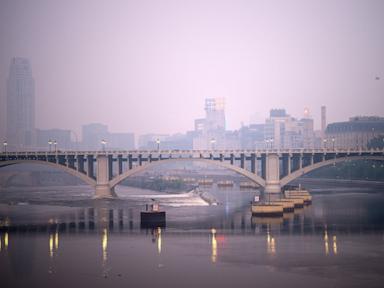
You step outside, expecting the fresh, clean breeze Minnesota summers are famous for. Instead, you get hit by a wall of thick, acrid smog that smells like a campfire gone wrong. Your eyes sting. Your throat feels dry. The skyline has vanished behind a sickly, orange-gray shroud.
This isn't a dystopian movie. It's the reality in Minneapolis right now.
The Twin Cities just clinched a title nobody wanted, temporarily ranking as the city with the absolute worst air quality on earth. According to global tracking group IQAir, Minneapolis jumped past international pollution hotspots to claim the top spot, flanked closely by Detroit and Chicago as dense wildfire smoke blankets the Midwest.
With the Air Quality Index (AQI) spiking deep into the hazardous "maroon" category—peaking at a jaw-dropping 460 in some areas—the simple act of breathing has become a health hazard.
If you're wondering how a city known for its pristine lakes and green spaces ended up with dirtier air than Beijing, you aren't alone. Let's look at what's actually happening, why it's so dangerous, and how you can protect your lungs until the skies clear.
The Perfect Storm of Canadian and Local Wildfires
The smoke choking the Twin Cities isn't coming from just one source. It's a double-whammy of massive Canadian blazes and intense local forest fires.
Over 180 wildfires are actively burning across Ontario, Canada. At the exact same time, northern Minnesota is battling its own crisis. The Superior National Forest is currently dealing with 16 active wildfires, including multiple blazes in the Boundary Waters Canoe Area Wilderness that have forced a historic, full closure of the entire wilderness area.
These aren't small brush fires. Several of these northern blazes have merged under hot, dry, and windy conditions. Winds are acting like a giant conveyor belt, funneling millions of tons of heavy particulate matter directly south into the Twin Cities metro area.
To make matters worse, we aren't just dealing with smoke. We're in the middle of a punishing heat wave.
Why Extreme Heat and Smoke Are a Deadly Mix
When you combine extreme summer heat with heavy wildfire smoke, you get a toxic cocktail that is incredibly hard on the human body. Ryan Lueck of the Minnesota Pollution Control Agency pointed out that the body struggles significantly more when dealing with both of these stressors simultaneously compared to facing just one.
Here is what's happening under the hood when you breathe this stuff in:
- The Fine Particulate Threat (PM2.5): Wildfire smoke is packed with microscopic particles smaller than 2.5 micrometers. They are so tiny that they bypass your lung's natural filtration systems, entering your bloodstream directly. This triggers systemic inflammation.
- Double Heart Stress: Extreme heat forces your heart to pump harder and faster to keep you cool. Meanwhile, PM2.5 constricts your blood vessels and reduces oxygen intake. Your cardiovascular system is essentially working overtime on a depleted battery.
- Rapid Dehydration: Hot, dry air accelerates dehydration, which makes your respiratory tract even more sensitive to the microscopic ash and soot floating in the air.
Dr. Beth Stegora, a heat and health expert at Hennepin Healthcare, confirmed that emergency rooms across local hospital systems are seeing a surge in patient visits. People are coming in not just with asthma flare-ups, but with heat-related illnesses, vomiting, dizziness, and confusion caused by the combined physical toll of the weather and the air.
Spotting the Signs of Smoke Exposure
You don't need to have chronic asthma to feel the effects of a 400+ AQI day. While children, older adults, pregnant individuals, and those with heart or lung conditions are at the highest risk, healthy adults will still experience symptoms if they spend too much time outside.
Pay close attention to how you feel. Common warning signs that the air is getting to you include:
- A persistent, scratchy cough or a tickle in the back of your throat.
- Burning, watery, or red eyes.
- Shortness of breath or a feeling of tightness in your chest.
- An unusual, lingering headache or sudden fatigue.
- Dizziness, nausea, or feeling faint—classic signs that heat exhaustion is compounding the respiratory strain.
If you start experiencing chest pain, wheezing that won't stop, or severe trouble breathing, don't try to tough it out. Get to an urgent care or emergency room immediately.
Survival Guide for Hazardous Air Days
When the air quality index hits the purple or maroon categories, standard advice like "try to limit outdoor time" isn't enough. You need to actively manage your indoor environment to keep the bad air out.
Seal Your Living Space
Keep every window and door tightly shut. If you have a central HVAC system, set it to "recirculate" so it isn't pulling smoky air from the outside. If your system allows for it, run it with a high-efficiency filter, like a MERV 13 or higher, which can trap fine smoke particles.
Upgrade Your Masks
If you absolutely must go outside, ditch the cloth masks or basic surgical masks left over from the pandemic. They don't do a thing against PM2.5 particles. You need a tight-fitting N95 or KN95 respirator to actually filter out the microscopic ash.
Use HEPA Air Purifiers
If you have a portable air purifier, run it on high in the room where you spend the most time, typically your bedroom. If you don't own one, you can make a cheap, highly effective DIY version (often called a Corsi-Rosenthal box) by taping a MERV 13 furnace filter to the intake side of a standard box fan.
Avoid Creating Indoor Pollution
Don't fry foods, burn candles, use incense, or vacuum while the air outside is terrible. These activities kick up additional fine particles inside your home, worsening the air you are trying to keep clean.
When Will the Air Clear up?
The short answer is that we need a major weather shift.
While meteorologists hint at a weak cold front and light rain on the horizon to help temporarily knock down the smoke, local fire officials warn that these deep forest fires could smolder and burn well into autumn. As National Weather Service meteorologist Phil Manuel put it during a recent briefing, it takes "rain with a name" to truly extinguish massive, deep-seated wilderness fires.
Until then, treat these high-AQI days with the same caution you would use during a severe winter blizzard. Stay inside, keep your air filters running, keep yourself hydrated, and check in on your neighbors who might be vulnerable to the heat and smog.