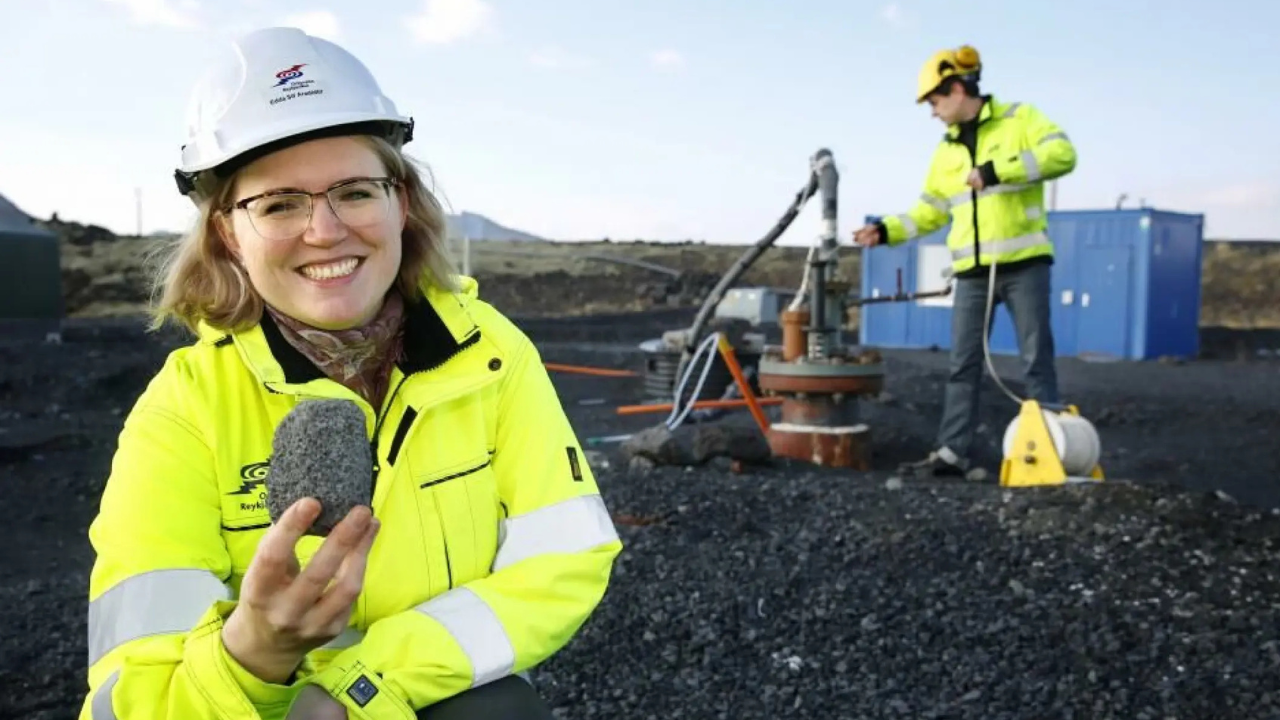
Atmospheric carbon dioxide mitigation requires permanent sequestration pathways that bypass the reversibility vulnerabilities of biological storage and deep saline aquifer injection. Mineral carbonation addresses this vulnerability by transforming gaseous carbon dioxide into solid carbonate minerals through direct geochemical reaction with divalent metal cations, primarily calcium, magnesium, and iron. This process converts a mobile fluid phase into an inert geological formation, effectively neutralizing leakage risks.
Evaluating the scalability of this intervention demands an analytical breakdown of subsurface reactive transport, energy penalties associated with fluid handling, and regional lithological constraints. Current operational frameworks demonstrate that combining dissolved carbon dioxide with basaltic formations accelerates a reaction timeline from centuries to under two years.
The Subsurface Mineralization Mechanism
The chemical conversion of carbon dioxide into stone relies on dissolution followed by precipitation. When carbon dioxide dissolves in water, it forms a weak acid containing dissolved bicarbonate and carbonate ions. Injecting this acidic fluid into formations rich in basalt—an extrusive volcanic rock containing high concentrations of calcium, magnesium, and iron silicates—triggers rapid dissolution of the host rock matrix.
CO2 (aq) + H2O <---> H2CO3 <---> HCO3- + H+
Ca2+ + CO32- <---> CaCO3 (Solid Calcite)
As the pH buffers upward due to silicate dissolution, the concentration of divalent cations reaches a saturation threshold. Carbonate ions then bond with these released ions to precipitate stable carbonate minerals such as calcite, magnesite, and siderite.
Porosity reduction represents the primary physical variable governing this mechanism. Initial dissolution increases rock permeability by opening micro-fractures, which facilitates fluid migration. Subsequent carbonate precipitation occludes pore spaces, sealing the pathway. Optimizing the injection protocol requires balancing the reaction rate against premature pore clogging, which can halt further fluid ingress if engineered improperly.
The Operational Energy Cost Function
Deploying large-scale mineral carbonation incurs high energy penalties, primarily driven by water requirements and pumping dynamics. For every metric ton of carbon dioxide permanently mineralized, standard dissolved-phase injection protocols require approximately twenty-five metric tons of water. Sourcing, treating, and pressurizing this volume introduces operational friction that scales non-linearly with depth and distance from water bodies.
The energy balance equation incorporates three distinct operational variables:
- Capture and Compression Energy: Power required to separate carbon dioxide from point sources or ambient air and compress it to supercritical or liquid states.
- Dissolution Footprint: Energy expended to dissolve carbon dioxide into water prior to injection, ensuring the fluid remains undersaturated enough to prevent premature surface precipitation.
- Injection Parasitic Load: Parasitic power draw of high-pressure pumps required to overcome hydrostatic and lithostatic pressures at target injection depths ranging from four hundred to two thousand meters.
Offshore deployment strategies utilize seawater to eliminate freshwater scarcity constraints, introducing additional chemical complexity due to the presence of competing ions and corrosion potentials within subsurface infrastructure. Systems engineering teams must optimize the mass flow rate to minimize the parasitic load while maintaining continuous subsurface mineral precipitation.
Lithological Constraints and Geographic Arbitrage
Basaltic formations are not uniformly distributed, creating geographic friction for global deployment. While continental flood basalts and oceanic crusts offer vast reactive surface areas, industrial point sources rarely sit directly atop suitable geological strata. Transporting captured carbon dioxide via pipeline or shipping lanes introduces capital expenditure burdens and regulatory bottlenecks.
Locations featuring optimal pairings of basalt geology, abundant water supply, and baseline industrial emissions are scarce. Iceland provides a uniquely favorable anomaly due to extensive sub-surface basalt columns combined with abundant geothermal energy and water resources. Replicating this model in landlocked industrial corridors requires extensive pipeline infrastructure or long-distance transport networks, altering the economic feasibility of the intervention.
Furthermore, structural heterogeneity within volcanic rock formations creates unpredictable fluid flow pathways. Subsurface fissures, fault lines, and variable vesicularity dictate whether injected fluids contact fresh reactive surfaces or bypass them entirely through preferential channels. High-resolution seismic imaging and tracer testing are mandatory pre-conditions for site selection to prevent operational failure from channeling.
Economic Trajectories and Cost Reduction Vectors
Mineral carbonation currently operates at a cost disadvantage compared to conventional geological storage in depleted oil and gas reservoirs, primarily due to the intense water-handling infrastructure required. Achieving commercial viability demands systematic cost compression across three distinct operational vectors.
- Direct-Gas Injection vs. Dissolved-Phase Injection: Eliminating the water dissolution step by injecting supercritical carbon dioxide directly into deep, dry basalt formations reduces water-handling infrastructure costs. However, this approach shifts the chemical kinetic bottleneck, as dry supercritical carbon dioxide reacts significantly slower with silicate minerals than aqueous carbonic acid.
- Industrial Waste Utilization: Integrating alkaline industrial wastes, such as steel slag, fly ash, and construction demolition debris, with captured carbon dioxide provides an alternative feedstock. These materials contain high concentrations of reactive calcium and magnesium oxides, enabling above-ground mineral carbonation that bypasses deep-well injection costs entirely.
- Co-Location Economics: Siting direct air capture facilities or industrial emitters directly adjacent to coastal basalt formations minimizes transportation footprints and capital amortization periods.
Long-Term Monitoring and Reversibility Risk Mitigation
Assessing the permanence of geological storage requires continuous monitoring protocols to verify that mineralized carbon remains sequestered under changing tectonic and thermal regimes. Unlike gas-phase storage in structural traps, which carries a residual risk of leakage via compromised wellbores or caprock fracturing, mineralized carbon locked within a carbonate lattice is thermodynamically stable over geological timescales.
Monitoring frameworks rely on a combination of micro-seismic monitoring, geochemical fluid sampling from monitoring wells, and permanent gravity surveys. As carbon dioxide converts to dense carbonate minerals, the local bulk density of the rock formation increases measurably. Time-lapse gravity anomalies provide non-invasive confirmation of mass transformation beneath the surface.
Deploy capital toward integrating continuous downhole fiber-optic sensors with real-time fluid chromatography to map reaction fronts dynamically, replacing periodic physical sampling cycles with automated predictive analytics.