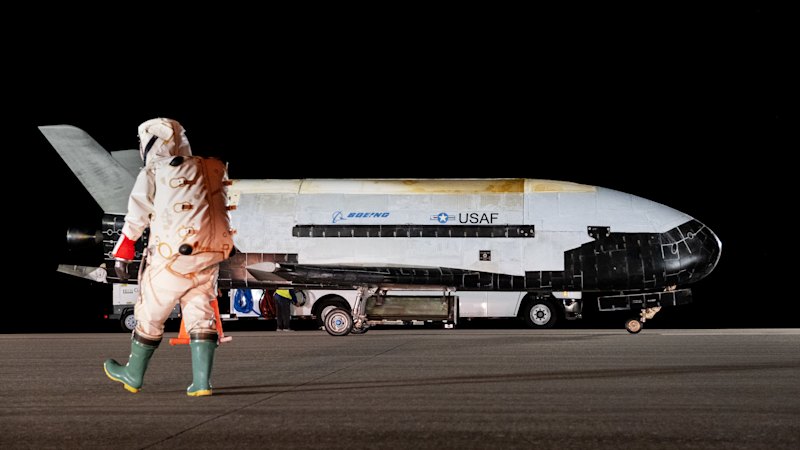
We spent decades treating orbit like an infinite, peaceful ocean. Satellites beamed our GPS directions, predicted our weather, and kept global finance ticking. That quiet luxury is dead. Right now, major spacefaring nations are quietly hardening spacecraft, testing anti-satellite missiles, and positioning maneuverable inspector craft that look suspiciously like orbital hit squads.
If you think space is still a sanctuary above earthly politics, you haven't been paying attention.
The orbital arms race isn't coming. It's already happening over our heads at seventeen thousand miles per hour. Let's look at what's actually unfolding in low-earth orbit and why governments are panicking behind closed doors.
The Shift From Science to Battlefield
For a long time, the unwritten rule of space was simple. Don't touch the other guy's bird. Both the United States and the Soviet Union demonstrated anti-satellite capabilities during the Cold War, but they exercised restraint. They knew blowing up a satellite created thousands of high-speed shrapnel bullets that didn't care whose flag was painted on the hull.
That restraint evaporated.
India, China, the United States, and Russia have all tested direct-ascent kinetic kill vehicles. These aren't abstract theories. They are missiles launched from the ground that smash directly into defunct satellites to prove a point. When India tested its Mission Shakti weapon in 2019, it created a debris cloud that threatened the International Space Station. Russia repeated a similar reckless stunt in 2021, forcing astronauts to shelter in their return capsules.
When nations are willing to trash the neighborhood just to prove they can reach it, the rules change. Space is officially a contested warfighting domain.
The Stealth Threat of Co-Orbital Weapons
Missiles fired from the ground get all the headlines, but they're clumsy. The real danger lives up there right now, blending in with commercial hardware.
Co-orbital weapons are spacecraft designed to stalk other satellites. Imagine a small, unassuming satellite launched under the guise of an orbital mechanic or a space debris cleaner. It drifts close to a high-value military communications satellite belonging to a rival nation. It sits there, tracking its targets, mapping its vulnerabilities, and waiting for an order.
When a satellite can nudge itself right up to a competitor's billion-dollar asset and spray it with a chemical agent, blind its optical sensors, or simply ram it, traditional deterrence theories collapse. You can't easily trace who bumped your satellite when space is crowded with thousands of commercial internet nodes. Attribution is messy. Plausible deniability is built into the architecture.
Why Kessler Syndrome is the Real Sword of Damocles
People worry about space lasers and kinetic impacts because they sound like science fiction. The actual threat keeping aerospace engineers awake at night is far more mundane and infinitely more terrifying: math.
It's called the Kessler Syndrome. Once you cross a certain density threshold of orbital debris, every collision triggers a chain reaction. One smashed satellite becomes three thousand high-speed shrapnel bullets. Those bullets shred three more satellites, creating nine million pieces of shrapnel. Within a few decades, low-earth orbit becomes an impenetrable wall of hypervelocity trash.
If a full-scale orbital war breaks out, we won't just lose military eyes in the sky. We could trap ourselves on the surface of the Earth. Global positioning, weather forecasting, maritime tracking, and secure communications would vanish in a single afternoon. You wouldn't be able to launch a rocket for generations because the departure corridor would resemble a literal shotgun blast.
The Commercial Wild Card
Here is where the conventional military analysis falls apart. Governments no longer hold a monopoly on the high ground.
Private enterprise changed the economics of launch completely. Thousands of small commercial satellites now crowd low-earth orbit to provide global broadband. This creates a massive gray zone. When military commands rely on commercial mega-constellations for battlefield communication and drone navigation, those commercial assets stop being civilian.
They become legitimate military targets.
If a nation decides to blind an adversary by taking out a commercial satellite network, they are attacking private property that happens to serve millions of regular people on the ground. The legal frameworks governing armed conflict in space were written in the late nineteen-sixties, when astronauts still smoked cigarettes in capsules and nobody dreamed of commercial broadband constellations. We are trying to referee a cyber-kinetic space war using a rulebook written for the Apollo era.
How to Track the Real Escalation
You won't see space wars declared on the evening news with dramatic ticker tapes. You have to watch the signals that defense ministries try to hide.
Watch for the frequency of unannounced orbital maneuvers by classified payloads. Pay attention to diplomatic deadlock at the United Nations Committee on the Peaceful Uses of Outer Space, where every treaty proposal on weapon bans is quietly filibustered or watered down by nations building their own offensive capabilities. Track the budgets. Space force funding isn't shrinking anywhere on earth.
The weaponization of space isn't a future crisis we might manage to prevent. It is a present reality we are currently failing to control. The only question left is how much of our technological infrastructure we are willing to risk before we realize that fighting in the dark void above us means losing everything we've built down here.