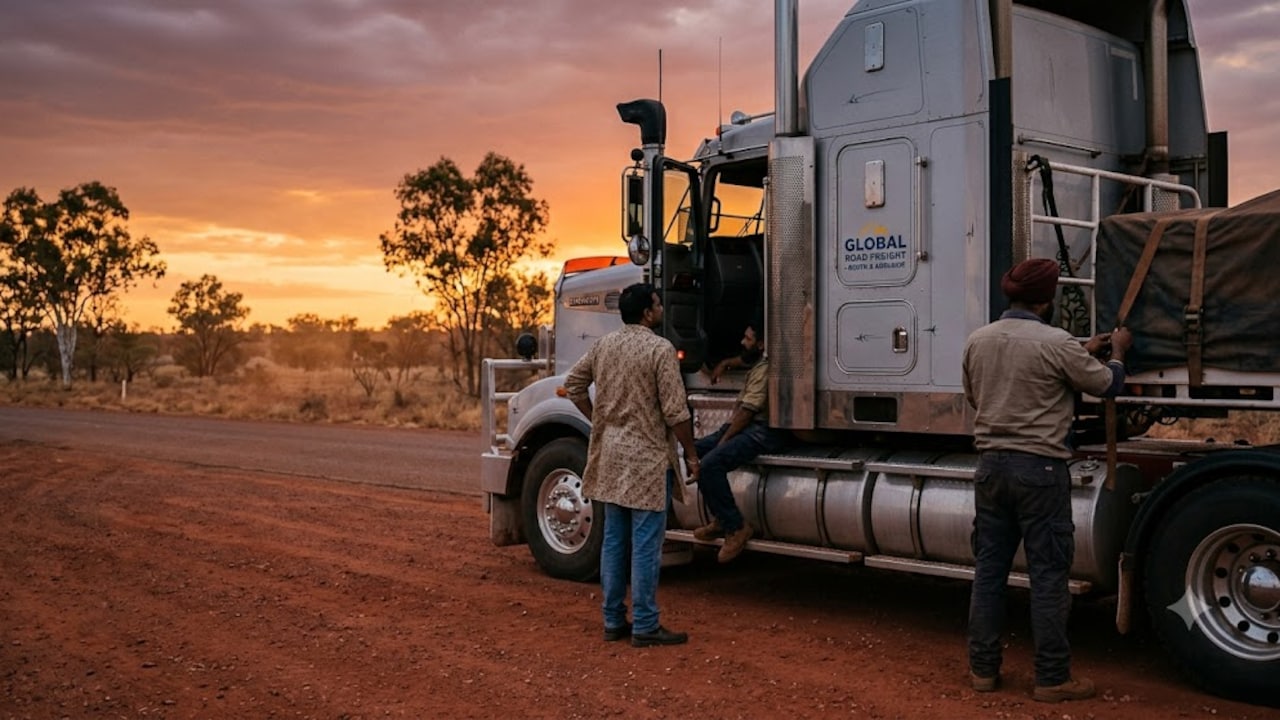
The asphalt doesn't care where you were born. Under the heavy, unforgiving hum of an eighteen-wheeler cutting through the pitch-black expanse of the Australian outback, the road demands only one thing: endurance. But for a growing army of migrant truck drivers navigating the interstate freight routes between Sydney, Melbourne, and Brisbane, the tarmac demands something far more precious. It demands their dignity. It demands their silence.
Imagine a man named Satnam. He is a hypothetical composite of the dozens of Punjabi drivers who have recently stepped forward to pull back the curtain on Australia’s transport industry, but his fears are entirely real. It is three in the morning. The cabin of his prime mover is a solitary island of fluorescent dashboard lights. Outside, the landscape is a void. Suddenly, the static on the UHF radio crackles to life. It isn’t a warning about a wandering kangaroo or a breakdown ahead. It is a torrent of racial slurs, delivered with casual, venomous certainty by a voice miles down the highway. The phrase cuts through the cabin noise, echoing a historical malice that has found a second life on the open road: "A good Indian is a dead Indian."
Satnam turns the volume down. His hands grip the steering wheel tighter. He cannot afford to answer back. He cannot afford to pull over and shake. In the back of his mind, a mathematical equation is constantly running: the cost of his visa, the debt he owes to the labor hire agency, the rent due in Melbourne, and the family waiting for news in Punjab. To survive this industry, he has learned to swallow the bile rising in his throat and keep his eyes fixed on the white lines separating the bitumen from the dirt.
The Economics of Silence
The logistics machine that keeps suburban supermarket shelves stocked depends on speed. We expect fresh milk, overnight deliveries, and cheap goods without ever questioning how they arrived. Beneath that convenience lies a fractured system of subcontracting that disproportionately squeezes those least able to fight back.
International students and temporary visa holders enter the heavy transport sector seeking a foothold in a new country. Instead, many find themselves trapped in a web of economic coercion. Large transport companies outsource routes to smaller operators. These operators subcontract to even smaller fleets, creating a chain of custody where accountability vanishes into thin air. By the time the pressure trickles down to the man in the driver's seat, the margins are razor-thin.
Consider the reality of wage theft in this sector. While enterprise agreements guarantee a fair hourly rate for domestic drivers, migrant workers are frequently paid flat day rates or by the kilometer. The math simply does not add up. A driver might log a fourteen-hour shift, navigating treacherous mountain passes and managing heavy fatigue, only to realize their take-home pay falls drastically below the legal minimum wage.
But complaining is a luxury.
When a driver’s right to remain in the country is tied directly to their employer’s sponsorship, a paycheck is no longer just money. It is survival. Unscrupulous operators know this. They hold the threat of visa cancellation over these men like a pendulum. If you refuse to drive an unroadworthy vehicle, there is a line of desperate applicants ready to take your place. If you demand to record your logbook accurately instead of fudging the hours to meet an impossible deadline, your shifts disappear next week.
The Slur in the Static
Isolation is the defining characteristic of long-haul trucking, but for South Asian drivers, that isolation is weaponized. The UHF radio, traditionally a lifeline for truckies to share road conditions and camaraderie, has transformed into a conduit for unmitigated hostility.
It is easy to dismiss anonymous radio chatter as the crude venting of frustrated individuals. It is much harder to dismiss it when it manifests in physical intimidation at truck stops. Drivers report being blocked from using amenities, receiving aggressive taunts while refueling, and finding exclusionary graffiti scrawled on bathroom walls.
The psychological toll of this constant low-level hostility is cumulative. It erodes a person’s sense of safety in a job that is already ranked among the most dangerous occupations in the country. When you are operating a vehicle weighing more than forty tons, focus is everything. A mind distracted by fear, humiliation, or the exhaustion of working consecutive sixteen-hour stretches is a hazard to everyone sharing the highway.
The industry’s regulatory bodies are not blind to these conditions. The Federal Court and fair work tribunals regularly penalize transport firms for systemic underpayment and exploitation. Yet, the fines are often treated as merely the cost of doing business. The structural incentives to cut corners remain intact because the consumer demand for cheap, instantaneous shipping shows no signs of slowing down.
The Ghost Fleet
We rarely see the people who move our world until something breaks. We notice the empty shelves during a supply chain crisis, or we read a brief paragraph in the local news about a horrific collision on a rural highway. We blame the driver. We point to the fatigue. We do not look at the ledger books of the logistics company that forced that driver into a choice between falling asleep at the wheel or losing his livelihood.
The men driving these routes are not statistics. They are parents, sons, and neighbors who moved across the world believing in the promise of a fair day's work for a fair day's pay. They wanted to build a future in a society that prides itself on egalitarian values, on the concept of a "fair go."
Instead, they find themselves operating a ghost fleet within the national infrastructure. They drive the longest hours, take the oldest rigs, accept the lowest pay, and endure the loudest abuse, all while keeping the engine of the nation running in the dark.
The real problem lies in our collective willingness to look away as long as the deliveries arrive on time. We have built an environment where safety is sacrificed for speed, and dignity is traded for discount freight.
The headlights of an oncoming road train flash in the distance, momentarily blinding the cabin before rushing past with a deafening roar that shakes the chassis. The road falls quiet again, save for the persistent hum of the tires on the cold ground. Satnam reaches out and turns off the radio completely. The silence inside the truck is heavy, filled with the weight of an unacknowledged sacrifice, as the vehicle pushes forward into the long grey dawn.

.webp)