The coffee went cold hours ago. Outside the window, the streetlights hummed against a heavy, starless sky, casting long, bruised shadows across the pavement. Inside, the living room glowed with the amber light of a television screen broadcasting from a hemisphere away.
São Paulo was alive. Not with the quiet rustle of a sleeping suburb, but with a roar that felt less like sound and more like atmospheric pressure.
Nearly twenty-five million people were tethered to the exact same second.
We forget, sometimes, how easily geography can shrink. We live partitioned by oceans and time zones, locked behind our respective borders, speaking different languages, waking up while others are winding down. Yet sport possesses this strange, stubborn alchemy. It bypasses the intellect entirely and strikes right at the chest.
Consider what happens when a football is kicked across a field in Brazil, and an apartment building in Baltimore holds its collective breath.
The numbers are staggering on paper. Twenty-four point nine million viewers on CBS alone. A record for an NFL game played on foreign soil. It reads like a corporate press release, a neat little statistic meant for quarterly earnings reports and executive back-slapping. But statistics are just ghosts of human experiences. Behind that twenty-four point nine million figure is a tapestry of sleepless fans, glowing screens in dark kitchens, children draped in oversized jerseys, and the quiet, collective heartbeat of two cities staring at a glowing rectangle.
Let us trace the invisible lines connecting them.
Imagine a living room in Dallas. The air conditioning hums a low, familiar tune. A father and daughter sit shoulder-to-shoulder on a worn leather couch, their eyes locked on the broadcast. The father remembers when football was strictly a domestic affair, a crisp autumn Sunday ritual wrapped in the smell of fallen leaves and backyard grills. Now, the game belongs to the globe.
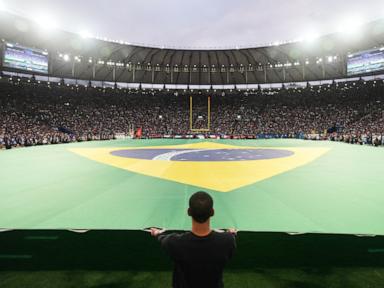
Thousands of miles away, in the heart of Brazil, the roar of the stadium rattles the concrete foundations. It is alien and electric. For the local fans, this isn't just an imported spectacle; it is a collision of worlds. American football, with its heavy armor and intricate tactical chess matches, has found a brand new cathedral.
When the Baltimore squad stepped onto foreign grass, they weren't just playing for a tally in the win column. They were carrying the weight of a cultural bridge. Every snap of the ball was broadcast into millions of homes where fans were rewriting their weekend habits, trading late-night sleep for a glimpse of athletic theater.
We often talk about globalization as a cold, economic force—shipping containers, fiber-optic cables, multinational supply chains. But true globalization looks like this. It looks like a teenager in São Paulo scrolling through highlight reels on a phone while an elderly couple in Baltimore shakes their heads at a missed tackle. It is cultural cross-pollination happening in real time, fueled by adrenaline and the sheer human love for competition.
The broadcast booth captured the friction and the beauty of it. Announcers translated the rhythm of the game for a massive international audience while domestic viewers caught glimpses of a foreign culture painted in vibrant yellow and green banners.
And then the clock ran out.
The screen cut to black. The noise in the stadium faded into the echoes of a retreating crowd. In millions of homes around the world, the amber glow vanished, leaving behind the quiet hum of refrigerators and the faint light of dawn creeping up against the blinds.
The record will eventually be broken. Another game will be played in another distant city. More numbers will be crunched, tallied, and filed away into the archives of sports history.
But for one night, twenty-five million people shared the exact same pulse. And as the dark room settled back into silence, the world felt just a little bit smaller, and a whole lot closer together
Midnight Football And The Sound Of A New Era
sports
The air in São Paulo was thick with the scent of humidity, exhaust, and roasted corn. Midnight approached, but the streets outside the stadium refused to sleep. Inside, the roar was different. It did not sound like an American autumn Sunday. It sounded like an ocean trapped in a concrete bowl.
Consider what happens when a sport born in the crisp October air of the American Rust Belt travels four thousand miles south. It sheds its coat. It learns a new language.
On that night, twenty-four million, nine hundred thousand people tuned in through CBS. They sat in living rooms in Baltimore, in kitchens in Dallas, on sagging couches in college dorms across the continent. They watched through glowing screens as green grass met the floodlights under a Brazilian sky. Numbers on a ratings sheet rarely tell the whole truth, but this number shouted. It was a record. Not just for a game, but for an entire culture stretching its boundaries past the water's edge.
Football has always belonged to geography. It belongs to the smell of burnt leaves, the crunch of gravel under heavy boots, the aluminum bleachers vibrating beneath the feet of shivering high schoolers. For generations, the game stayed put. It stayed inside its borders. It was ours, wrapped in autumn leaves.
Then came the shift.
Picture a twelve-year-old kid in a worn-out jersey sitting on a concrete stoop in a neighborhood where American football is usually just something strange on a YouTube highlight reel. To that kid, the helmets look like spacecraft. The collisions sound like thunder. On this night, the screen isn't showing a distant culture; it is inviting them inside. That is the invisible stake of the international expansion. It is not about revenue streams or television contracts. It is about a handshake across a cultural divide.
The logistics alone were a quiet masterpiece of madness. Moving two massive franchises, their equipment, their training regimens, their medical staffs, and their towering linemen across hemispheres requires a precision usually reserved for space flight. But the real weight wasn't in the cargo holds. It was in the air. Would the crowd care? Would the stadium echo with silence?
Silence never stood a chance.
When the opening whistle blew, the noise drowned out the broadcast booth. It was relentless. It was rhythmic. It was soccer culture colliding with American pads, creating a hybrid monster of sound that caught the players off guard. Quarterbacks squinted against the lights, trying to check wristbands through the roar, realizing that home-field advantage had just been exported to the Southern Hemisphere.
We often think of sports as mirrors of society, but sometimes they are bridges. They give disparate groups a shared language of adrenaline. When a receiver stretches his fingertips toward a high-arcing pass, time compresses. The viewer in Texas and the viewer in São Paulo inhale at the exact same microsecond.
The game ended, the confetti fell, and the exhaustion settled over the turf. The broadcast numbers rolled in later like a tide, confirming what the noise in the stadium had already whispered. The boundaries of the sport had shifted.
The field grows larger. The night stays electric. The game is no longer just ours. It belongs to anyone willing to watch the kickoff under a foreign moon.