The grass under the stadium lights doesn’t care about reputations. It doesn’t care about hundred-million-euro price tags, social media followers, or the neatly scripted narratives pre-written by pundits sitting in air-conditioned press boxes. It only responds to pressure. Real, bone-crushing pressure.
When Spain stepped onto the pitch for the World Cup quarterfinal against Belgium, the air inside the arena felt thick enough to chew. Everyone expected the glittering names to steal the headlines. They wanted the teenage wingers with lightning in their boots or the elegant playmakers who pass the ball as if it were a glass ornament. Instead, the night belonged to a man whose greatness is often measured by the things he prevents rather than the things he creates.
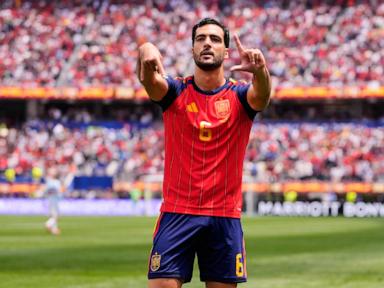
Mikel Merino.
He is not the player you usually buy a shirt to emulate. He doesn't glide past defenders with insolent step-overs. He operates in the engine room, that chaotic, claustrophobic central third of the pitch where careers go to die under the weight of heavy tackles and relentless running. Yet, by the ninety-ninth minute of a grueling encounter, it was his shadow that loomed largest over the tournament.
The Weight of the Invisible Shirt
To understand what happened out there, you have to understand the burden of wearing a Spanish midfield jersey. It is a historical curse. For nearly two decades, every man who occupies that space is compared to ghosts. The ghosts of 2010. The tiki-taka architects who turned football into a chess match played at hyperspeed.
When Belgium’s golden generation—or what remains of its stubborn, brilliant core—surged forward in the opening minutes, Spain looked fragile. The red shirts were passing, yes, but the passes were nervous. Side to side. Safe. The kind of possession that invites disaster.
Then came the opening blow. A sudden, vertical thrust from Belgium caught the Spanish backline flat-footed. A deflecting ball, a frantic scramble, and suddenly the Belgians were up 1-1 after an early exchange of blows that left the tactical game plans in tatters. The stadium erupted into a wall of Belgian sound.
In moments like that, teams can fracture. You see it in the eyes of the players—the frantic gesturing, the pointing of fingers, the sudden urge to try everything at once and end up achieving nothing.
But Merino didn’t panic. He simply adjusted his socks.
Consider what happens when a team loses its emotional anchor. The defenders drop deeper out of fear. The attackers stay higher out of desperation. The midfield becomes a vast, empty ocean. Merino filled that ocean by himself. He became a human shield, intercepting passes not with flashy slides, but with the quiet positioning of a man who can predict the future three seconds before it happens.
The Art of the Unseen Battle
Football broadcasts are designed to follow the ball. Because of this, they miss the real war.
Away from the television cameras, Merino was engaged in a brutal, exhausting wrestling match with the Belgian midfield. Every goal kick was a duel. Every loose ball was a physical collision that left bruises. It is the kind of work that leaves a player entirely spent by the hour mark, yet it is completely necessary if the artists up front are to have any license to create.
Spain’s equalizer had been a work of collective patience, a sequence of twenty passes that eventually found the back of the net to restore parity at 1-1. But the match wasn't settled by tactical superiority. It was grinding down into a war of attrition. The heat was oppressive. Legs were cramping.
Think about the last time you were utterly exhausted, when your lungs felt like they were lining with sand and every instinct told you to stop. Now imagine doing that while sixty thousand people scream at you and a Belgian midfielder weighing ninety kilograms tries to run through your chest.
That was the reality of the second half.
The breakthrough didn't come from a moment of divine inspiration. It came from persistence. Spain earned a corner late in the match. The tension was so suffocating that you could hear the thud of the ball being kicked from the far side of the stadium.
Merino moved into the box. He wasn’t the biggest man there, nor was he the most athletic. But he wanted it more.
The Decisive Leap
When the cross came in, it didn’t have the perfect arc of a training ground routine. It was a messy, spinning ball, knocked down into a crowded penalty area where twenty legs twitched to clear it or poke it home.
Merino anticipated the bounce.
He didn’t just jump; he hung in the air, defying the exhaustion that had been dragging at his limbs for the previous eighty minutes. His header wasn’t a rocket. It was a deliberate, downward redirection, aimed precisely at the one patch of grass the Belgian goalkeeper couldn't reach.
The net bulged.
2-1.
The celebration wasn’t a choreographed dance for the cameras. It was a release of pure, unadulterated relief. Merino ran toward the corner flag, his face contorted in a scream that echoed the collective anxiety of an entire nation watching from thousands of miles away. He was mobbed by teammates who knew exactly how much dirt he had chewed to put them in that position.
But the match wasn't over. The final whistle hadn't blown, and Belgium poured forward with the fury of a team staring at the exit door of the biggest tournament on earth.
Holding the Line
The final five minutes of a World Cup quarterfinal are not about football. They are about survival.
Belgium threw everyone forward. Long balls rained into the Spanish penalty area. The elegant Spanish style was completely gone, replaced by a desperate, frantic rearguard action. Balls were hacked away blindly. Men threw their bodies in front of shots.
In the middle of the chaos stood the man of the hour. Merino wasn't attacking anymore. He was a third central defender, heading balls clear, winning fouls just to buy his team thirty seconds of breathing room, calming down the younger players who were letting the occasion get to their heads.
When the referee finally blew the whistle three times, the Spanish bench emptied onto the pitch.
Most of the players collapsed to the ground, spent. Merino stood still for a moment, looking up at the sky, his jersey stained with sweat and turf, before being enveloped in a hug by his manager.
Spain was through to the semifinals.
The newspapers tomorrow will talk about statistics. They will analyze the pass completion percentages, the distance covered, and the tactical tweaks made at halftime. They will try to turn a night of human drama into a math problem.
But football is not a math problem. It is a game played by human beings who feel fear, fatigue, and doubt. On a night when Spain needed a hero, they didn't find one in the flashes of individual brilliance or the expensive superstars. They found it in a midfielder who understood that sometimes, the only way to achieve glory is to embrace the grind.
He walked off the pitch slowly, limping slightly, his face tired but serene. The stadium was still singing his name, a melody that would follow him all the way to the team bus, through the quiet corridors of the hotel, and into the history books of Spanish football.