The stopwatch does not care about human mythology. It does not remember the sultry August night in Berlin back in 2009, when Usain Bolt threw his arms wide, chest puffed, having rewritten human biology with a time of 9.58 seconds. That record was never just a number. It was a holy text written in sweat, bone, and lightning, long deemed the absolute ceiling of what flesh and sinew could achieve.
Consider what happens next: a machine built by engineers in Beijing steps onto a rubberized track, and the stopwatch ticks down to 9.32 seconds. For an alternative perspective, see: this related article.
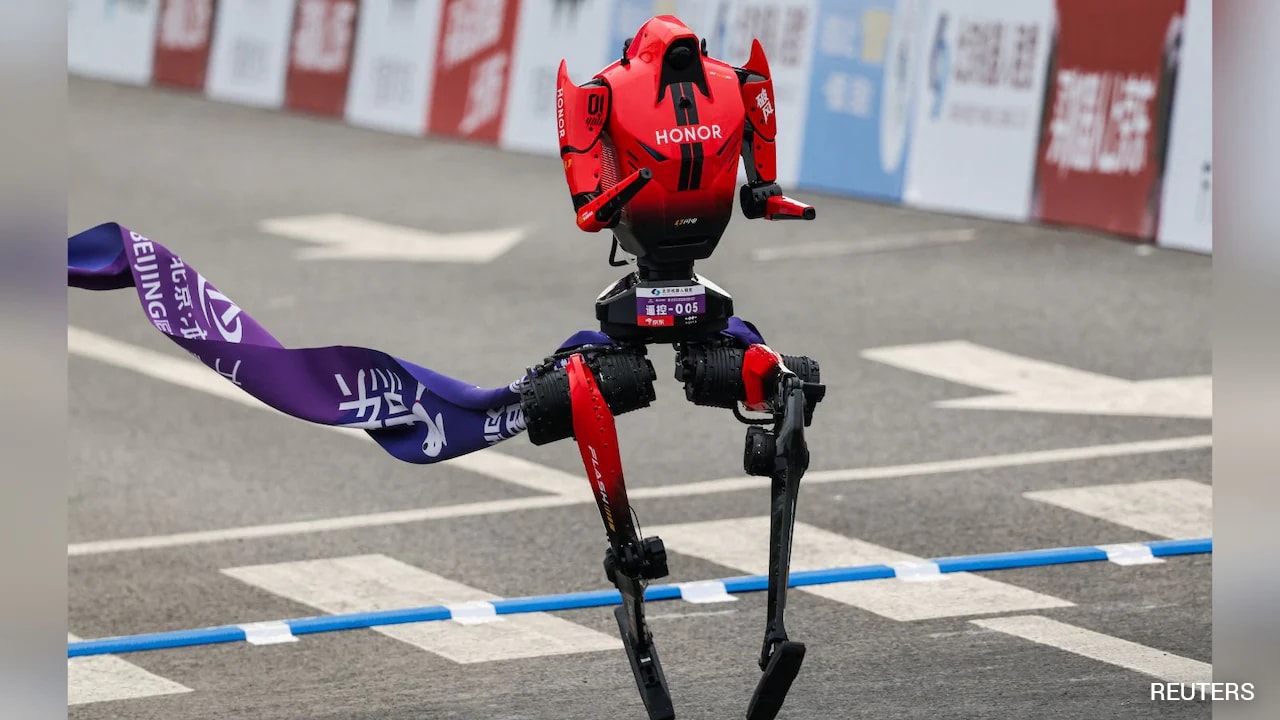
The robot is named Lightning. It was built not by a traditional aerospace laboratory, but by Honor, a smartphone maker better known for pocket-sized glass rectangles than for sprinting titans. Standing tall with newly elongated legs stretching past a meter in length, Lightning does not breathe. It does not feel the lactic acid burning through its thighs or the psychological weight of a stadium holding its breath. It simply processes equations of torque, gravity, and momentum at a peak velocity of 14.5 meters per second.
To watch footage of these trials during the buildup to the World Humanoid Robot Games is to experience a strange cognitive dissonance. There is the familiar geometry of a 100-meter dash—the starting blocks, the tension in the air, the white lines painted sharp against the red track. Yet the runner is an articulation of carbon fiber, actuators, and whirring micro-motors. It lacks grace, carrying a stiff, mechanical rigidity that reminds you immediately of what it is. And yet, it crosses that finish line nearly a quarter of a second faster than the greatest sprinter in human history. Further coverage on this matter has been shared by The Verge.
We have spent centuries defining our species by our limits. We measure our worth against our fragility. When a machine breaks a human record, the initial reaction is almost visceral—a defensive tightening of the chest, an urge to asterisks the achievement with disclaimers about motors, batteries, and artificial advantages. That skepticism is entirely correct, of course. Lightning does not run under the grueling biological constraints of World Athletics rules. It is a showcase of hardware engineering and artificial intelligence, a kinetic proof-of-concept born from a national push into advanced robotics.
Look closer at the broader picture, though. Months prior, this same machine conquered the Beijing half marathon, chewing up twenty-one kilometers at a pace that left elite human endurance runners trailing in its wake. Engineers tinkered, lengthened its stride by ten centimeters, tuned its balance algorithms, and pointed it toward a short-distance sprint. The machine adapted. The metal obeyed.
We are moving past the era where robotics meant clumsy industrial arms welding chassis behind safety cages. We are entering a reality where bipedal systems share our pacing, our pathways, and eventually, our environments.
Imagine walking down a city street and hearing the rhythmic, unnatural thud of a titanium stride accelerating behind you, moving faster than any biological sprinter could dream of sustaining. It sounds like science fiction. It is the news of today.
The stopwatch has spoken. Bolt's legendary mark remains the pinnacle of human achievement, an untouchable monument to our biological potential. But the era of flesh holding a monopoly on speed is officially over.