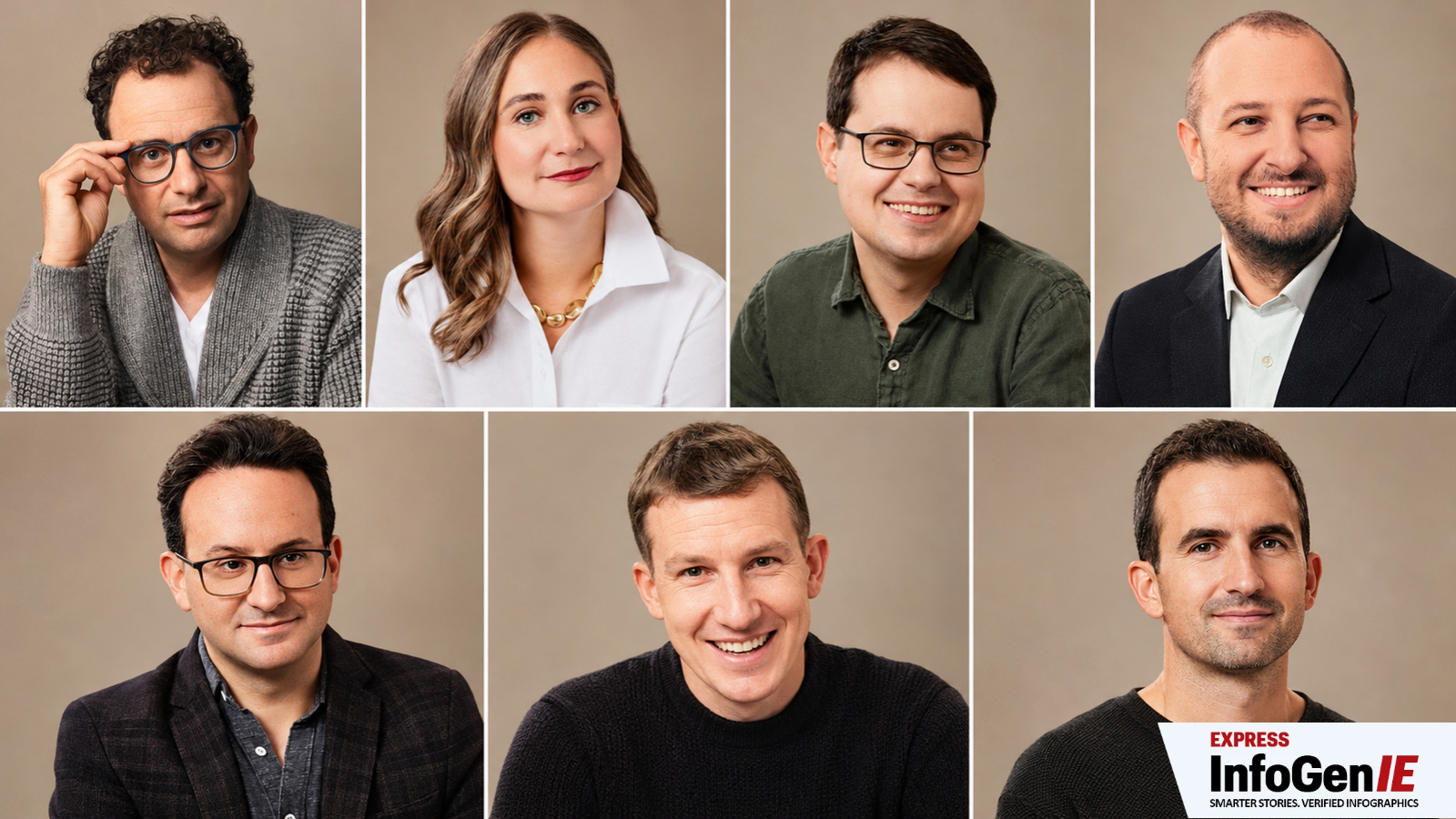
Seven people walked out of OpenAI in late 2020 and early 2021. Five years later, their breakaway company, Anthropic, sits at a valuation north of $60 billion, and every single one of those seven co-founders has joined the billionaire ranks on paper.
Most coverage of Anthropic treats the company like a two-person show starring siblings Dario and Daniela Amodei. That misses the real story. Anthropic wasn't founded by a pair of executives with a slide deck—it was built by a tight-knit faction of researchers and engineers who helped invent modern large language models at OpenAI, decided the lab was moving too fast without enough safety guardrails, and took their institutional knowledge with them.
If you want to understand why Claude behaves the way it does, why Amazon and Google poured billions into the company, and how AI safety went from an academic niche to a multi-billion-dollar business strategy, you have to look at all seven founders.
Why Seven Senior Leaders Walked Away from OpenAI
Before getting into the individual names, you need the context. By 2020, OpenAI had already released GPT-3 and signed its initial $1 billion partnership with Microsoft. Commercialization pressure was ramping up inside the San Francisco lab.
A group of senior researchers and policy leaders grew worried that product deadlines were outpacing safety research. They believed scaling up massive neural networks without solving alignment—making sure AI systems actually do what humans intend—was reckless. Instead of staying to fight internal battles, they quit together and incorporated Anthropic as a Public Benefit Corporation in early 2021.
This wasn't a random assortment of coworkers. Many of them had worked side-by-side for years, co-authoring the foundational papers on scaling laws and reinforcement learning from human feedback (RLHF) that made ChatGPT possible in the first place. When they left, OpenAI didn't just lose seven employees. It lost the core team behind its most important technical breakthroughs.
The 7 Anthropic Co-Founders and What They Actually Do
Here is the full roster of Anthropic's founding team, their backgrounds before the split, and the specific roles they took on to turn a safety-focused research lab into OpenAI's fiercest rival.
1. Dario Amodei (Chief Executive Officer)
Dario Amodei is the public face of Anthropic and the intellectual architect behind its "scaling plus safety" philosophy. Before co-founding the company, he served as Vice President of Research at OpenAI, overseeing the teams that built GPT-2 and GPT-3.
His academic path wasn't straight computer science. He earned a PhD in physics from Princeton University, focusing on biophysics and neural circuits, before working as a postdoctoral scholar at Stanford University School of Medicine. After brief stints at Baidu and Google Brain, he joined OpenAI in 2016.
At OpenAI, Dario co-invented reinforcement learning from human feedback (RLHF), the exact technique used to train models to follow human instructions safely. He also helped establish the empirical scaling laws showing that throwing more compute and data at transformer models predictably improves intelligence. As CEO of Anthropic, he sets the technical direction and has become Washington's go-to AI executive when lawmakers want to discuss frontier model risks.
2. Daniela Amodei (President)
If Dario runs the science, his younger sister Daniela runs the machine. Before Anthropic, she was Vice President of Safety and Policy at OpenAI, managing technical safety, policy, and engineering teams.
Unlike her brother, Daniela came from the humanities and operations side. She graduated from the University of California, Santa Cruz with a degree in English literature and started her career in global health and politics, even working on congressional campaigns before joining Stripe. At Stripe, she rose to become a risk manager and helped scale the fintech giant's recruiting and operations during its hyper-growth years.
She joined OpenAI in 2018 and quickly became the operational glue holding fast-moving research teams together. At Anthropic, she serves as President, overseeing business operations, enterprise sales, legal, and partnerships—including the massive cloud and investment deals with Amazon and Google that gave Anthropic the compute power to train frontier Claude models.
3. Jared Kaplan (Chief Science Officer)
Jared Kaplan is the theoretical physicist who figured out the math behind modern AI progress. While still a professor of theoretical physics at Johns Hopkins University—where he studied quantum field theory and cosmology—he began consulting for OpenAI and quickly became one of its most influential researchers.
In 2020, Kaplan led the landmark paper "Scaling Laws for Neural Language Models." That research proved that AI performance scales smoothly as a power law with model size, dataset size, and compute. Without that discovery, tech companies wouldn't have had the confidence to spend tens of billions of dollars building massive GPU clusters.
At Anthropic, Kaplan serves as Chief Science Officer. He leads the company's core research into scaling laws, model capabilities, and Constitutional AI—the method Anthropic uses to train Claude to police its own outputs using a written set of principles rather than relying solely on human moderators.
4. Jack Clark (Head of Policy)
Most AI founders are pure engineers or physicists. Jack Clark is a former tech journalist who taught himself machine learning and became one of the sharpest policy minds in Silicon Valley.
Clark spent years covering technology and distributed systems for The Register and Bloomberg News in London and San Francisco. In 2016, OpenAI hired him as its Communications Director, and he eventually became Policy Director. Along the way, he founded Import AI, a widely read weekly newsletter dissecting technical AI papers for researchers and policymakers, and co-chaired the Stanford AI Index steering committee.
At Anthropic, Clark leads public policy and societal impacts. He spends much of his time in Washington, D.C., Brussels, and London, advising governments on AI safety institutes, compute governance, and frontier model evaluations. When Anthropic pushes for mandatory safety testing or transparency standards, Clark is usually behind the strategy.
5. Sam McCandlish (Chief Architect)
Sam McCandlish is the infrastructure brain who makes sure Anthropic's massive training runs don't crash. Like Jared Kaplan, McCandlish came out of theoretical physics, earning his PhD from Stanford University where he researched quantum gravity and black holes.
He joined OpenAI in 2018, working closely with Dario Amodei and Jared Kaplan on large-scale pre-training and scaling laws. Training a frontier model across tens of thousands of GPUs or TPUs is notoriously fragile—hardware fails constantly, gradients explode, and a single bug can waste millions of dollars in compute.
As Anthropic's Chief Architect, McCandlish oversees the pre-training and infrastructure engineering that turn raw compute clusters from AWS and Google Cloud into working Claude models. He rarely seeks media attention, yet inside the company he is widely credited with keeping Anthropic competitive on raw model intelligence despite having fewer resources than Google or Meta early on.
6. Tom Brown (Lead Engineer)
If you used GPT-3 when it blew up in 2020, you were using Tom Brown's engineering work. Brown was the lead engineer on GPT-3 at OpenAI, responsible for coordinating the massive distributed systems engineering required to train a 175-billion-parameter model—an unprecedented scale at the time.
Brown's path into AI wasn't traditional. He didn't finish a PhD. Instead, he worked as a software engineer at startups and Google Brain before joining OpenAI, proving that elite systems engineering matters just as much as theoretical math when building giant neural networks.
At Anthropic, Brown oversees compute, cluster engineering, and core infrastructure systems. Getting tens of thousands of chips to communicate at peak efficiency without bottlenecks is one of the hardest engineering problems in tech right now, and Brown is one of the few people on Earth who has done it multiple times at frontier scale.
7. Chris Olah (Co-Founder and Interpretability Lead)
Chris Olah is arguably the most unconventional thinker on the founding team—and the person working on Anthropic's biggest scientific moonshot. He never went to college. Growing up in Canada, he taught himself math and machine learning, published influential visual essays explaining neural networks, and got hired by Google Brain at 21 before moving to OpenAI to lead its interpretability team.
Olah focuses on mechanistic interpretability—essentially reverse-engineering neural networks to see what happens inside the "black box" when a model thinks. Instead of just testing whether Claude gives a right or wrong answer, Olah's team maps out the specific internal features and circuits that activate when the model recognizes concepts like deception, programming bugs, or specific people.
In 2024 and 2025, Olah's group made global headlines by successfully mapping millions of interpretable concepts inside Claude 3 Sonnet, proving that giant language models aren't completely inscrutable after all. If Anthropic ever cracks how to inspect an AI's "brain" before deploying it, Olah's work will be the reason why.
How All Seven Became Billionaires Without Selling Out
Here's what makes the Anthropic wealth story unusual compared to typical Silicon Valley startups.
Anthropic is structured as a Public Benefit Corporation (PBC) with a Long-Term Benefit Trust—an independent body of trustees that has the power to appoint and remove board members to ensure the company prioritizes AI safety over pure shareholder profit. When the founders started the company, they didn't take standard mega-founder stakes designed to maximize personal payouts. In fact, reports from Forbes and The Information indicate the seven co-founders collectively hold a smaller percentage of the company than founders at traditional tech startups—roughly split evenly among the seven rather than concentrated in one or two hands.
Yet the sheer scale of AI capital overwhelmed that modesty.
Between 2023 and 2025, Amazon committed up to $8 billion to Anthropic, while Google invested over $2 billion, alongside major rounds led by Lightspeed Venture Partners, Menlo Ventures, and Spark Capital. By early 2025, Anthropic's valuation crossed $61.5 billion, and subsequent secondary transactions and funding talks pushed its implied value even higher. Even with conservative equity estimates of around 2% to 3% per co-founder after dilution, every single member of the seven-person founding team holds a stake worth well over $1 billion on paper.
Of course, paper wealth in private AI companies comes with caveats. None of the seven have cashed out billions in liquid cash, and Anthropic's massive compute bills mean profitability is still a long-term target rather than a current reality.
What Most People Get Wrong About the Anthropic Founders
If you only read casual tech headlines, it's easy to fall for two common myths about this group.
Myth 1: They left OpenAI because they wanted to build small, slow, academic models.
Wrong. Dario Amodei and Jared Kaplan literally wrote the scaling laws paper. They believe harder than almost anyone that bigger models bring breakthrough capabilities. Their disagreement with OpenAI wasn't about whether to scale—it was about running safety, interpretability, and alignment research at the exact same speed as scaling, rather than treating safety as an afterthought once a product ships.
Myth 2: Anthropic is just Dario Amodei making all the calls.
Unlike OpenAI—where Sam Altman operates as a traditional tech CEO—Anthropic runs much more like a consensus-driven research leadership council. Each of the seven co-founders owns a distinct pillar of the company: Dario on vision and research strategy, Daniela on operations and enterprise, Kaplan on science, Clark on policy, McCandlish on pre-training architecture, Brown on compute systems, and Olah on interpretability. That division of labor is why Anthropic hasn't suffered the dramatic boardroom coups or executive exodus that hit OpenAI between 2023 and 2024.
How to Track Anthropic's Next Moves Yourself
If you want to follow what these seven founders are actually building—without waiting for second-hand media summaries—skip the press releases and watch their primary outputs directly:
- Read Anthropic's Alignment and Interpretability Papers: Follow Chris Olah and Jared Kaplan's publications on transformer-circuits.pub and anthropic.com/research to see how Claude's internal safety mechanisms evolve before they hit commercial products.
- Subscribe to Jack Clark's Newsletter: Read Import AI every Monday to see which technical papers and policy debates Anthropic's Head of Policy is paying attention to.
- Watch Enterprise API Releases Over Consumer Hype: Under Daniela Amodei's operational direction, Anthropic prioritizes developer tooling, coding benchmarks, and regulated enterprise contracts over viral consumer gimmicks—so its real business momentum always shows up in API adoption and cloud partnerships first.



