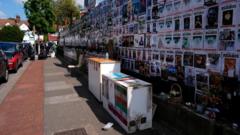
The arrest of two suspects following an arson attack at a memorial in Golders Green represents more than a localized criminal event; it is a clinical breakdown in the security of symbolic infrastructure. When a site of communal mourning is targeted by incendiary means, the perpetrator isn't merely destroying physical property but is attempting to manipulate the psychological cost of public remembrance. This act operates within a specific framework of asymmetric aggression, where low-cost physical inputs—in this case, accelerants and a match—aim to produce high-value social disruption.
To understand the gravity of the Golders Green incident, one must analyze it through three distinct analytical lenses: the logistics of the kinetic act, the legal architecture of hate crime prosecution, and the secondary impact on urban security protocols.
The Logistics of Symbolic Destruction
The choice of arson as a method of attack reveals a specific intent to maximize visual and emotional resonance. Unlike simple vandalism or graffiti, which are additive and often reversible, arson is subtractive and transformative. It seeks to erase the object of focus entirely.
The Golders Green memorial serves as a high-value soft target. In security terminology, a "soft target" is a location with high accessibility and limited kinetic defenses. Because the memorial is designed for public access, it lacks the perimeter hardening—such as reinforced barriers or active checkpoints—found at government buildings. This vulnerability creates an "opportunity gap" where the time required to initiate an attack is significantly shorter than the average response time of local law enforcement.
The Metropolitan Police Service (MPS) confirmed the arrests of a 22-year-old man and a 23-year-old woman on suspicion of arson. From a forensic standpoint, the involvement of two individuals suggests a division of labor: one acting as a lookout while the other deploys the accelerant. This minor degree of coordination elevates the event from an impulsive act of frustration to a planned operation.
The Legal Framework of Aggravated Offenses
Standard arson charges are defined by the damage to property and the potential risk to life. However, when the target is a memorial associated with a specific protected group, the legal calculus shifts toward the "Hate Crime" framework. Under UK law, specifically the Crime and Disorder Act 1998 and the Sentencing Act 2020, an offense is "aggravated" if it is motivated by hostility toward a person's religion or ethnicity.
The evidentiary burden for an aggravated charge is higher. Investigators must move beyond the act of setting the fire to prove the animus behind it. This involves:
- Digital Footprint Analysis: Scouring the suspects' communication logs and social media activity for radicalized content or prior intent.
- Temporal Correlation: Determining if the timing of the attack aligns with significant religious dates or geopolitical flashpoints.
- Site Specificity: Establishing why this specific memorial was selected over other flammable structures in the vicinity.
If the "aggravated" element is proven, the sentencing guidelines provide for a significant uplift. This serves a dual purpose: retributive justice for the specific act and general deterrence meant to signal that the state places a higher premium on the protection of communal cohesion than on generic property.
The Security-Visibility Paradox
Urban planners and community leaders face a persistent conflict between accessibility and security. A memorial that is encased in bulletproof glass or surrounded by high-tensile fencing loses its primary function—to provide a space for open, public reflection. This is the "Security-Visibility Paradox."
When an attack occurs, the immediate reaction is to increase surveillance. However, the deployment of Closed-Circuit Television (CCTV) acts more as a forensic tool than a preventative one. In the Golders Green case, while CCTV likely assisted in the identification of the suspects post-facto, it did nothing to harden the target against the initial flame.
The systemic failure here isn't one of surveillance, but of proactive deterrence. A robust security posture for communal sites requires a tiered approach:
- Low-Profile Hardening: Using fire-retardant materials in the construction of memorials to increase the "time-to-ignition."
- Environmental Design (CPTED): Modifying the landscape to eliminate blind spots and ensure that any approach to the memorial is visible from multiple public angles.
- Active Monitoring: Transitioning from passive recording to real-time AI-assisted video analytics that can detect "anomalous behavior," such as a person loitering with a container of liquid at 3:00 AM.
The Economic and Psychological Cost Function
The impact of this arson attack can be quantified through a cost function where the "Total Social Damage" ($D_s$) is a sum of direct physical costs ($C_p$) and indirect communal trauma ($C_t$).
$$D_s = C_p + C_t$$
While $C_p$ (the cost of cleaning and restoration) might be relatively low, $C_t$ is exponential. It includes the cost of increased policing, the loss of "perceived safety" among residents, and the potential for retaliatory actions. This atmospheric tension functions as a "tax" on the community, requiring businesses and religious institutions to divert resources from growth toward private security firms and insurance premiums.
The Golders Green attack is a signal of heightened volatility. It demonstrates that the current barrier to entry for domestic disruption is remarkably low. As law enforcement processes the two individuals currently in custody, the focus must shift from the specific perpetrators to the systemic vulnerabilities they exploited.
Community leaders must now navigate a landscape where symbolic sites are the frontline. The strategic imperative is to reinforce these locations without turning them into fortresses. This involves a shift toward intelligence-led policing, where community liaisons and digital monitoring identify threats before they reach the kinetic stage. Failure to adapt this model will result in a cycle of reactive arrests that do little to protect the sanctity of public spaces.
The arrests are a tactical win, but the strategic vulnerability remains. The preservation of communal spaces depends on the ability to anticipate the "asymmetric threat"—the realization that a gallon of petrol and a radicalized intent can bypass millions of pounds in passive infrastructure if the social contract is not actively defended.