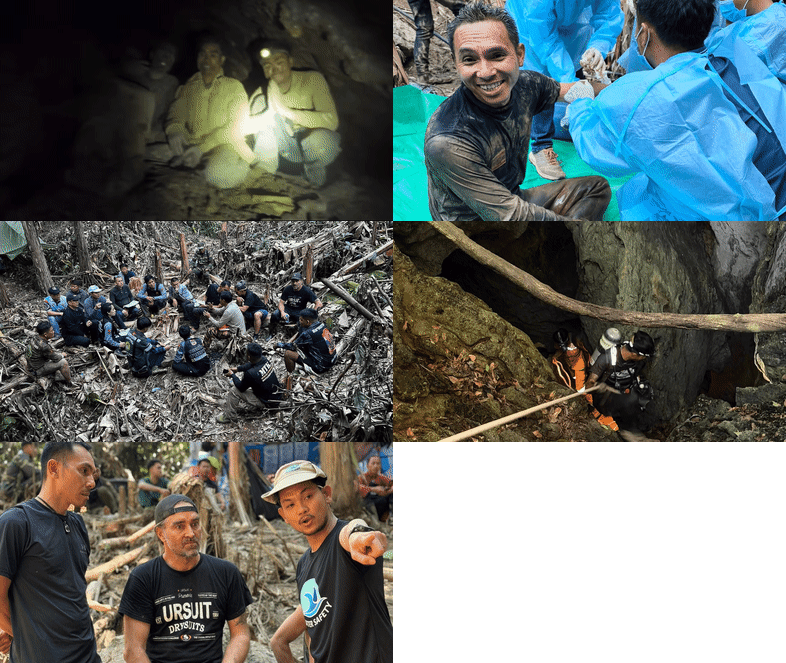
Subterranean search and rescue operations represent some of the most logistically complex, high-risk endeavors in emergency management. The transition from a successful extraction of a known cohort to an open-ended search for missing persons in a cave network exposes critical vulnerabilities in resource allocation, subterranean communication, and environmental risk assessment. When news emerged from Laos regarding the rescue of a stranded group followed immediately by the ongoing hunt for two missing villagers, the narrative centered on human emotion. The operational reality, however, dictates a cold analysis of asymmetric information, geological hazards, and the compounding friction of time.
To understand the systemic challenges of this operation, the incident must be deconstructed through three analytical pillars: the fluid dynamics of cave inundation, the cognitive errors in wilderness navigation, and the operational pivot from fixed-point extraction to wide-area tracking.
The Tri-Component Risk Framework of Cave Rescue
Every subterranean incident operates within a hostile environment where traditional surface rescue tactics fail. The operational environment in the Laos cave system can be categorized by three distinct variables that dictate the probability of success.
P(Success) = f(Hydrogeomorphic State, Resource Velocity, Information Accuracy)
1. Hydrogeomorphic State (The Environmental Constraint)
Laos features extensive karst topography—soluble limestone landscapes characterized by sinkholes, losing streams, and highly unpredictable underground drainage systems. During monsoon or heavy rainfall events, these systems act as literal funnels.
The primary threat is not merely rising water, but the rate of inundation. In a confined limestone conduit, a minor increase in surface rainfall translates to exponential velocity and volume increases underground due to the Venturi effect. This creates a dual hazard:
- Physical Trapping: Rising water levels seal off exit sumps (passages completely filled with water), transforming open air chambers into pressurized pockets.
- Atmospheric Deprivation: As water fills a chamber, it compresses the remaining air. If organic material is present, decomposition quickly depletes oxygen levels while increasing carbon dioxide ($CO_2$) concentrations, creating localized hypoxic zones before total inundation occurs.
2. Resource Velocity (The Logistics Bottleneck)
Subterranean environments reject standard machinery. You cannot deploy drones, heavy earthmovers, or standard satellite communication arrays inside a limestone fissure. Every piece of equipment—diving cylinders, decompression gas mixtures, structural shoring, medical supplies—must be transported via human chain.
The velocity of the resource deployment drops exponentially with every meter of depth and every directional change in the cave profile. A rescue team operating two kilometers inside a complex cave matrix requires a support network of four to five times their number on the surface and in intermediate staging areas just to maintain a continuous supply line.
3. Information Accuracy (The Sump of Asymmetric Data)
The pivot from rescuing the initial group of villagers to searching for the remaining two highlights a critical failure in the initial information architecture. In surface search and rescue, search grids are established based on last known positions (LKP) and statistical probability models. In a cave, spatial geometry is non-linear. A subject may be physically only 50 meters away from a rescue team in a straight line, but separated by hundreds of meters of solid rock or an impassable, flooded siphon.
The lack of reliable subterranean mapping data in rural regions creates a dependency on localized, anecdotal knowledge from villagers. This local data, while valuable, often lacks precise spatial measurements, leading to misallocated search assets.
The Operational Pivot: Extraction vs. Wide-Area Search
The transition from a known-location rescue to an unknown-location search alters the mathematical probability of survival.
+------------------------------------+------------------------------------+
| Fixed-Point Extraction (Initial    | Wide-Area Search (Missing          |
| Group)                             | Villagers)                         |
+------------------------------------+------------------------------------+
| Known LKP (Last Known Position)    | Variable LKP                       |
| Concentrated Resource Allocation   | Dispersed Resource Allocation      |
| Static Risk Profile                | Dynamic, Compounding Risk Profile  |
| Clear Success Criteria             | Ambiguous Disengagement Thresholds |
+------------------------------------+------------------------------------+
When the initial group was extracted, the operational footprint was localized. The team managed a known variable: a specific chamber holding a specific number of individuals. The strategy required stabilizing the environment (pumping water, establishing a guide line) and executing a sequential extraction.
The moment the objective shifted to finding two missing villagers, the operational framework inverted. The search space expanded from a single point to a multi-branching vector network.
The Search Theory Inside a Linear Matrix
Surface searches utilize probability of detection (POD) models across a two-dimensional grid. Subterranean search requires a one-dimensional, branching network model where the probability of detection is binary within any given passage but highly dependent on exploring every sub-branch.
The search strategy must prioritize passages based on two distinct behavioral hypotheses:
- The High-Ground Seeking Hypothesis: Survival instinct drives untrained individuals upward into high-level chambers or dry bypasses to escape rising water. Rescue teams must target upper galleries, even if the access points require technical climbing.
- The Flow-Line Transit Hypothesis: If the individuals were caught in active water flow during the initial inundation, their positions are dictated by fluid dynamics. Search assets must be deployed down-gradient, targeting structural traps, choke points, and sumps where debris naturally accumulates.
This secondary strategy carries a severe risk profile. Deploying divers into unmapped, zero-visibility sumps to search for potential casualties introduces a high probability of responder injury with a low probability of live recovery.
Communication and Telemetry Deficits in Karst Environments
The defining crisis of the Laos cave operation, and similar deep-subterranean missions, is the immediate collapse of the standard electromagnetic communication stack.
High-frequency (HF), very-high-frequency (VHF), and ultra-high-frequency (UHF) radio waves are rapidly attenuated by wet limestone and solid rock. Standard emergency radios cannot penetrate more than a few meters of earth. This creates an information vacuum between the underground advance team and the surface command center.
To bridge this structural gap, operations must deploy specialized alternative technologies, each with distinct operational limitations:
Through-the-Earth (TTE) Communication
TTE systems utilize ultra-low frequency (ULF) or very-low frequency (VLF) magnetic fields to transmit signal pulses through hundreds of meters of solid rock.
- The Mechanism: Large wire loops are deployed on the surface directly above the suspected operational zone, with a corresponding loop carried by the cave team.
- The Limitation: TTE systems offer extremely low bandwidth—often limited to text or low-rate voice data. Furthermore, they require accurate surface-to-cave mapping alignment; if the surface loop is misplaced by even a small margin relative to the underground team's true position, the signal SNR (Signal-to-Noise Ratio) drops below usable thresholds.
Single-Wire Telephone Systems (Michie Phones)
A low-tech, highly reliable fallback involves physical lines paid out by the advancing team.
- The Mechanism: A robust, lightweight two-core wire is laid along the cave floor, connecting hard-wired headsets.
- The Limitation: These lines are highly vulnerable to mechanical failure. Rockfalls, swift water currents, or shifting debris can sever the line instantly, isolating the forward team and forcing a tactical halt to operations until the break can be located and spliced.
The Physiology of Prolonged Subterranean Entrapment
The survival window for the two missing villagers decreases along a non-linear decay curve determined by three physiological factors: hypothermia, dehydration, and atmospheric vitiation.
Hypothermia in Tropical Caves
A common misconception is that tropical caves are warm. While surface temperatures in Laos may be high, deep cave systems maintain a stable temperature equivalent to the annual average temperature of the region, often significantly cooler than the surface. Combined with a relative humidity of near 100% and wet clothing, conductive and evaporative heat loss is continuous.
Once core body temperature drops below 35°C ($95^\circ\text{F}$), cognitive function declines, leading to poor decision-making (such as discarding clothing or entering dangerous water passages voluntarily).
Dehydration vs. Water Contamination
While water is abundant in a flooded cave, it is often heavily contaminated with suspended limestone sediment, agricultural runoff, and organic pathogens. Ingestion of highly turbid water induces acute gastrointestinal distress, accelerating dehydration through vomiting and diarrhea, which rapidly depletes electrolytes and induces hypovolemic shock.
The Hypercapnia Escalation
In unventilated chambers, human respiration alters the atmospheric composition. As oxygen levels decrease below 19.5%, $CO_2$ levels rise. In normal air, $CO_2$ sits at approximately 0.04%. Inside a sealed cave pocket, if $CO_2$ concentration reaches 5%, individuals experience severe headaches, hyperventilation, and confusion. At 10% or higher, unconsciousness and respiratory arrest occur within hours, rendering the subjects incapable of signaling to search teams.
Strategic Resource Allocation: The Disengagement Decision
The hardest phase of any complex search operation is determining the transition from an active rescue to a recovery mission, or ultimately, to total cessation of operations. Management must utilize a objective utility model rather than emotional momentum to guide resource deployment.
Expected Value of Search = (Probability of Life * Value of Life Saved) - (Probability of Responder Casualty * Operational Cost)
As time passes without contact:
- The Probability of Life decays toward zero based on the physiological limits of hypothermia and dehydration.
- The Probability of Responder Casualty increases as continuous exposure to hazardous environments induces physical and mental fatigue, equipment degradation, and exposure to shifting weather patterns that could trap the rescue teams themselves.
When the risk-to-benefit ratio crosses a critical threshold, the command structure must systematically wind down high-risk search vectors.
The immediate strategic priority for the Laos operation must be the deployment of structural hydrologic monitoring equipment at the primary cave entrances and sinkholes up-gradient. Teams should halt deep, unmapped diving operations until a precise structural map of the karst network can be generated via surface ground-penetrating radar or LiDAR mapping of known entrances.
Concurrently, a secondary perimeter of low-risk acoustic monitoring stations should be established at known air-fissures along the ridge line. This approach mitigates responder risk while maintaining passive detection capabilities for any acoustic signaling from the missing individuals, maximizing resource efficiency under extreme environmental constraints.