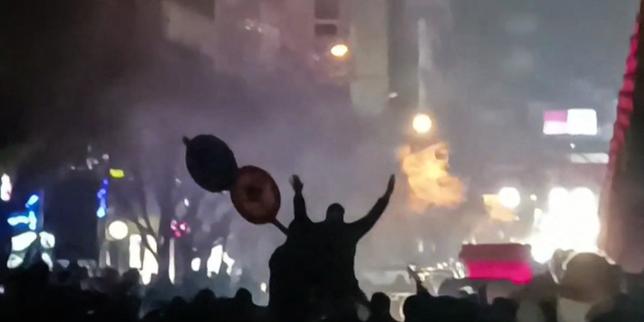
The execution of individuals designated by the Iranian judiciary as local leaders of civil unrest functions not as an isolated act of retributive justice, but as a calibrated instrument of state deterrence. When Iranian state media reports the hanging of a citizen framed as a "ringleader" of protests—such as the demonstrations that destabilized regional centers in January—it signals the deployment of a specific political survival mechanism. This mechanism relies on shifting the risk-reward calculus for potential dissidents from a collective action model to an individualized cost model. Understanding this process requires dismantling the sentimental narratives surrounding state crackdowns and analyzing the precise operational, psychological, and structural frameworks the Iranian regime uses to maintain internal stability.
State survival under acute domestic pressure depends on the management of two distinct variables: the velocity of information and the perceived cost of mobilization. When protests erupt, the state faces a decentralized network of actors. By identifying, prosecuting, and executing specific nodes within this network—the alleged "meneurs" or ringleaders—the judiciary aims to decapitate the organizational structure of local resistance movements while projecting absolute enforcement capability. Discover more on a connected subject: this related article.
The Tripartite Framework of Regime Deterrence
The Iranian apparatus for suppressing dissent operates via three independent yet reinforcing pillars. Each pillar targets a specific phase of public mobilization, moving from preventative structural barriers to definitive physical elimination.
1. Information Asymmetry and Narrative Monopoly
The state utilizes its judiciary and state-controlled media organizations, such as IRNA and Mizan Online, to define the parameters of the unrest post-facto. The individual facing execution is systematically stripped of political agency and reclassified through legal definitions as a security threat or an agent of foreign intelligence. By labeling a local protester a "ringleader," the state achieves two strategic objectives: Additional journalism by Associated Press highlights related views on the subject.
- It reduces complex, systemic economic or social grievances to the malicious actions of a few instigators.
- It justifies the application of capital charges, such as moharebeh (enmity against God) or mfsad-fil-arz (corruption on Earth), which carry mandatory death sentences.
2. Selective Escalation and Targeted Elimination
The judicial execution of a localized protest leader represents a strategy of selective escalation. Mass incarceration carries high administrative and international diplomatic costs, and it risks turning prisons into hubs for deeper radicalization. Targeted execution, conversely, maximizes the psychological impact on a specific demographic while minimizing the physical footprint of state violence. The state selects individuals who possess high hyper-local influence but lack the international profile that would trigger immediate, punitive global sanctions.
3. The Bureaucratization of Terror
The efficacy of the deterrent relies entirely on its institutional formalization. The process is deliberately funneled through the Revolutionary Courts. This bureaucratization signals to the populace that the elimination of dissent is not an erratic, emotional reaction by security forces on the street, but a formalized, inevitable legal output of the state machinery. The certainty of the outcome replaces the chaos of street clashes with a cold, predictable calculus of state power.
The Cost Function of Dissidence
To understand why the state prioritizes the execution of local leaders, one must examine the microeconomics of collective action during civil unrest. A citizen's decision to participate in an anti-government demonstration can be modeled as a balance between the perceived probability of achieving political change and the personal cost of participation.
[Perceived Probability of Success] vs. [Personal Cost of Participation]
In the early stages of protests, high crowd density lowers the individual risk of arrest, creating a safety-in-numbers effect. The state’s counter-strategy focuses on artificially inflating the personal cost variable until it outweighs any perceived probability of success.
Executing an alleged leader alters this equation by introducing an extreme, irreversible penalty. The psychological friction introduced by capital punishment operates on a lag. While immediate street violence by security forces causes immediate dispersion, the formal execution of a protest figure months after the event creates a persistent, low-level anxiety that suppresses future mobilization windows.
This strategy introduces a structural bottleneck for underground opposition movements. Potential leaders must calculate that their involvement carries a high probability of death, which drastically reduces the supply of operational organizers willing to coordinate logistical tasks, such as setting protest routes, managing digital communication channels, or printing physical media.
Operational Limitations of Judicial Violence
While capital punishment serves as an effective short-term deterrent, the strategy contains systemic vulnerabilities that can destabilize the regime over longer operational horizons. The primary risk factor is the creation of a martyred political symbol.
When the judiciary executes a local figure, it attempts to project strength, but it simultaneously risks transforming a living, flawed political actor into an unassailable symbol of resistance. This transformation shifts the opposition's narrative from a material grievance (e.g., fuel prices, systemic inflation) to a moral imperative.
The second limitation is the law of diminishing returns regarding fear. For deterrence to function, the populace must still have something to lose. If economic conditions deteriorate to a point of total structural collapse, or if the application of the death penalty becomes so widespread that ordinary citizens perceive their baseline probability of survival to be low regardless of participation, the deterrent capability of the state degrades. The threat of execution loses its psychological leverage when the target population becomes habituated to extreme state violence.
Regional Variance in Enforcement Metrics
The application of capital punishment in Iran is not uniform; it varies significantly based on geography, ethnicity, and local economic dependency. An analysis of judicial outputs reveals that executions targeting protest leaders are disproportionately concentrated in peripheral provinces.
- Peripheral and Border Provinces: Regions with significant ethnic minority populations, such as Sistan and Baluchestan or Kurdistan, face a higher velocity of capital sentences. The state views unrest in these zones through the lens of territorial integrity and secessionist threats, leading to a much lower threshold for the application of moharebeh.
- Urban Economic Centers: In major metropolitan areas like Tehran or Isfahan, the state frequently relies on prolonged incarceration, financial asset seizure, and social death (banning individuals from public sector employment or travel). This difference exists because the urban middle class responds differently to state pressure, and the international media visibility of these hubs increases the diplomatic costs of executions.
This geographical bifurcation allows the regime to calibrate its level of violence based on the specific threat profile of each region, ensuring that maximum force is applied precisely where the structural integrity of the state is most vulnerable.
Strategic Forecast: The Stabilization Curve
The deployment of executions to suppress the memory and legacy of previous protest waves follows a predictable lifecycle. In the immediate aftermath of unrest, the state prioritizes mass arrests to clear the streets. This is followed by an investigative phase where digital surveillance, forced confessions, and informant networks are leveraged to isolate the organizing nodes.
The execution phase typically occurs six to eighteen months after the initial disruption. This deliberate delay ensures that the executions do not trigger immediate retaliatory riots, instead occurring at a time when public exhaustion has set in.
Based on current operational trajectories, the Iranian state will maintain this baseline frequency of targeted executions to preempt future economic shockwaves. By establishing a rigid precedent of capital retribution for localized leadership, the security apparatus buys the political leadership the time required to navigate international sanctions and internal succession dynamics without facing the immediate threat of coordinated, nationwide regime collapse. The survival of the system depends on keeping the cost of mobilization higher than the population's threshold of endurance. Every execution is a public recalibration of that metric.