The targeted execution of ten individuals, including a minor, in a Mexican town massacre is not an isolated outburst of irrational violence. It is a calculated exercise in territorial signaling and the enforcement of a regional monopoly. Within the context of Mexican organized crime, mass casualty events function as high-volume data points in a broader strategy of "compellence"—the use of force to change a rival's behavior or clear a geographic bottleneck. This incident serves as a diagnostic tool for understanding the shifting friction between dominant federations and localized splinter cells.
The Strategic Utility of Mass Casualty Events
Public-facing violence of this magnitude follows a specific logic of escalation. When a cartel moves into a "plaza" (a strategic transit hub), they face a choice between co-option and elimination. If the local power structure resists, the incoming group utilizes high-visibility massacres to achieve three primary objectives:
- Administrative Paralysis: By overwhelming local law enforcement with a body count they cannot process, the cartel forces a collapse of the local judicial apparatus. This creates a vacuum where the cartel provides the only functional "order."
- Psychological Displacement: The inclusion of non-combatants, such as children, is a deliberate breach of previous "gentleman’s agreements" among older generations of traffickers. It signals a shift toward total war where the cost of neutrality for the local population becomes higher than the cost of collaboration.
- Rival Identification: Massacres force hidden rivals to respond. If a rival group claims the territory but fails to retaliate or protect their "base," their credibility evaporates, leading to a rapid desertion of rank-and-file members to the stronger aggressor.
The Geography of the Corridor
Massacres rarely occur in stagnant territories. They are concentrated in "interstitial zones"—regions where two major cartels share a fluid border. These zones are often characterized by:
- Logistical Redundancy: Areas that offer multiple routes for the movement of synthetic precursors or migrants. If one route is seized by the state, the cartel must hold the surrounding towns to maintain operational continuity.
- Production Proximity: The proximity to clandestine laboratories for fentanyl or methamphetamine production makes every square mile of terrain a high-yield asset.
- Extortion Diversification: As drug interdiction efforts fluctuate, cartels pivot to "sovereign" revenue streams. This includes the taxation of legitimate industries like agriculture (avocados, limes) and mining. A massacre is a "rebranding" of the tax authority.
The Fragmented Command Structure
The modern Mexican security environment is no longer defined by the "Kingpin era." The removal of top-tier leaders via the "Kingpin Strategy" has led to a horizontal fracturing of power. We are currently observing a transition from a duopoly (Sinaloa vs. CJNG) to a "feudal anarchy" model.
This fragmentation creates a feedback loop of violence. Smaller cells, often referred to as células, lack the long-term perspective of a globalized syndicate. They operate on shorter time horizons and higher discount rates. For a small cell, a massacre is a low-cost, high-impact tool to gain immediate notoriety and leverage in negotiations with larger federations.
The Failure of Traditional Deterrence
The persistent recurrence of these massacres highlights a fundamental breakdown in the state's deterrent capability. Deterrence relies on the certainty, celerity, and severity of punishment. In the Mexican context, the certainty of prosecution for homicide remains below 10%.
When the state fails to provide security, the cartels fill the role of a "stationary bandit." This is an economic concept where a group finds it more profitable to provide a degree of order and extract consistent taxes rather than simply looting and moving on. However, during the transition phase—where the bandit is not yet "stationary"—the violence is maximal. The massacre in question represents this transition.
Operational Variables in Post-Massacre Response
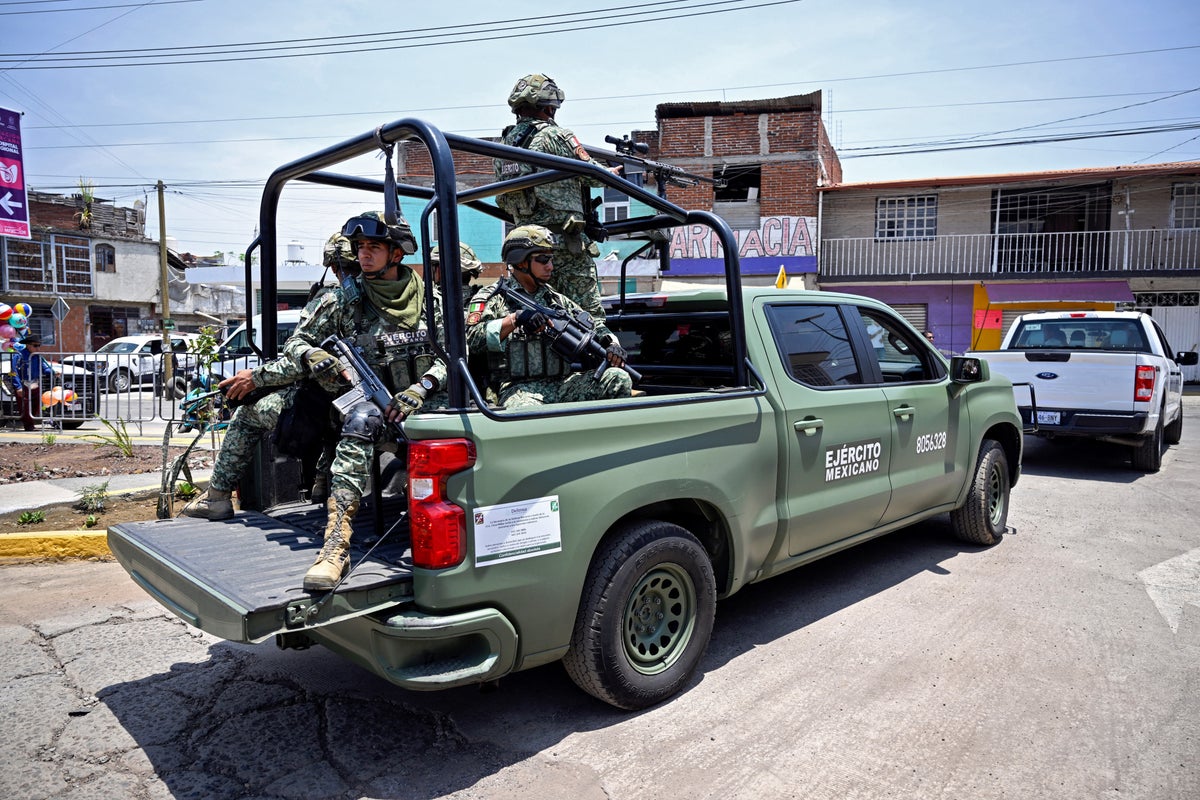
The deployment of federal forces (National Guard or SEDENA) following such an event typically follows a scripted cycle that cartels have learned to exploit.
- Saturation: Federal troops flood the immediate area.
- Dispersal: The gunmen responsible for the massacre retreat to safe houses in neighboring states or melt into the civilian population.
- Attrition by Proxy: The cartels provide anonymous tips to the military about their rivals' locations, using the state as a "clearing house" to eliminate competitors.
- Withdrawal: Once the news cycle fades and federal troops are redeployed to the next crisis point, the original aggressors return to consolidate the territory.
The Role of Non-Combatant Casualties
The death of a child in this massacre is a critical metric. In traditional insurgencies, killing civilians is often counterproductive as it alienates the base. In the current Mexican theater, the "base" is irrelevant. The cartels do not seek hearts and minds; they seek total compliance.
The mechanism at work here is "signaling through atrocity." By killing the most vulnerable, the cartel demonstrates that the state cannot protect anyone. This undermines the social contract at its most fundamental level. If a father cannot protect his child despite the presence of a local police force, he will eventually pay "protection money" to the group that actually wields the power of life and death.
Future Trajectory of Territorial Violence
The data suggests that violence will continue to cluster around three specific variables:
- Port Access Points: Specifically on the Pacific coast, where chemical precursors arrive.
- Inland Transit Hubs: Cities that connect the southern border to the northern export markets.
- Extractive Resource Zones: Areas with high-value agricultural or mineral output.
We should expect an increase in "signature massacres" in states where the dominant cartel is facing an internal schism. The internal instability of a major federation (like the recent internal volatility within the Sinaloa Cartel) creates ripples of violence across every territory they influence. Sub-commanders will use massacres to prove their autonomy or to signal loyalty to a new faction leader.
Strategic Recommendations for Institutional Resilience
To move beyond the cycle of reactive deployment and subsequent withdrawal, the security apparatus must pivot toward a "Network Neutralization" framework. This involves:
- Mapping Financial Chokepoints: The violence is funded by the "taxation" of local economies. Decoupling the cartel from the local business chambers and agricultural unions is more effective than high-speed chases.
- Local Intelligence Autonomy: Strengthening municipal police forces to act as early-warning systems rather than relying on a centralized National Guard that lacks local context.
- Targeting the Middle Management: The most volatile layer of the cartel is the "Lieutenant" class—those responsible for local plazas. Removing the top leader creates a vacuum, but removing the mid-tier manager disrupts the actual execution of violence.
The massacre is the symptom of a structural realignment in the criminal market. Until the cost of such an operation—measured in seized assets and dismantled logistics—outweighs the tactical gain of territorial signaling, the body count will remain a standard tool of the trade. The focus must shift from the "who" of the massacre to the "why" of the territory.