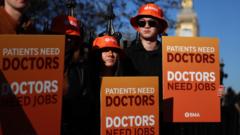
Public health labor disputes are fundamentally driven by structural asymmetries in compensation indexing and operational capacity. The cancellation of a resident doctor strike does not signal a permanent systemic resolution; rather, it represents a temporary equilibrium achieved within a bilateral monopoly bargaining framework. To understand why these disputes occur—and how the resulting settlements alter the long-term fiscal and operational trajectory of healthcare systems—requires decomposing the underlying economic and operational variables.
When resident doctors threaten or execute industrial action, they exploit a specific operational vulnerability: the extreme reliance of secondary and tertiary care facilities on high-volume, low-cost clinical labor. Governments, acting as monopsony or near-monopsony employers in state-funded systems, use their regulatory and budgetary power to suppress labor costs. This collision of operational dependency and fiscal constraint guarantees cyclical unrest unless the structural drivers of dissatisfaction are addressed.
The Economic Architecture of Residency Labor
The labor market for resident doctors operates under a distinct set of constraints that separate it from standard highly skilled labor markets. Understanding this architecture requires analyzing three specific economic pillars.
The Monopsony Premium and Market Distortion
In most national healthcare frameworks, the government or a centralized network of insurance providers acts as the primary purchaser of medical labor. Resident doctors, bound by standardized training pathways and institutional accreditation requirements, cannot easily exit the system or sell their labor to alternative buyers without abandoning their career progression. This gives the employer immense monopsony power, allowing the state to set wages below the marginal revenue product of the labor provided. The gap between the value generated by a resident doctor and their actual compensation functions as an implicit subsidy for the public healthcare budget.
Real vs Nominal Wage Stagnation
Industrial disputes rarely materialize from absolute compensation levels. Instead, they are triggered by the divergence between nominal wage growth and localized cost-of-living metrics. When inflation outpaces general tariff adjustments for medical training contracts over multiple fiscal cycles, residents experience a compounding reduction in real purchasing power. This erosion is exacerbated by the high debt-to-income ratios common among junior medical staff, transforming a macroeconomic trend into an acute personal financial crisis.
The Asymmetry of Opportunity Cost
During training, a resident doctor invests highly specialized human capital that is non-transferable to other industries. The opportunity cost of striking is immediate loss of income and potential delays in qualification. However, the long-term opportunity cost of accepting stagnant wages is higher, as it permanently lowers the baseline for lifetime earnings once specialization is achieved. This calculation shifts the risk tolerance of the workforce, making prolonged industrial action a rational economic choice rather than an emotional reaction.
The Operational Cost Function of System Disruptions
The decision of a government to modify its financial offer depends directly on its calculation of the total cost function of a strike. A strike does not merely pause clinical activity; it introduces immediate and compounding liabilities across the entire healthcare ecosystem.
Total Strike Cost = Direct Reallocation Cost + Delayed Care Penalty + Political Capital Depreciation
The primary variables within this cost function dictate the urgency of the state's response.
Elective Backlog Accumulation
The immediate casualty of a resident doctor strike is elective surgical and diagnostic activity. To maintain basic safety, hospitals reallocate senior consultant staff to cover emergency departments, intensive care units, and acute admission wards. This internal redeployment stops revenue-generating or target-driven elective procedures. The cost is two-fold: immediate financial penalties for missed government targets and a compounding backlog that requires years of premium-rate overtime funding to clear.
The Consultant Overtime Bottleneck
Using senior consultants to perform tasks typically delegated to resident doctors is highly inefficient. Consultants command significantly higher hourly rates, often amplified by emergency or strike-rate premiums. The operational capacity of the hospital shrinks while its labor cost per patient hour increases exponentially. This creates a severe budgetary bleed that quickly eclipses the fiscal savings generated by withholding the salaries of striking residents.
Clinical Risk and Institutional Liability
As staffing ratios degrade during a dispute, the probability of adverse clinical events rises. While emergency coverage is designed to mitigate mortality risks, the cancellation of routine monitoring, outpatient reviews, and chronic disease management creates a secondary wave of acute admissions. The legal and financial liability associated with these systemic failures rests with the institutional operators, creating a strong incentive for executive leadership to pressure central government negotiators for a swift resolution.
Structural Decomposition of the Settlement Framework
The resolution of a strike involves a complex trade-off between immediate cash injections and structural adjustments to the labor contract. A standard government offer designed to avert or end industrial action consists of four distinct components, each targeting a different dimension of the workforce's grievances.
Base Salary Adjustment and Backdated Restitution
The core of any new offer is a percentage increase in the base salary scale. This is usually presented as a headline figure to satisfy union leadership and public perception. To secure an immediate cessation of strike activity, governments frequently combine this with a lump-sum, backdated payment covering the period of negotiation. This injects immediate liquidity into the workforce but creates a permanent structural increase in the healthcare system's baseline recurring expenditure.
Inflation Indexing and Future Safeguards
To prevent a recurrence of industrial action in subsequent financial years, unions demand mechanisms that peg future salary increments to independent measures of inflation, such as the Consumer Price Index (CPI). Governments generally resist rigid indexing because it removes fiscal flexibility during economic downturns. Settlement agreements often compromise on conditional indexing clauses, where future raises are tied to productivity metrics or specific macroeconomic thresholds.
Working Hour Caps and Non-Financial Compensation
Because financial compensation is constrained by national budgetary limits, negotiators frequently use non-financial levers to close the gap between union demands and state offers. These structural adjustments include:
- Reductions in the maximum allowable consecutive hours per shift.
- Mandatory minimum rest periods between night rotations.
- The conversion of uncompensated administrative tasks into protected training time.
- Direct subsidies for mandatory licensing exams and professional indemnity insurance.
Retention and Geographic Premiums
Healthcare systems often suffer from asymmetric staffing shortages, where specific specialties (e.g., emergency medicine, general practice) or remote geographic regions struggle to retain talent. A sophisticated government offer introduces targeted retention premiums rather than a flat, across-the-board raise. This allows the state to allocate its financial capital to areas of maximum operational vulnerability while minimizing the total fiscal impact of the settlement.
Strategic Failure Modes of Short-Term Settlements
While a cancelled strike provides immediate operational relief, poorly structured settlements introduce long-term distortions into the healthcare labor market. Executive leadership must anticipate these secondary effects.
The Compression of Wage Differentials
When a government offers substantial wage increases exclusively to resident doctors to resolve an acute crisis, it inadvertently compresses the wage differential between residents and senior clinicians or nursing staff. This wage compression destroys the financial incentive for residents to take on the increased responsibility of senior leadership roles later in their careers. It also triggers secondary industrial action from other healthcare unions, who demand parity to maintain historical pay relativities.
The Productivity Deferral Trap
Governments often fund wage increases by demanding vague productivity improvements from the medical workforce, such as increased adoption of digital triage systems or extended weekend working hours. If these productivity gains are not rigidly defined and legally enforceable within the contract, the healthcare system experiences the full weight of the increased labor cost without any offsetting expansion in patient throughput. This results in a net decrease in the fiscal efficiency of the healthcare delivery model.
Strategic Recommendation and Forecast
The cancellation of this strike represents a temporary truce, not a permanent structural fix. Over the next twenty-four months, inflation and increasing patient demand will stress the financial boundaries established by this new agreement. Healthcare organizations cannot rely on cyclical emergency government funding to manage their labor lines.
The definitive strategic requirement for hospital networks and regional health boards is to aggressively decouple their operational capacity from a total reliance on resident medical labor. This requires an immediate shift toward an advanced clinical practitioner model. By expanding the scope of practice for specialized nurses, physician associates, and clinical pharmacists, institutions can build a more resilient staffing matrix.
This diversification accomplishes two things: it reduces the operational leverage held by any single labor union during future disputes, and it optimizes the delivery of routine care by matching clinical tasks with the appropriate, cost-effective level of professional training. Organizations that fail to diversify their clinical workforce during this period of stability will find themselves highly vulnerable when the current settlement inevitably degrades under future economic pressures.