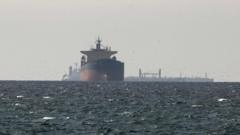
The United States military intervention against Iranian-backed assets following attacks on commercial cargo vessels represents a calculated shift from passive defensive escorting to active threat degradation. In maritime logistics, the security of choke points determines the global equilibrium of supply chains. When state or proxy actors utilize low-cost asymmetric warfare—such as uncrewed aerial vehicles (UAVs) and anti-ship cruise missiles (ASCMs)—to disrupt high-value commercial shipping, the economic friction extends far beyond the immediate target. The strategic objective of US kinetic strikes is not merely retaliatory; it is a forced recalibration of the risk-reward calculus for adversaries operating within critical sea lines of communication.
Evaluating these military actions requires bypassing political rhetoric and focusing strictly on the operational and economic variables at play. The confrontation can be deconstructed into three core pillars: target asymmetry, the cost-imbalance of maritime defense, and the strategic doctrine of proportional degradation.
The Triad of Maritime Disruption
To understand the necessity of US kinetic intervention, one must first isolate the variables that make commercial shipping vulnerable to asymmetric state-sponsored actors.
1. The Geographic Bottleneck Factor
Global trade relies on specific maritime choke points. When an attack occurs within or near these channels, it forces commercial fleets to choose between two high-cost alternatives: enduring inflated war-risk insurance premiums while risking asset loss, or rerouting vessels around longer macro-routes (such as the Cape of Good Hope). The rerouting option immediately injects structural inefficiency into global supply chains, extending transit times by 10 to 14 days, reducing global container capacity, and compounding fuel expenditure.
2. Payload Asymmetry
Adversaries leverage a steep cost-to-damage ratio. A loitering munition costing less than $50,000 can critically disable or sink a commercial vessel valued at upwards of $100 million, carrying cargo worth hundreds of millions more. This economic inversion means non-state actors or regional powers can achieve strategic denial capabilities without possessing a conventional blue-water navy.
3. The Defensive Depletion Rate
Prior to the decision to conduct direct strikes, naval forces relied heavily on area-defense interceptors. Firing a $2 million surface-to-air missile to neutralize a $20,000 drone is an unsustainable cost function. The secondary constraint is magazine depth; naval vessels have a finite number of vertical launching system (VLS) cells available before they must return to a secure port to reload. Prolonged defensive posturing risks depleting interceptor stockpiles against low-tier threats, leaving carrier strike groups vulnerable to saturation attacks.
The Cost Function of Persistent Interdiction
The transition from a purely defensive posture to offensive kinetic strikes alters the operational calculus. A defensive strategy cedes the initiative to the attacker, allowing them to choose the time, place, and scale of the engagement. By executing targeted strikes against the infrastructure enabling these maritime attacks—specifically radar installations, coastal missile sites, UAV launch facilities, and forward ammunition depots—the US military aims to alter the adversary's cost function.
                  [Adversary Launch Infrastructure]
                     /                         \
                    /                           \
         (Defensive Posture)             (Kinetic Intervention)
                  /                               \
                 v                                 v
    [Passive Interception at Sea]       [Direct Depot Degradation]
         - High VLS depletion                - Eliminates supply at source
         - Adversary retains initiative      - Forces structural re-supply cost
         - Economic friction on trade        - Restores defensive equilibrium
This intervention is governed by a strict degradation model. The efficacy of the strikes is measured not by short-term political concessions, but by the measurable reduction in the adversary's operational tempo.
The first mechanism of this degradation is the destruction of command-and-control (C2) nodes. Asymmetric maritime strikes require real-time intelligence, surveillance, and reconnaissance (ISR) to track moving cargo ships across vast waters. By systematically eliminating shore-based radar networks and intelligence-gathering vessels, the US military blindfolds the adversary, reducing their targeting efficiency from precision tracking to blind, uncoordinated launches.
The second mechanism centers on supply chain interdiction. The components for advanced ASCMs and loitering munitions frequently rely on external state sponsorship, smuggled via clandestine maritime routes. Kinetic strikes targeting transshipment hubs and storage warehouses create an immediate hardware bottleneck. While the adversary may possess the intent to strike commercial shipping, their physical capacity to sustain a high-volume launch cadence is structurally compromised.
Structural Limitations of Kinetic Deterrence
While direct military intervention lowers the immediate operational capacity of an adversary, it possesses distinct strategic limitations that prevent it from being a permanent resolution.
- The Decentralization of Assets: Asymmetric forces rarely utilize centralized military bases. Launch platforms for UAVs and mobile anti-ship missiles can be retrofitted onto standard commercial trucks or hidden within rugged terrain, making complete elimination via air strikes structurally impossible.
- The Regeneration Cycle: So long as the primary state sponsor remains willing and able to re-supply the proxy force via covert land or sea routes, the degradation achieved by kinetic strikes remains temporary. The intervention buys time and space for commercial shipping but does not inherently neutralize the underlying geopolitical motivation.
- The Escalation Ladder: Every direct strike carries the latent risk of horizontal escalation. If an intervention results in significant casualties or strikes high-value assets belonging directly to the state sponsor rather than the proxy, it may trigger a wider regional conflict that could completely close the maritime passage in question, achieving the exact opposite of the initial freedom-of-navigation objective.
The Strategic Shift to Proportional Degradation
The current US operational doctrine has adapted to these limitations by adopting a framework of proportional degradation. Rather than attempting an unrealistic total eradication of the adversary's arsenal, the military applies calibrated kinetic pressure to maintain a manageable threshold of risk for commercial maritime traffic.
This strategy hinges on making the execution of maritime attacks increasingly expensive for the adversary's internal infrastructure. When the cost of launching a missile includes the guaranteed loss of a scarce radar system or a critical command bunker, the internal political and military pressure within the adversary's command structure shifts toward conservation rather than expenditure.
This framework relies on high-fidelity battle damage assessments (BDA). Satellite imagery and signals intelligence must continuously verify that the struck assets were critical links in the kill chain. If strikes merely hit empty launch sites or low-value decoys, the deterrence model fails, and the adversary retains the upper hand in the economic war of attrition.
The Long-Term Operational Playbook
To secure critical sea lanes permanently, naval strategy must evolve beyond sporadic kinetic interventions into a continuous, multi-domain containment framework. Naval commanders must integrate localized strikes with aggressive maritime interdiction operations (MIO) to intercept weapon components before they reach the launch theater. Simultaneously, the deployment of directed-energy weapons and high-capacity, low-cost electronic warfare systems must be accelerated across both military and commercial fleets to break the defensive cost-imbalance permanently. The ultimate objective is to transform the maritime environment into an unprofitable theater for asymmetric disruption, ensuring that the cost of interference consistently outweighs any perceived geopolitical leverage.