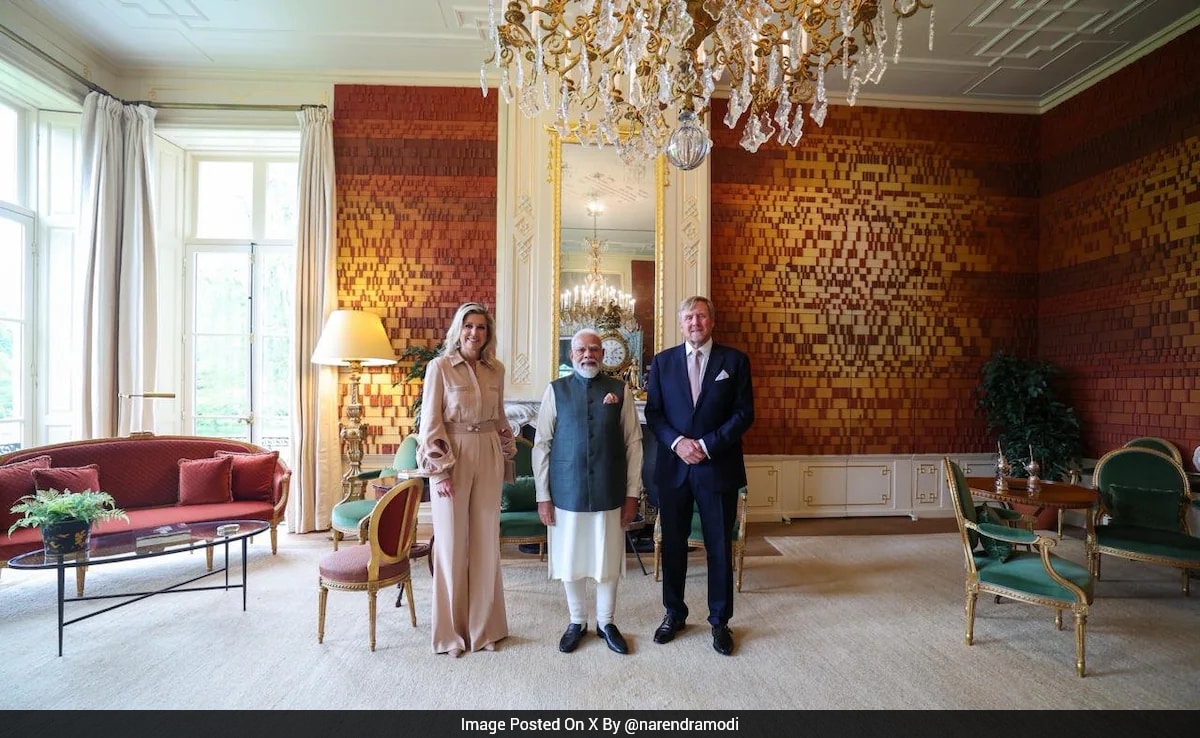
The diplomatic engagement between Indian Prime Minister Narendra Modi and the Dutch Royal Family, led by King Willem-Alexander and Queen Máxima, represents a calculated realignment of supply chain architecture rather than a standard bilateral courtesy. While conventional media covers these meetings through the lens of political optics, an analytical breakdown reveals a structural convergence focused on mitigating specific vulnerabilities in global technology and maritime trade.
The relationship operates across three distinct operational pillars: technology sovereignty, infrastructure logistics, and sustainable resource management. By decoupling these pillars, we can map the exact economic incentives and structural bottlenecks driving the Indo-Dutch corridor.
The Silicon Axis Trade Asymmetry and Photolithography Interdependence
The primary economic driver behind current Indo-Dutch relations is the asymmetric interdependence in the semiconductor manufacturing stack. India represents one of the fastest-growing design and consumption markets for electronics, yet it lacks domestic fabrication capabilities. Conversely, the Netherlands holds a near-monopoly on the critical infrastructure required to manufacture advanced microchips.
The Lithography Bottleneck
Advanced semiconductor manufacturing relies entirely on Extreme Ultraviolet (EUV) and Deep Ultraviolet (DUV) photolithography systems. Because Dutch firms control the upstream equipment market, any nation seeking to establish semiconductor sovereignty—such as India through its India Semiconductor Mission (ISM)—must secure long-term, predictable access to Dutch supply chains.
This creates a specific bilateral transaction matrix:
- India's Capital and Market Asset: India provides an massive engineering talent pool and a domestic market projected to reach hundreds of billions of dollars in electronics consumption. It offers capital subsidies of up to 50% for fabrication plant setup.
- The Dutch Technology Asset: The Netherlands provides the precision machinery, optical systems, and chemical integration expertise required to make these fabrication plants viable.
The operational bottleneck is not capital; it is the transfer of specialized tacit knowledge and tool allocation. Without deep integration with Dutch equipment manufacturers, India’s domestic fabrication facilities run the risk of becoming technologically obsolete before they reach full production capacity.
Maritime Geopolitics and Port Optimization
Beyond hardware, the geopolitical alignment is dictated by the efficiency of maritime trade lanes. The Netherlands houses the Port of Rotterdam, the largest logistical gateway to Europe, while India controls critical oceanic checkpoints in the Indian Ocean Region (IOR).
The Gateway Interface Model
The commercial relationship relies on a two-node transit model. The Port of Rotterdam serves as the entry point for Indian manufactured goods, apparel, and chemical exports entering Western Europe. Simultaneously, Indian ports like Jawaharlal Nehru Port Authority (JNPA) and the developing deep-water transshipment ports in the south act as the primary distribution nodes for European machinery and agricultural tech entering South Asia.
Optimizing this corridor requires addressing structural inefficiencies in port turnaround times and digital customs clearance. The application of Dutch maritime logistics software and automated terminal management systems within Indian ports is the mechanism used to lower the total cost of freight. This structural upgrade directly reduces transit times, making Indian exports more cost-competitive in the European market.
Resource Management and Agritech Integration
The third structural pillar covers water management and agricultural optimization. The Netherlands faces existential geographic pressures regarding water management, leading to the development of advanced circular water systems and high-yield, low-land agriculture. India faces the opposite problem: severe water stress combined with inefficient, resource-heavy agricultural practices that deplete groundwater tables.
The Circular Water Efficiency Function
The collaboration in this sector centers on transferring localized water-recycling mechanisms to industrial clusters in India. By deploying Dutch technologies in industrial wastewater treatment, Indian manufacturing hubs can reduce their freshwater footprint.
In agriculture, the integration focuses on controlled-environment agriculture (CEA) and automated irrigation. The objective is to shift Indian farming from a system dependent on unpredictable monsoon cycles to one governed by data-driven resource allocation. This transition is critical for India to maintain food security while scaling its industrial manufacturing footprint, which naturally competes with agriculture for water and land resources.
Structural Constraints and Strategic Risks
A rigorous analysis must account for the friction points that threaten this bilateral architecture. No economic strategy functions without operational headwinds, and the Indo-Dutch corridor faces two primary systemic risks.
Regulatory Disalignment
The European Union’s regulatory frameworks, particularly regarding the Carbon Border Adjustment Mechanism (CBAM) and strict data privacy laws (GDPR), create compliance friction for Indian exporters. If Indian manufacturing processes fail to meet European environmental baselines, the economic viability of the trade corridor degrades, regardless of political goodwill.
Intellectual Property and Technology Transfer Barriers
Dutch technology companies operate under strict export control regimes, often influenced by broader Western geopolitical strategies. This limits the depth of technology transfer available to India. The risk is that India remains a consumer of Dutch machinery rather than a co-developer, leaving its technology sector dependent on external licensing agreements.
Strategic Recommendation
To maximize the ROI of this bilateral alignment, Indian policy must pivot away from generic trade agreements and focus on establishing joint institutional frameworks. The priority must be the creation of dedicated Indo-Dutch technology parks within India's special economic zones (SEZs). These zones should be co-managed by Dutch technical experts and backed by harmonized regulatory standards that bypass standard bureaucratic delays.
By anchoring Dutch photolithography servicing hubs and maritime logistics firms directly inside Indian jurisdiction, both nations secure their respective ends of the value chain. This transforms a standard diplomatic relationship into an interdependent economic defense mechanism.