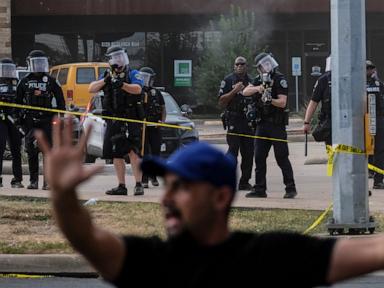
The operational friction points between municipal jurisdiction and federal immigration enforcement mechanisms often manifest as volatile street-level encounters. When a federal operation intersects with local municipal resistance, the resulting vector of escalation follows a predictable sequence of operational choices, legal friction points, and systemic consequences.
The mechanics of the incident involving an Immigration and Customs Enforcement agent and a Venezuelan national, Wilber Rafael Garces Perez, in Austin, Texas, offer a clear framework for analyzing how targeted vehicle stops degrade into use-of-force scenarios. Deconstructing this event requires examining the structural dynamics of targeted enforcement operations, the legal architecture governing federal police powers versus local municipal policy, and the operational bottlenecks inherent in high-stakes tactical apprehensions.
The Operational Anatomy of a Targeted Vehicle Stop
Immigration enforcement actions executed outside of secure detention or institutional facilities typically rely on two operational models: broad sweeps or targeted apprehensions based on specific intelligence, prior removal orders, or administrative warrants. In the Austin incident, the operation took the form of a targeted vehicle stop.
A targeted vehicle stop introduces distinct tactical variables that dictate the speed and trajectory of the encounter:
- Information Asymmetry: The enforcement target is often stationary or operating a motor vehicle, creating an immediate physical barrier between the operative and the subject. This dynamic compresses the timeline for threat assessment.
- Mobility Vectors: A vehicle functions simultaneously as a transit mechanism and a potential kinetic weapon. When a subject attempts to evade a stop by driving away or initiating a brief pursuit, the operational calculus shifts immediately from administrative apprehension to dynamic suspect interdiction.
- Environmental Constraints: Executing stops on public thoroughfares introduces civilian bystanders, moving traffic, and unpredictable spatial configurations that complicate containment protocols.
When the subject in Austin allegedly attempted to evade apprehension following the initial stop, the operational protocol transitioned into an active pursuit phase. The friction point between compliance and evasion creates a high-entropy environment where split-second tactical decisions govern outcomes.
The Legal and Jurisdictional Friction Matrix
The aftermath of an enforcement action involving the discharge of a firearm by a federal agent exposes a complex jurisdictional matrix. Federal law enforcement officers operate under federal statutes, agency-specific use-of-force policies, and constitutional boundaries defined by federal jurisprudence. However, these operations occur within municipal boundaries governed by local law enforcement agencies and political leadership that may hold conflicting policy stances.
The jurisdictional interplay is defined by structural vectors:
- Investigative Primacy: Following an officer-involved shooting involving a federal agent, primary investigative authority typically falls to federal entities such as Homeland Security Investigations (HSI) and the Federal Bureau of Investigation (FBI), rather than the local municipal police department. This separation often creates acute friction with local officials and mayors who demand independent municipal oversight to maintain community trust.
- Criminal Charging Mechanisms: When an individual is wounded during an apprehension and subsequently charged with assaulting or resisting a federal officer under federal statutes, the legal battlefield shifts from immigration administrative law to federal criminal prosecution. The dual status of the individual—facing an active deportation order while simultaneously defending against felony criminal charges—creates a complex procedural holding pattern.
- Sanctuary and Non-Cooperation Policy Collisions: Municipalities like Austin operate within political environments that formally discourage local law enforcement cooperation with federal immigration authorities. When federal agencies operate unilaterally without local synchronization, the lack of localized intelligence sharing increases reliance on reactive, street-level tracking rather than controlled, institutional handoffs.
The Cost Function of Opaque Enforcement Tactics
A central point of contention in high-profile federal enforcement actions is the availability and transparency of evidentiary data, specifically body-worn camera (BWC) footage. Reports indicating an absence of ICE body camera footage for the Austin encounter highlight a structural vulnerability in accountability mechanisms.
Without direct visual telemetry from the perspective of the operative, reconstructing the precise timeline of escalation relies on conflicting witness accounts, post-incident forensic evidence, and official agency declarations. This evidentiary vacuum imposes distinct systemic costs:
- Erosion of Institutional Credibility: When rapid, transparent verification is impossible due to missing or restricted documentation, public skepticism rises. This forces municipal authorities and federal agencies into a reactive messaging cycle.
- Information Polarization: The absence of primary source data allows partisan narratives to fill the vacuum, transforming a tactical operational failure into a broader proxy conflict over federal immigration policy.
- Litigation and Defense Bottlenecks: Legal counsel for defendants facing charges of assaulting federal officers are structurally disadvantaged when key visual evidence of the initial physical struggle is absent, shifting the burden entirely to forensic reconstructions and testimonial evidence.
Systemic Outcomes and the Enforcement Horizon
The enforcement trajectory in urban centers like Austin demonstrates that increased federal enforcement density directly correlates with heightened political friction and operational risk. As federal agencies execute removal priorities against individuals with final orders of removal who lack active legal protections, the probability of kinetic resistance increases proportionally.
The systemic reality is that standard operating procedures for mobile apprehensions lack the institutional insulation of controlled facility transfers. Every vehicle stop involving individuals facing imminent deportation carries an inherent potential for rapid tactical escalation. Without standardized body-worn camera mandates across all federal immigration enforcement units and structured protocols for local coordination, these encounters will continue to trigger immediate jurisdictional clashes, political polarization, and high-stakes criminal proceedings.
Future operational stability depends on whether federal agencies adjust their tactical visibility to match municipal demands for transparency, or whether the current model of unilateral, high-friction urban enforcement remains the baseline for federal immigration strategy.


