The traditional model of emergency management in the United States assumes that extreme environmental hazards occur as isolated, localized events with linear recovery phases. This assumption has been invalidated by the emergence of compound climate events—the concurrent or closely sequenced occurrence of multiple distinct hazards. In mid-2026, the simultaneous convergence of dangerous wildfire smoke in the Midwest, sustained extreme heat along the East Coast, and catastrophic flash flooding in Texas has exposed a critical structural vulnerability. The threat is not merely meteorological; it is operational. The intersection of these multi-hazard events with deep, systematic reductions in federal disaster funding, meteorological staffing, and emergency response infrastructure has created an unprecedented vulnerability gap.
Understanding this vulnerability requires a rigorous examination of how compound physical hazards interact with depleted institutional capacities. When federal safety nets recede, the administrative and fiscal burdens do not disappear; they cascade downward, overwhelming municipal governments that lack the structural capacity to absorb them. Recently making waves in related news: When the Sky Falls on Ordinary Streets.
The Operational Mechanics of Compound Events
A compound climate event creates a non-linear demand on emergency infrastructure. To quantify this stress, we must look beyond individual hazard baselines and evaluate the operational friction generated when protective actions contradict one another.
Let $H_1, H_2, \dots, H_n$ represent distinct environmental hazards occurring within a shared geographic or temporal window. Under historical risk-planning models, the joint probability of these events was treated as the product of independent marginal probabilities. Modern meteorological feedback loops have decoupled from these historical baselines. The joint probability of concurrent extreme heat ($H_1$) and high particulate matter from wildfire smoke ($H_2$) is represented as: More details into this topic are detailed by The Washington Post.
$$P(H_1 \cap H_2) \gg P(H_1)P(H_2)$$
This statistical coupling translates directly into operational paralysis at the local level. When extreme heatwaves and toxic wildfire smoke blanket a metropolitan area simultaneously, standard public health interventions actively undermine one another:
- Ventilation vs. Filtration: Standard municipal heat mitigation relies on public cooling centers and urging citizens to open windows or utilize simple evaporative cooling. However, heavy wildfire smoke requires sealing buildings and running high-efficiency particulate air (HEPA) filtration systems.
- Active vs. Passive Cooling: Municipalities frequently utilize public parks, splash pads, and outdoor recreational areas to mitigate heat stress for vulnerable, non-air-conditioned populations. If the Air Quality Index (AQI) exceeds hazardous thresholds, directing populations outdoors to escape indoor heat exposes them to severe respiratory damage.
- First Responder Degradation: The presence of particulate air pollution during extreme heat conditions accelerates heat exhaustion in emergency personnel. Response times lengthen as teams require more frequent rotation and medical monitoring, creating an operational bottleneck during peak demand.
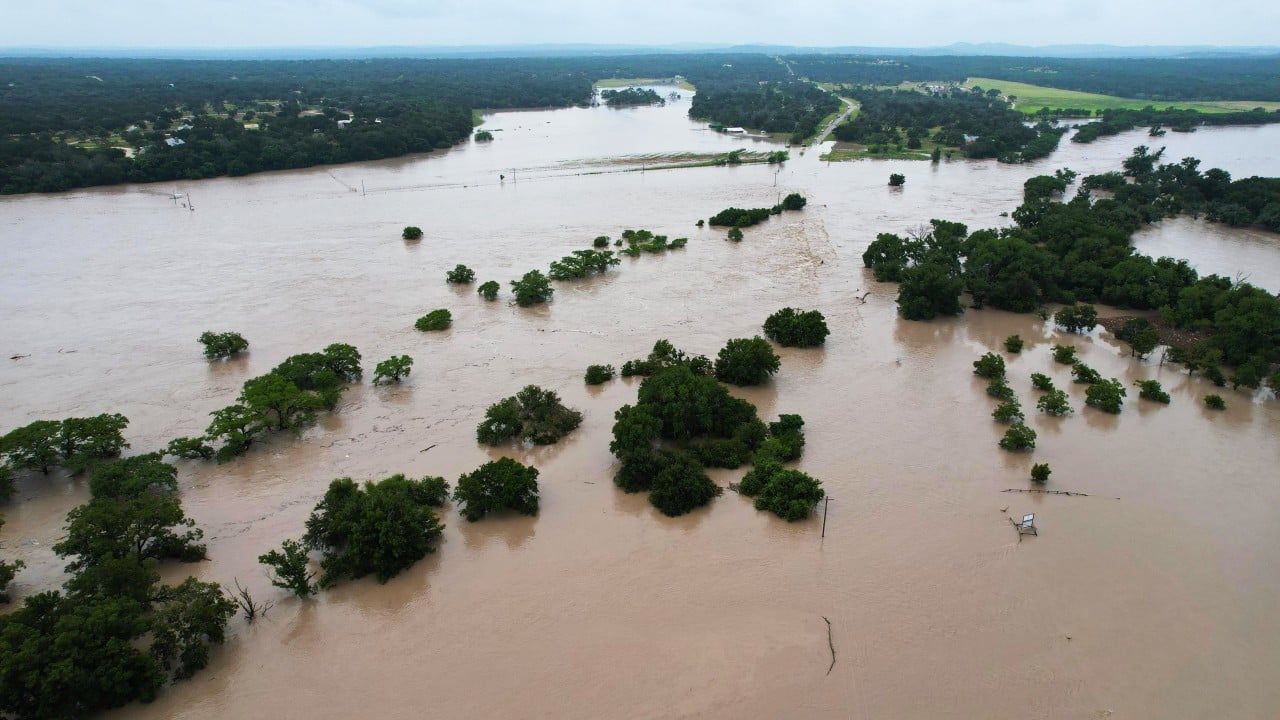
When a secondary disaster hits a region before it has recovered from a primary shock, the compounding effect is economic. In central Texas, recurrent flash floods along the Guadalupe River have struck communities still actively rebuilding from prior catastrophic inundations. This zero-interval recovery cycle prevents the replenishment of municipal rainy-day funds, exhausts local volunteer networks, and leaves physical infrastructure—such as weakened dams and saturated soil—highly vulnerable to subsequent failure.
The Defunding Framework: Deconstructing the Federal Retreat
The compounding severity of these physical hazards coincides with a deliberate institutional retrenchment at the federal level. Recent policy shifts under the Trump administration have systematically reduced the capacity of the three core pillars of the domestic safety net: the National Weather Service (NWS), the National Oceanic and Atmospheric Administration (NOAA), and the Federal Emergency Management Agency (FEMA).
This institutional deconstruction operates across three distinct vectors: human capital attrition, instrumentation degradation, and capital allocation restrictions.
+-----------------------------------------------------------------------+
|                       FEDERAL RETRENCHMENT VECTORS                    |
+-----------------------------------------------------------------------+
                                    |
       +----------------------------+----------------------------+
       |                            |                            |
       v                            v                            v
[Human Capital Attrition]     [Instrumentation Decay]     [Capital Restrictions]
 - 600+ NWS departures         - Ocean sensor removal      - $885M withheld
 - Key leadership vacancies    - Balloon launch halts      - BRIC program ended
 - Staffing "loyalty tests"    - $250M modeling cuts       - Aid requests denied
1. Human Capital Attrition
Following extensive personnel buyouts and targeted staff reductions led by the Department of Government Efficiency (DOGE), the National Weather Service lost approximately 600 specialized personnel through forced departures or resignations. During the catastrophic Texas floods, critical local NWS offices were missing vital personnel, including senior hydrologists, meteorologists-in-charge, and warning coordination meteorologists.
Without this localized expertise, offices must redirect remaining staff from long-range predictive analysis to immediate emergency warning operations. This labor shift introduces a dangerous latency in localized forecasting. The introduction of mandatory "loyalty tests" for new meteorologist applicants has further constrained the recruitment pipeline, leaving critical roles vacant during peak hurricane and wildfire seasons.
2. Instrumentation and Early Warning Deterioration
The "Big Beautiful Bill" legislative package reduced NOAA’s budget by hundreds of millions of dollars:
- $200 million was cut from weather forecasting and public alert programs.
- $150 million was stripped from advanced weather observation systems and modeling.
- $50 million in climate system study grants was eliminated.
The tangible impact of these budget cuts is the literal dismantling of the physical observation network. The administration initiated a 15-month descoping of the Ocean Observatories Initiative, removing more than 900 marine instruments and in-water arrays from four of its five primary global research sites. This removal of deep-sea sensors is projected to cause a 163% increase in measurement error for annual ocean heating rates, crippling the nation's primary early-warning system for rapid marine warming and subsequent hurricane intensification.
On land, the elimination of weather balloon launches in key regions—including Alaska—directly degrades the initialization data used by global numerical weather prediction models, introducing wider margins of error for storm track and precipitation forecasting across the continental United States.
3. Capital Allocation and Disaster Declaration Policy
At the operational level, FEMA has faced both direct funding clawbacks and a structural shift in how disaster declarations are approved. The administration unilaterally withheld more than $885 million in enacted congressional funding, targeting the Next Generation Warning System and critical local support programs. Simultaneously, the administration ended the Building Resilient Infrastructure and Communities (BRIC) program, which previously served as the primary federal vehicle for funding local pre-disaster mitigation and infrastructure resilience projects.
Beyond these budget cuts, there is a fundamental policy shift toward denying major disaster declarations. FEMA has recently rejected state requests for federal disaster aid following destructive tornadoes in Arkansas, severe flooding in West Virginia, and windstorms in Washington. By raising the threshold for what constitutes a federal disaster, the administration is forcing states and municipalities to bear the full financial weight of recovery.
The Localized Fiscal Burden Transfer
When federal disaster aid is denied or delayed, the economic cost does not dissipate; it is forced onto municipal balance sheets. This dynamic represents a direct structural cost shift.
To model the fiscal impact on a municipality, let the vulnerability index $V$ of a local government be defined by the ratio of localized hazard demand to total available response capacity:
$$V = \sum_{i=1}^{n} P(H_i) \cdot \frac{D(H_i)}{R_{local} + \alpha R_{fed}}$$
Where:
- $P(H_i)$ is the probability of hazard $i$.
- $D(H_i)$ is the localized damage and response cost demanded by hazard $i$.
- $R_{local}$ is the independent fiscal and operational capacity of the municipality.
- $R_{fed}$ is the potential federal disaster relief allocation.
- $\alpha \in [0, 1]$ represents the federal accessibility coefficient.
Under previous administrative regimes, $\alpha$ approached $1.0$ for qualifying events, meaning federal resources absorbed up to 75% or more of public recovery costs. As the current administration systematically denies declarations and clawbacks pre-disaster mitigation capital, $\alpha$ approaches $0$.
Because municipal governments cannot print currency and are often legally bound to maintain balanced budgets, they must absorb the deficit through highly disruptive fiscal mechanisms:
                  [FEDERAL AID DENIAL (α → 0)]
                               |
                               v
               [MUNICIPAL FISCAL REBALANCING]
                               |
         +---------------------+---------------------+
         |                                           |
         v                                           v
[Reserve Depletion]                      [Capital Project Deferral]
 - Exhaustion of rainy-day funds          - Delayed stormwater upgrades
 - Credit rating downgrades               - Deferred grid hardening
 - Increased borrowing costs              - Multiplied future vulnerability
- Reserve Depletion: Smaller municipalities, such as Issaquah, Washington, have seen municipal reserves severely depleted after absorbing millions of dollars in uncompensated storm cleanup costs. This depletion of emergency capital leaves them highly exposed to subsequent minor shocks.
- Capital Project Deferral: To balance immediate emergency response expenditures, local governments are forced to defer long-term capital improvement programs. This typically results in delaying critical infrastructure maintenance, such as upgrading stormwater drainage systems, hardening municipal grids, or elevating coastal roadways. Deferring these projects mathematically increases the damage coefficient $D(H_i)$ for future hazards, creating a compounding feedback loop of increasing structural vulnerability.
- The Municipal Credit Spiral: As local reserves dwindle and infrastructure vulnerabilities rise, rating agencies downgrade municipal debt. This raises the cost of borrowing for the municipality, making it even more expensive to fund resilience projects in the future.
Strategic Countermeasures for Municipal Resiliency
In an era of federal retrenchment, local and state leaders cannot rely on historical assistance models. Survival requires a fundamental shift from reactive emergency management to proactive, decoupled resilience strategies.
Decentralized Warning Networks
Municipalities must build redundant, local sensor and communication networks to offset the degradation of NWS and NOAA forecasting. This includes investing in municipal-grade weather stations, localized soil-moisture sensors, and independent flood-gaging networks. By utilizing low-cost Internet of Things (IoT) sensors, local governments can establish high-density observation networks that provide real-time telemetry directly to municipal emergency operations centers, bypassing the data gaps left by understaffed federal offices.
Parametric Insurance and Catastrophe Bonds
To resolve the volatility of federal disaster declarations, state and local governments must look to alternative risk-transfer mechanisms. Unlike traditional indemnity insurance—which requires lengthy damage assessments—parametric insurance payouts are triggered automatically when a pre-defined physical threshold is crossed (such as a specific wind speed, rainfall volume, or flood stage).
By issuing municipal catastrophe bonds or entering into regional parametric insurance pools, local governments can guarantee immediate liquidity within 72 hours of an event, bypassing federal bureaucracy entirely.
Multi-Hazard Mutual Aid Agreements
Because compound events deplete local first responder capacity, municipalities must establish formal, cross-border resource sharing pacts. These agreements should move beyond simple municipal fire and police sharing to encompass specialized assets: public health air-filtration teams, emergency hydrologists, and backup power generation fleets.
These resource pools must be legally structured to allow rapid deployment without waiting for a state or federal emergency declaration to clear.
The era of predictable, federally subsidized disaster recovery has ended. Municipalities that continue to model their emergency protocols on single-hazard baselines and reliable federal bailouts face inevitable fiscal and operational failure. Real resilience now depends on local fiscal independence, decentralized warning networks, and proactive, multi-hazard risk mitigation.
To better understand how these overlapping weather systems impact local communities in real-time, review this national broadcast detailing the simultaneous impact of floods, smoke, and heat across the United States. This coverage provides direct visual context to the operational friction that emergency managers face when coordinating responses to compound disasters.