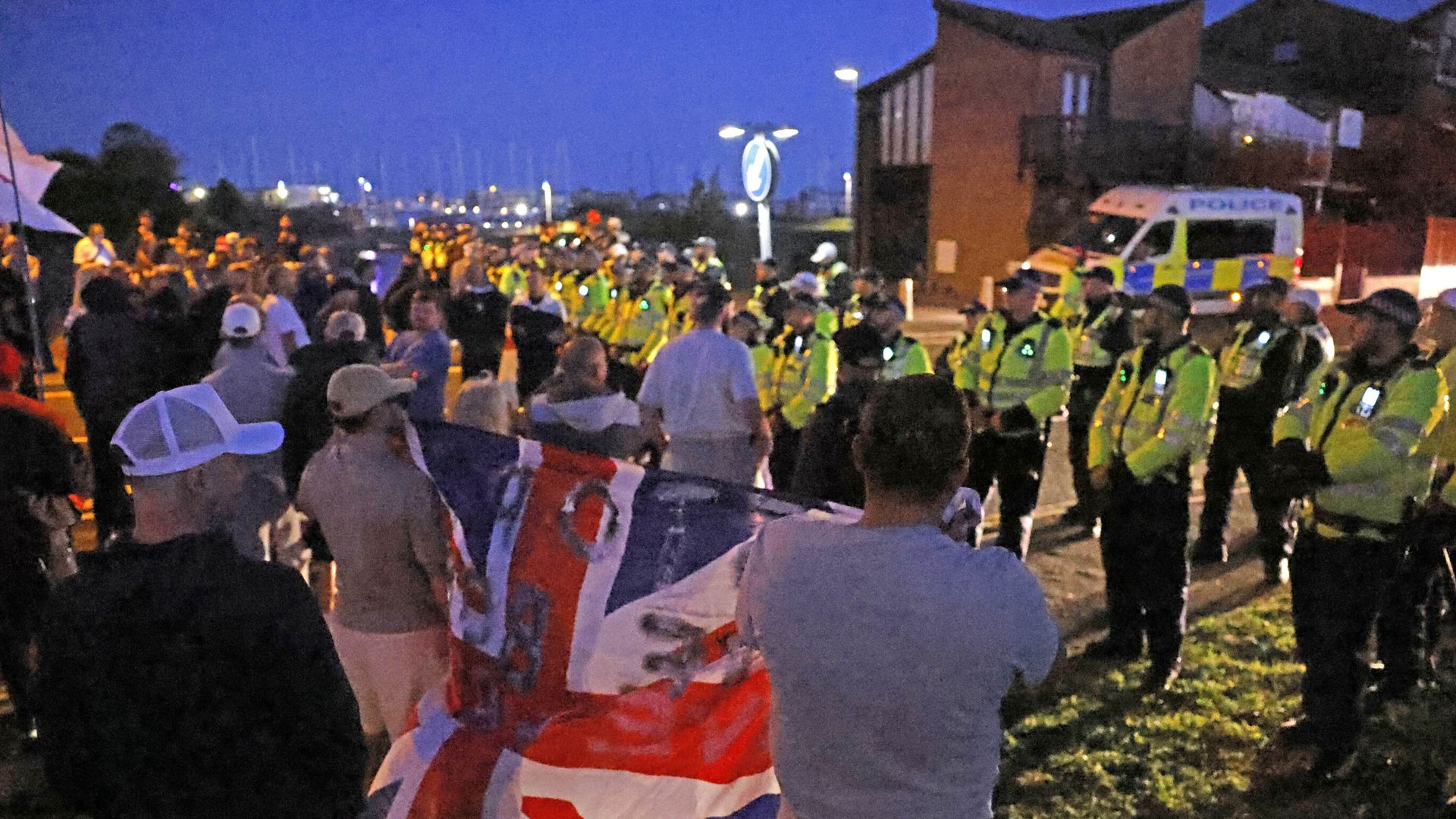
Mass demonstrations intersecting with immigration friction follow predictable escalation pathways that combine socioeconomic grievance, opportunistic agitation, and tactical law enforcement containment. When a seaside town becomes the focal point for an anti-migrant mobilization resulting in twelve arrests, the event represents the visible breakdown of local social equilibrium. Deconstructing this incident requires moving past the surface narrative of civic disturbance to examine the underlying institutional stress points, the mechanics of crowd polarization, and the operational response functions of municipal authorities.
The Structural Drivers of Hostility
Friction points in localized demographic shifts rarely materialize in a vacuum. They accumulate through institutional bottlenecks in housing, healthcare infrastructure, and employment competition. For another look, read: this related article.
Resource Scarcity Perception
The primary catalyst for civic unrest in peripheral municipalities often stems from a perceived zero-sum competition over public services. When municipal authorities accommodate transient populations without expanding baseline infrastructure capacity, local residents experience measurable degradation in service velocity.
- Housing Market Compression: Limited affordable housing stock creates direct price pressure.
- Healthcare Strain: Local clinic and emergency room wait times lengthen, generating acute frustration among long-term taxpayers.
- Fiscal Allocation: Communities frequently interpret state-level support for incoming groups as a net deficit in local infrastructure maintenance.
When these structural strains remain unaddressed by regional governance structures, civil society creates alternative channels of expression. These channels frequently bypass traditional democratic mediation, shifting the theater of conflict from council chambers to public streets. Further analysis on this trend has been shared by Associated Press.
The Escalation Lifecycle of Mobilized Protests
Crowd dynamics during politically charged demonstrations follow a distinct operational sequence. Understanding this sequence allows analysts to identify the precise moment peaceful assembly transitions into unlawful disruption.
Phase One: Information Cascades and Digital Mobilization
Modern protests rely on decentralized communication vectors. Social media algorithms accelerate grievance loops, transforming isolated local complaints into cross-regional rallying points. The velocity of digital dissemination often outpaces the intelligence-gathering capabilities of local law enforcement, preventing preemptive mediation.
Phase Two: Tactical Convergence
The physical assembly point is rarely arbitrary. Seaside towns, due to their geographic layout—often characterized by bottlenecks, linear promenades, and limited egress routes—present distinct tactical challenges for both protestors and containment forces.
- Spatial Concentration: High-density public squares concentrate opposing factions, exponentially increasing the probability of physical friction.
- Anonymity and Impersonation: Agitators utilizing face coverings and standardized dress codes reduce individual accountability, lowering the threshold for aggressive behavior.
- Escalation Triggers: A single verbal confrontation or police intervention can act as a catalyst, shifting the crowd from a static demonstration to a dynamic kinetic event.
The Operational Cost Function of Law Enforcement Interventions
When twelve individuals are arrested during a public order disturbance, the action is the culmination of a high-stakes calculation by commanders on the ground. Law enforcement agencies operate under a constrained resource matrix where every intervention carries systemic risk.
The Containment Dilemma
Police forces must balance two opposing imperatives: upholding the freedom of assembly and maintaining public safety. Over-intervention can be construed as state suppression, further radicalizing moderates within the crowd. Under-intervention risks property damage, bodily injury, and a complete collapse of municipal deterrence.
- Proportionality Thresholds: Officers deploy physical force or restrictive measures only when the crowd breaches statutory definitions of unlawful assembly.
- Resource Allocation Bottlenecks: Managing volatile crowds requires drawing personnel from surrounding jurisdictions, leaving other municipal sectors exposed to secondary security vulnerabilities.
- Evidentiary Capture: Securing convictions for arrested individuals requires robust documentation amidst chaos, making body-worn cameras and aerial surveillance critical operational components.
Systemic Vulnerabilities in Municipal Crisis Response
The arrest of a dozen participants does not resolve the underlying systemic tensions; it merely pauses the physical manifestation of the conflict. Municipalities lacking proactive conflict-resolution frameworks remain structurally vulnerable to recurring flare-ups.
Communication Deficits
When local governments fail to maintain transparent communication regarding demographic resource allocation, informational vacuums emerge. These vacuums are rapidly filled by speculative narratives, extremism, and polarization vectors that reward radical posture over pragmatic compromise.
Inter-Agency Friction
Regional police departments, municipal councils, and national immigration authorities often operate within siloed operational frameworks. This fragmentation delays threat assessment and inhibits coordinated preventative interventions. Effective containment requires real-time intelligence sharing between social service agencies and public safety directorates—a linkage that is historically weak in secondary and tertiary towns.
Strategic Mitigation and Structural Forecasts
To prevent municipal flashpoints from escalating into recurring civil disorder, governance models must shift from reactive containment to preventative structural adjustment.
Adaptive Infrastructure Scaling
Municipalities designated as reception or transit zones must receive dynamic budgetary adjustments prior to demographic influxes, insulating local infrastructure from degradation.
Early Warning Mediation Networks
Deploying neutral community mediators to engage with grassroots organizers before protests crystallize can de-escalate rhetoric and decouple legitimate civic grievances from predatory extremist elements.
The recurrence of anti-migrant demonstrations in coastal and regional towns indicates that local friction points are symptoms of broader national policy disconnects. Until structural mechanisms address both the resource anxieties of host populations and the management of transient arrivals, public squares will remain the default arena for unresolved systemic grievances.