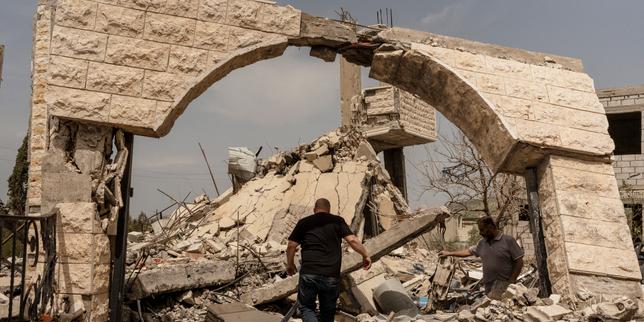
The persistence of kinetic activity in Southern Lebanon despite formal cessation agreements reveals a fundamental misalignment between diplomatic rhetoric and the operational realities of asymmetric warfare. Truces in this theater often fail because they treat high-intensity conflict as a binary state—on or off—rather than a fluid spectrum of escalation. When the underlying drivers of friction remain unaddressed, the interval of a "truce" merely functions as a period of tactical repositioning and logistical replenishment.
The Triad of Kinetic Persistence
Three distinct variables explain why destruction continues when a ceasefire is technically in effect. These factors create a feedback loop that sustains violence even in the absence of large-scale maneuver warfare.
- The Information Gap and Attribution Ambiguity: In a decentralized operational environment, the time-lag between a high-level political agreement and its execution at the squad or cell level creates windows of "residual fire." Because non-state actors operate with varying degrees of autonomy, localized commanders often interpret defensive postures as offensive opportunities.
- Infrastructure Neutralization as a Strategic Constant: Military doctrine for state actors frequently prioritizes the "shaping" of the battlefield. This involves the systematic demolition of tunnel networks, observation posts, and storage facilities. If a truce does not explicitly define "hostile intent," one side may view the demolition of a bunker as a defensive necessity, while the other views it as an act of active aggression.
- The Threshold of Tolerable Violations: Every cessation agreement possesses an unwritten limit on how many minor infractions can occur before the agreement is declared null. This creates a "gray zone" where both parties engage in low-level attrition, testing the opponent's resolve without triggering a full-scale return to total war.
Structural Vulnerabilities in the Litani Buffer Logic
The recurring geopolitical focus on the Litani River as a geographic boundary for security ignores the evolution of modern missile technology and subterranean logistics. The assumption that pushing armed elements north of a specific line creates safety is a legacy of 20th-century conventional warfare.
The current failure of the buffer zone logic stems from Integrated Topography. The geography of Southern Lebanon—defined by limestone ridges, deep wadis, and dense urban clusters—favors a "stay-behind" force structure. Even if personnel are withdrawn, the pre-positioned hardware and hardened infrastructure remain. Consequently, the presence of a technical truce does not remove the threat; it merely hides it.
The Cost Function of Displacement
Destruction in the south is not merely a byproduct of combat; it is a calculated economic and social lever. The degradation of civilian infrastructure serves two functions within the broader strategy of attrition:
- Zone Deniability: By rendering a village uninhabitable through the destruction of water, power, and telecommunications, a military force effectively creates a "no-man's land" without needing to maintain a physical presence. This prevents the return of the population, which in turn removes the human shield or intelligence network that an adversary might utilize.
- Logistical Depletion: Every destroyed structure represents a future drain on the adversary's state or organizational resources. The long-term cost of reconstruction acts as a secondary front in the war, forcing the opponent to choose between military spending and social stability.
Tactical Evolution and the Failure of Monitoring
International monitoring bodies, such as UNIFIL, operate under mandates that are structurally mismatched with the current reality of the conflict. Their presence relies on the "consent of the parties," a principle that collapses when those parties have diverging definitions of what constitutes a violation.
When an artillery strike occurs during a truce, the monitor's role is typically forensic rather than preventative. This creates a reactive lag. By the time a violation is documented and reported, the victim has usually already retaliated, creating a new cycle of violence that makes the original report irrelevant. The lack of enforcement mechanisms means that the cost of violating the truce is consistently lower than the perceived tactical benefit of the strike.
The Calculus of Proportionality and Preemption
The ongoing destruction is driven by a shift from reactive defense to preemptive degradation. In this framework, waiting for an attack to happen is seen as a strategic failure. Instead, military planners use the "truce" window to identify and eliminate high-value targets that were previously obscured by the fog of active war.
This creates a paradox: the quieter the front becomes, the more visible the targets become to surveillance drones and signals intelligence. When a target is identified, the temptation to strike is high, as the "opportunity cost" of letting a strategic asset survive outweighs the diplomatic cost of a truce violation.
The Dynamics of Urban Attrition
Southern Lebanese border towns are no longer just residential centers; they are fortified nodes in a larger defense-in-depth system. The destruction of these towns follows a specific pattern:
- Detection of Hardened Points: Intelligence identifies a residence used for munitions storage.
- Precision Neutralization: A targeted strike is conducted to minimize immediate collateral while maximizing structural damage to the facility.
- Secondary Detonation: Often, the resulting fires or explosions from stored materials cause more damage than the initial strike, leading to the widespread ruin seen in recent reports.
This cycle ensures that even if no "new" battles are fought, the map of destruction continues to expand as old intelligence is acted upon.
Strategic Forecast: The Erosion of the Buffer State
The current trajectory indicates that Southern Lebanon is moving toward a state of permanent "high-tension instability" rather than a sustainable peace. The truces being negotiated are tactical pauses, not strategic resolutions.
The move toward a definitive resolution requires a shift away from geographic lines and toward functional disarmament. This would necessitate a verification regime capable of real-time intervention—a requirement that neither side is currently willing to accept. Without a fundamental change in the enforcement mechanism, the south will continue to experience a "destructive peace," where the absence of a declared war does not equate to the presence of safety.
The strategic play now is the transition from broad-spectrum kinetic operations to targeted infrastructure denial. Parties will continue to degrade the physical environment to ensure that even if a formal peace is eventually signed, the terrain itself is no longer a viable launchpad for future conflict. The destruction is the strategy, not the byproduct.