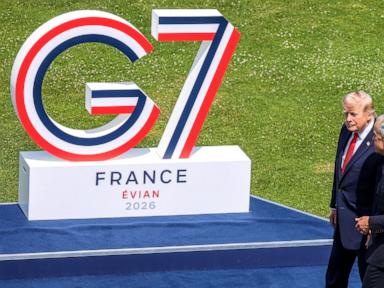
The absence of a formal bilateral meeting between Canadian Prime Minister Mark Carney and U.S. President Donald Trump at the G7 summit in Évian-les-Bains signals a structural shift in middle-power diplomacy, rather than a conventional diplomatic snub. In bilateral statecraft, formal meetings serve as a mechanism for scripted point-scoring or the ratification of pre-negotiated treaties. When a middle power faces an asymmetric trade relationship—where 75% of Canadian exports are bound for the United States—the optimization strategy shifts from formal bilateral forums to opportunistic, informal interactions.
The media focus on the lack of a scheduled sit-down misinterprets the strategic calculus governing the upcoming July 1 review window for the Canada-United States-Mexico Agreement (CUSMA). By tracking the structural dynamics of the summit, three clear mechanisms emerge that explain how Canada is managing its economic exposure without escalating political friction.
The Friction-Reduction Framework: From Confrontation to Transaction
The relationship between Carney and the Trump administration has been defined by structural tension since Carney’s January address at the World Economic Forum in Davos, where he critiqued systemic coercion by hegemonic states. However, the operational reality of the CUSMA renewal requires a pivot from ideological resistance to transactional alignment.
This friction-reduction framework operates on two distinct levels:
- Asymmetric Exposure Management: Canada cannot afford an escalatory tariff cycle. To mitigate the risk of the U.S. introducing annual reviews or terminating the agreement, Canadian leadership must demonstrate alignment on core American economic priorities—specifically, containing Chinese industrial overcapacity.
- Decoupling Policy from Rhetoric: While public-facing speeches preserve domestic political capital, the structural execution of trade policy relies on quiet concessions. The recent "hot mic" interaction regarding Chinese electric vehicles (EVs) illustrates this shift.
During a working luncheon, Carney explicitly highlighted Canada's decision to enforce a hard cap on Chinese EV imports, limiting them to less than 3% of the domestic market (approximately 49,000 vehicles). This exchange reveals the strategic utility of informal access. By framing Canada’s defensive trade maneuvers as a structural win for American economic isolationism, Carney secured immediate rhetorical validation from Trump without navigating the bureaucratic overhead or adversarial press cycles of an official bilateral meeting.
The Cost Function of Summit Format Execution
Relying on formal bilaterals carries high transactional costs during a high-stakes trade review. A formal meeting forces both sides to establish rigid public baselines, reducing the flexibility required for granular concessions. The structural design of the G7 summit allows for a different optimization model: multi-contact informal diplomacy.
Carney documented seven to eight distinct interactions with Trump over a 36-hour window. This distributed communication model yields distinct advantages over a single 60-minute bilateral session:
- Iterative Feedback Loops: Instead of presenting a comprehensive trade package that could be rejected wholesale, the Canadian delegation can test individual policy components—such as EV caps, agricultural tariff adjustments, and strategic autonomy measures—across multiple low-stakes conversations.
- Mitigation of Media Variance: Formal bilaterals generate intense press scrutiny, forcing leaders to adopt nationalist postures for domestic consumption. Informal exchanges allow for pragmatic policy alignment away from cameras.
- Direct Bureaucratic Bypassing: By socializing key concepts directly with the U.S. Executive, Canadian negotiators can gauge real red lines before formal text is exchanged by U.S. Trade Representative Jamieson Greer and Canadian Trade Minister Dominic LeBlanc.
The Structural Vulnerabilities of Canada’s Trade Position
The strategic pivot observed in Évian-les-Bains highlights the core vulnerability of the Canadian economic model. The primary constraint on Canadian foreign policy is its lack of geographic and commercial diversification.
[Canada Export Distribution] ----> 75% ----> [United States Market]
                                 ----> 25% ----> [Rest of the World]
This concentration creates an structural imbalance during trade reviews. The U.S. administration can leverage market access to demand domestic policy alterations in Canada. For example, Canada’s recent concession to reduce its 100% tariff on Chinese electric cars in exchange for Beijing lowering tariffs on Canadian agricultural products introduced a friction point with Washington. The U.S. administration views any integration of Chinese supply chains into North America as a threat to its industrial strategy.
The strategy deployed by Carney at the G7 suggests an explicit recognition of this bottleneck. To preserve the core architecture of CUSMA for another 16 years, Canada must mirror U.S. protectionist frameworks on critical sectors like automotive manufacturing and artificial intelligence, even if it limits Canada's autonomous trade relations with Asian markets.
Strategic Forecast: The CUSMA Renewal Path
The interactions at the G7 indicate that the U.S. administration is unlikely to dismantle CUSMA entirely on July 1, as the economic disruption would destabilize integrated North American supply chains. Instead, the U.S. is poised to use the renewal window to inject deliberate policy uncertainty.
The most probable outcome is an push by the Trump administration to introduce rolling annual reviews or conditional sunset clauses. This mechanism would transform CUSMA from a permanent legal framework into a continuous instrument of political leverage.
Canada’s optimal response moving forward requires absolute consistency between technical trade teams and executive messaging. Minister Dominic LeBlanc and Chief Negotiator Janice Charette must continue aligning regulatory definitions with Ambassador Jamieson Greer at the working level, while the prime minister maintains the informal transactional channel established at the G7. Middle-power survival in an era of fractured global rules depends entirely on executing precise, sector-specific concessions while avoiding high-profile symbolic standoffs that force a populist response from a larger neighbor.