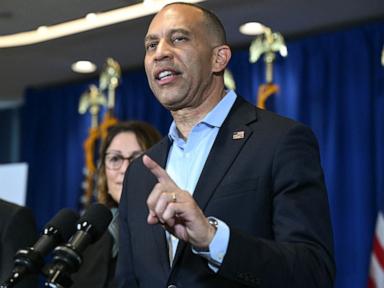
When House Minority Leader Hakeem Jeffries declares himself a "hard yes" on the impeachment of Defense Secretary Pete Hegseth, the statement functions not as a legislative mechanism, but as a signaling operation within a mathematically locked chamber. In a House of Representatives controlled by the opposing party, a minority leader's endorsement of impeachment carries a zero percent probability of floor passage without majority defections. Understanding this event requires stripping away partisan theater and analyzing the constitutional thresholds, procedural bottlenecks, and political incentive structures that govern minority-led impeachment initiatives.
Standard political coverage treats a leadership endorsement as an escalation toward removal from office. That framing misunderstands the mechanics of Article I, Section 2 of the U.S. Constitution. Impeachment is a binary, two-stage institutional process requiring a simple majority vote in the House to indict and a two-thirds supermajority in the Senate to convict. When the minority party initiates or endorses articles of impeachment against a sitting Cabinet official, the action bypasses the actual removal pipeline entirely and instead operates as an asymmetric messaging campaign designed to impose reputational costs, lock in caucus discipline, and establish a formal evidentiary record for future oversight.
The Structural Reality of Minority Impeachment Mechanics
To evaluate the operational impact of Jeffries' position, one must separate political rhetoric from parliamentary reality. In the House, the Speaker and the Rules Committee maintain absolute control over the legislative calendar. A minority leader cannot compel a floor vote on articles of impeachment through standard committee markup if the majority leadership refuses to schedule the resolution.
The procedural pathways available to the minority are severely constrained:
- Standard Committee Referral: Articles of impeachment introduced by a member are referred to the House Judiciary Committee. Under majority control, the Judiciary Chair simply declines to hold hearings or schedule a markup, effectively killing the resolution in committee without a recorded vote.
- Privileged Resolution Maneuvers: Under House Rule IX, a member can notice a resolution raising a question of the privileges of the House, which forces leadership to address the measure within two legislative days. However, the majority party routinely neutralizes this mechanism by immediately moving to table the resolution or refer it back to committee on a party-line vote.
- Discharge Petitions: A discharge petition allows a simple majority of the House (218 members) to force a bill or resolution out of committee and onto the floor. Because this requires defections from the majority caucus—members who would have to vote directly against their own party's Speaker and President—discharge petitions on Cabinet impeachments almost never reach the threshold.
Jeffries' declaration does not alter these procedural barriers. Without a shift in the underlying vote count, the endorsement leaves the legislative probability of removal unchanged. The strategic value lies elsewhere: by moving from cautious observation to an explicit "hard yes," the Minority Leader eliminates internal ambiguity within his own caucus and signals to the activist base that leadership is aligned with progressive oversight demands.
The Three-Variable Calculus of Leadership Endorsement
Party leaders rarely adopt maximalist positions like impeachment early in a dispute because doing so surrenders strategic optionality. Once a leader commits to a "hard yes," any subsequent compromise, censure motion, or standard oversight settlement looks like a retreat. Moving to this position requires a specific alignment of three political variables.
1. Caucus Cohesion and Base Pressure
In divided government, the minority party faces constant internal friction between frontline members in swing districts and safe-seat incumbents demanding aggressive confrontation. Frontline members generally avoid impeachment votes that force them to take polarizing stances without delivering tangible policy outcomes. When a minority leader endorses impeachment, it indicates that internal polling or constituent pressure has shifted the risk calculation. The political cost of appearing passive to the core electorate now exceeds the electoral risk posed to vulnerable incumbents—especially when the majority party's control of the floor guarantees those vulnerable members will never actually have to cast a recorded vote on the final articles.
2. Narrative Consolidation Against the Executive
Cabinet officials serve at the pleasure of the President, making them proxies for the administration's broader competence and ethics. Focusing impeachment rhetoric on the Secretary of Defense rather than the President serves a tactical purpose. Presidential impeachment triggers an immediate, existential constitutional crisis that rallies the opposing party's base and hardens partisan lines. Targeting a Cabinet official allows the opposition to frame the issue around specific operational failures, administrative misconduct, or national security risks. Jeffries' statement concentrates media attention on Hegseth's tenure, turning an ongoing series of news cycles into a unified narrative of administrative unfitness.
3. The Asymmetric Cost Function of Oversight
Impeachment inquiries and rhetoric impose an asymmetric resource drain on the executive branch. While the House minority expends minimal political capital to issue statements and draft resolutions, the Department of Defense and the White House must allocate legal, communications, and legislative affairs personnel to prepare defensive briefings, respond to document requests, and manage reputational fallout. Even without a formal House subpoena power—which remains with the majority—the credible threat of future investigations should chamber control flip in the next midterm cycle forces senior officials into a defensive posture.
Historical Precedent and the Erosion of the Impeachment Threshold
Evaluating the Jeffries-Hegseth dynamic requires placing it within the broader institutional trend of impeachment normalization. Historically, the impeachment of Cabinet officials was virtually nonexistent. Prior to the 2020s, only one Cabinet secretary in American history—Secretary of War William Belknap in 1876—had ever been impeached by the House, and he resigned hours before the vote in an unsuccessful attempt to avoid a Senate trial.
That institutional norm collapsed with the 2024 impeachment of Homeland Security Secretary Alejandro Mayorkas. By impeaching a sitting Cabinet secretary over policy disputes and alleged statutory noncompliance rather than traditional bribery or personal corruption, the House fundamentally altered the precedent governing executive branch accountability.
This precedent creates a permanent structural shift in legislative warfare:
- Lowered Evidentiary Bars: Disputes over departmental management, public statements, or operational security protocols are now routinely framed as "high crimes and misdemeanors."
- Tit-for-Tat Escalation: Once one party uses impeachment as a tool against a rival administration's Cabinet, the opposing party faces overwhelming internal pressure to deploy the exact same weapon when political roles reverse.
- Diminished Deterrent Value: As impeachment threats become a standard feature of partisan communication, their shock value declines. Media coverage cycles through the announcement faster, and swing voters increasingly discount the rhetoric as routine political noise.
Jeffries' "hard yes" operates directly inside this post-Mayorkas environment. Because the threshold for Cabinet impeachment was already lowered by the opposing party, the Minority Leader faces minimal institutional blowback for endorsing the mechanism against Hegseth.
Operational Limitations of the Minority Strategy
While the endorsement achieves short-term messaging alignment, relying on impeachment rhetoric as a primary opposition strategy carries distinct operational limitations and diminishing returns.
First, rhetorical escalation without execution creates an expectation gap. When leadership validates impeachment as the correct remedy, segments of the electorate expect a commensurate outcome. Because the minority lacks the gavel, it cannot deliver the outcome it has just endorsed. Over time, repeated declarations of support for unviable legislative actions can breed cynicism among engaged voters who recognize the gap between leadership rhetoric and institutional power.
Second, impeachment framing crowds out granular policy critique. Public debates over national security, defense procurement, military readiness, and Pentagon budget allocation require sustained, detailed scrutiny. Once the framing shifts to impeachment, media coverage collapses complex operational issues into a binary horse-race question: Are there enough votes to impeach? This dynamic often benefits the embattled official, as the administration can dismiss substantive policy criticisms as mere partisan attempts to overturn executive appointments.
Third, the strategy relies entirely on external missteps by the target. Unlike a majority-led investigation, which can manufacture momentum through scheduled hearings, witness subpoenas, and televised depositions, a minority-led impeachment push has no internal engine. If the target avoids major unforced errors over several news cycles, the minority leader's endorsement sits dormant, unable to generate organic legislative progress.
The Strategic Playbook Going Forward
Because a floor vote remains mathematically blocked under current chamber composition, the utility of Jeffries' endorsement depends entirely on how the minority caucus operationalizes the position outside the standard legislative calendar. Treating the "hard yes" as an endpoint guarantees strategic irrelevance; treating it as an anchor for pre-midterm positioning maximizes its leverage.
To convert this rhetorical commitment into tangible political capital, the minority leadership must execute three specific maneuvers:
- Shift from Impeachment Rhetoric to Appropriations Leverage: Rather than wasting floor time on symbolic privileged resolutions that will be tabled within minutes, leadership should tie specific oversight demands regarding Hegseth's conduct to must-pass legislative vehicles, specifically the National Defense Authorization Act (NDAA) and annual defense appropriations bills. Using funding riders and reporting mandates forces majority members to negotiate on substantive constraints rather than defending the official on a binary impeachment vote.
- Build a Shadow Evidentiary Archive: Minority members on the House Armed Services and Oversight committees must systematically catalog every administrative decision, communications lapse, and legal opinion tied to the Defense Secretary. By structuring this documentation to mirror formal articles of impeachment, leadership creates a turnkey investigative dossier that can be immediately activated if control of the House flips in the next election cycle.
- Segment Caucus Messaging by District Profile: Leadership must enforce strict message discipline across the caucus. Safe-seat members and committee leaders should drive the accountability and impeachment narrative in national media, while frontline members in competitive districts pivot entirely to defense readiness, military family support, and fiscal accountability. This division of labor captures the base-mobilizing benefits of Jeffries' endorsement while insulating vulnerable incumbents from nationalized partisan blowback.
The ultimate impact of Jeffries' statement will not be measured by a clerk's tally on the House floor, but by whether the minority uses the posture to extract policy concessions during budget negotiations and build a durable electoral case for reclaiming the gavel.