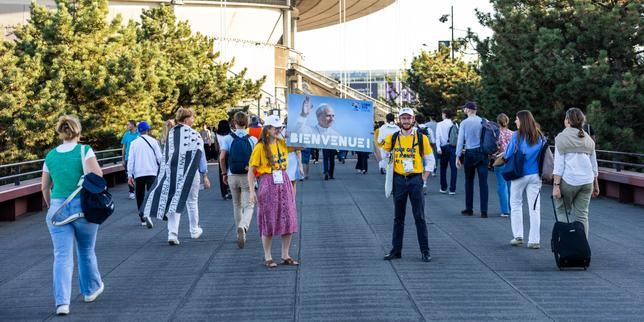
The media circus surrounding papal visits follows a predictable script. Millions tune in to watch a pontiff float through a historic cathedral or pack into a national stadium for a high-production prayer vigil. Commentators trip over themselves praising the logistics, the massive attendance figures, and the supposed spiritual revitalization of a secular capital.
It is all a comforting delusion. If you enjoyed this post, you should look at: this related article.
When a modern religious leader fills an arena like the Stade de France, we are not witnessing a revival of profound spiritual conviction. We are looking at a masterclass in mass-audience management, a geopolitical flex wrapped in vestments. The lazy consensus insists that these stadium spectacles prove faith is alive and well in the modern era. Look at the crowds. Count the streaming numbers. Measure the economic impact on local hotels.
That metric is bankrupt. Standing shoulder-to-shoulder with eighty thousand strangers under flashing stadium lights while a choir blasts through an acoustic nightmare of a sound system has nothing to do with asceticism, quiet contemplation, or authentic belief. It is a rock concert with incense. For another look on this story, see the latest coverage from The New York Times.
Let us look at the mechanics of what actually happens when the papacy goes on tour in a major secular metropolis.
The Logistics of Manufactured Awe
Behind every massive papal itinerary lies an army of event planners, security consultants, and municipal coordinators. Securing a venue like the Stade de France requires months of road closures, counter-terrorism sweeps, and millions of euros in public subsidies.
The media treats these gatherings as spontaneous outbursts of devotion. They are anything but. They are hyper-choreographed corporate events engineered to project institutional relevance in societies where regular institutional participation is plummeting. When attendance numbers are tallied, nobody asks how many attendees actually practice the faith on a random Tuesday morning, or how many simply treated the ticket like a rare festival pass to see a globally recognized celebrity.
By treating the sheer volume of bodies as proof of spiritual vitality, analysts commit a fundamental logical error. They confuse spectacle with substance.
"A crowd is not a community. A crowd is an audience waiting to be entertained or managed."
History shows that institutional power peaks right before its structural irrelevance becomes undeniable. The grander the stage, the louder the noise, the more frantic the effort to mask a hollowed-out core.
The Cathedral Versus the Arena
Consider the contrast at the heart of these tours. First comes the historic cathedral, a masterpiece of medieval engineering designed to dwarf the human ego and point the mind toward eternity. Then comes the concrete bowl of the sports stadium, an architectural monument to modern entertainment, commercial branding, and ticket sales.
Moving a religious vigil from a sacred architectural marvel to a venue built for soccer matches and pop concerts is not an adaptation to the modern world. It is a surrender. It reduces a sacred ritual to the level of athletic competition.
When you place a religious service inside a stadium, you submit to the rules of the stadium. You accept the jumbo screens, the corporate sponsorships, the plastic concession cups, and the temporal logic of crowd control. The medium ceases to be the message; the medium devours the message.
Dismantling the Revival Myth
Every time a pontiff packs a European arena, church apologists declare that secularism has hit a wall. They point to the young faces in the crowd as proof of a demographic counter-revolution.
The data tells a starkly different story. In major European urban centers, regular weekly mass attendance continues to hover at historic lows, often in the single digits among working-age populations. A once-in-a-generation spectacle does not reverse secularization any more than a Taylor Swift concert cures a city's housing crisis.
We need to stop evaluating religious health by the metric of stadium capacity. It flatters institutional vanity while blinding leadership to actual institutional decay. If an organization measures its success by how many people it can herd into a parking-lot-adjacent concrete bowl for a ninety-minute performance, it has stopped being a church and started being an events promoter.
Stop confusing pageantry with power. The future of belief—or its absence—won't be decided under the halogen lights of a stadium. It will be decided in the quiet, unfilmed choices of individuals who have abandoned the theater for something real.


