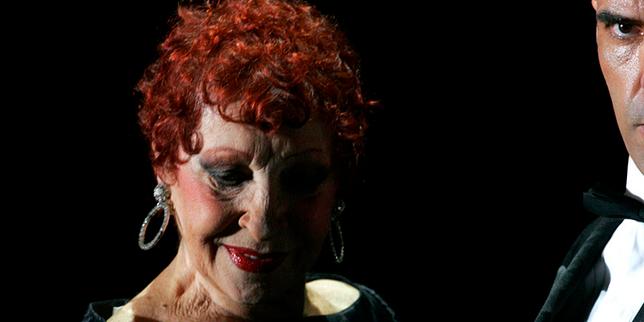
The internet has a morbid obsession with burying legends before they’ve actually stopped breathing. If you’ve seen the headlines claiming Maria Nieves Rego—the undisputed "Queen of Tango"—has passed away, you’ve been fed a lie. But the real tragedy isn't the misinformation about her pulse; it’s the lazy, saccharine way the world eulogizes her entire career while missing the point of why she actually matters.
People want to treat Maria Nieves like a museum piece. They want to frame her as the "abandoned partner" of Juan Carlos Copes or the "graceful grandmother" of Argentine culture. That narrative is insulting. Maria Nieves didn't just dance tango; she weaponized it. She took a street-level, machismo-driven social ritual and transformed it into a global theatrical powerhouse through sheer, unadulterated defiance.
The Myth of the Submissive Muse
The common consensus portrays Maria as the faithful shadow of Juan Carlos Copes. This is historical revisionism at its worst. Copes was the architect of "Tango Show," sure, but Nieves was the raw material that made the architecture stand up.
In the 1950s and 60s, tango was dying in Buenos Aires. Rock and roll was the new king. The "lazy" historian says Copes saved tango. The truth is that Maria Nieves saved the identity of the dance. While Copes focused on the geometry and the "Broadway-fication" of the steps, Nieves kept the dirt, the anger, and the sexual tension of the arrabal (the slums) alive in every kick.
If you look at the mechanics of their partnership, it wasn't a romance; it was a decades-long war.
- They stopped being a couple in the 1970s.
- They didn't speak off-stage for years.
- They shared a stage because they were the only two people on the planet who could handle each other’s speed and violence of movement.
To call her his "partner" is like calling a hurricane the "partner" of the coastline. She was the disruption.
Why "Tango Argentino" Was a Trojan Horse
In 1983, the show Tango Argentino hit Paris and later Broadway. This is usually cited as the "renaissance" of the dance. Critics loved the elegance. They loved the suits and the slit dresses.
But they missed the subversion. Maria Nieves was performing at an age when most dancers are relegated to teaching in dusty studios. She wasn't playing a character; she was performing her own survival.
The technicality of the boleo (the whip-like leg movement) in her prime wasn't about "beauty." In the context of the 1980s, it was a reclaimation of Argentine pride following the dark years of the military junta. When Maria Nieves stepped onto a stage in New York, she wasn't just dancing for applause. She was proving that Argentine grit couldn't be exported or imitated by some conservatory-trained ballerina.
The Physics of the "Nieves Style"
Most modern tango dancers are too "pretty." They prioritize the posture over the impulse.
If you want to understand why Nieves is the GOAT (Greatest of All Time), you have to look at the center of gravity.
- The Lean: Unlike ballroom tango, which is rigid, Nieves utilized a dynamic axis. She and Copes pioneered the $V$-shape embrace where the feet are far apart but the chests are fused.
- The Grounding: She never "floated." Every step was a strike against the floor.
- The Disassociation: Her ability to keep her hips facing her partner while her shoulders rotated nearly 90 degrees allowed for the rapid-fire leg work that defines the "Nieves" look.
The Problem with the "Legend" Label
When we call someone a "legend," we usually do it to put them in the past tense. It’s a way of saying, "Your time is over, thank you for the memories."
Maria Nieves is still very much alive, and she likely finds your tributes patronizing. The industry loves a "fallen star" narrative because it’s easy to sell. It’s much harder to sell the reality of an artist who outlived her era, outlived her famous partner, and remains the sharpest critic of the very dance form she helped popularize.
She has been vocal about the "plastic" nature of modern tango. She hates the way it’s become a tourist trap in La Boca. She despises the lack of "blood" in the new generation. And she’s right.
Why Modern Tango is Failing
The industry has traded mugre (dirt/filth) for glamour.
- Old Tango: A conversation between two people who might actually hate each other but need the dance to survive.
- New Tango: A synchronized routine designed for Instagram likes and cruise ship stages.
Maria Nieves represents the "Old Tango" not because she’s old, but because she understands that the dance is a zero-sum game. If there is no risk of falling—emotionally or physically—it isn't tango. It’s just gymnastics with an accordion soundtrack.
Stop Waiting for the Obituary
The "news" of her death was a glitch in the digital matrix, likely fueled by the fact that she has stayed out of the paparazzi's lens lately. But Maria Nieves doesn't need to be dead for us to reckon with her legacy.
In fact, the fact that she is alive makes her legacy even more uncomfortable for the tango establishment. She is a living reminder that the dance was born from pain, rejection, and the streets—not from high-end dance studios with mirrors and lattes.
I’ve seen "tango experts" spend thousands of dollars on workshops trying to replicate her footwork. They fail every time. You can’t buy her "swing." You can’t teach the way she looks at a partner like she’s deciding whether to kiss him or kill him.
The Real Advice for Dancers and Fans
If you actually want to honor Maria Nieves, stop reading her fake obituaries and stop watching "Tango for Beginners" tutorials.
- Watch the 2015 documentary Our Last Tango (Un tango más). It captures the sheer vitriol and brilliance of her relationship with Copes. It isn't a love story. It’s a documentary about two people who used art to survive their own toxicity.
- Learn the "Mugre": Stop trying to be elegant. Try to be honest. Maria was never "elegant" in the traditional sense; she was fierce.
- Question the Narrative: Every time a critic calls her "The partner of Copes," correct them. Copes was the man who had the privilege of holding Maria Nieves while she conquered the world.
The Final Word on the "Death" of a Legend
The internet’s rush to kill off Maria Nieves is a symptom of a culture that values the idea of a person more than the actual person. We want the closure of a funeral so we can package her life into a three-minute highlight reel.
Maria Nieves Rego is still here. She is still the woman who walked out of the slums of Belgrano and taught the world that a woman in tango isn't a follower—she’s the engine.
The next time you see a headline claiming a legend has passed, ask yourself who benefits from that silence. Maria isn't silent. She’s just waiting for the music to start again, and she doesn't give a damn if you can keep up.
Stop mourning and start listening to the floorboards. If they aren't screaming, you aren't dancing tango.