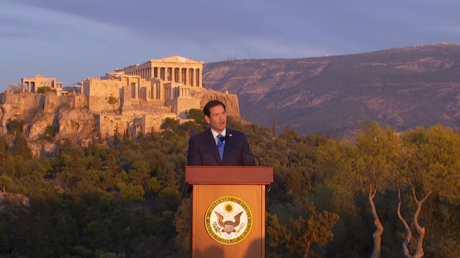
For years, the political establishment treated globalism as an unstoppable force. If you questioned open borders or the slow erosion of national sovereignty, you were labeled backward. But the conversation has shifted drastically. When U.S. Secretary of State Marco Rubio stepped up to address audiences in historic European locations like Athens, he didn't offer the usual diplomatic platitudes. He delivered a blunt warning about the survival of Western civilization.
If you've been paying attention to modern politics, you know this speech wasn't just about foreign policy. It was a direct ideological challenge to the open-borders consensus that has dominated Western capitals for decades.
The Core Message Behind the Rhetoric
Rubio's argument hinges on a simple, often-ignored premise: nations need borders to exist, and cultures need distinct identities to survive. Standing against the backdrop of ancient history, he argued that modern globalist policies have weakened the very foundations of democratic societies.
Critics love to dismiss these speeches as mere political theater. They claim it's just standard populist posturing. But you're missing the bigger picture if you look at it that way. The friction between Washington and traditional European allies isn't about petty diplomatic slights. It's a fundamental disagreement over whether nations should subordinate their laws and borders to international bodies and unregulated migration flows.
Consider what's actually happening on the ground. Unchecked migration and heavy-handed transnational climate regulations have strained social cohesion across the West. Rubio pointed out that when governments prioritize abstract global metrics over the immediate security and prosperity of their own citizens, public trust collapses.
Why the Birthplace of Western Civilization Matters
Choosing Athens as a backdrop wasn't an accident. By speaking where ancient democratic assemblies first took shape, the administration sought to connect current nationalist policies to the deep roots of Western thought. The message was clear: self-determination isn't a modern invention or a fringe idea. It's the core principle that built free societies in the first place.
Yet, this stance creates deep divisions. European leaders who have spent decades building integrated institutions view the American pushback with alarm. They argue that closing borders and rejecting global frameworks invites instability. On the flip side, proponents of national sovereignty argue that open borders destroy the social contract entirely. You can't have a functional welfare state or a secure democracy without defined limits.
What This Means Moving Forward
The debate over globalism versus national sovereignty isn't going away. As more voters across the West push back against high-level technocratic governance, political leaders are forced to choose sides.
You're going to see this tension define international summits for years. Governments that ignore public anxiety over border security and economic displacement will keep losing ground to movements demanding a return to national strength. The era of blind faith in globalism is ending, and the scramble to define what comes next is officially underway.
Marco Rubio Delivers Strong Message On Immigration And America's National Identity
This video provides additional context on how Secretary of State Marco Rubio frames national identity and immigration policy during major address events.