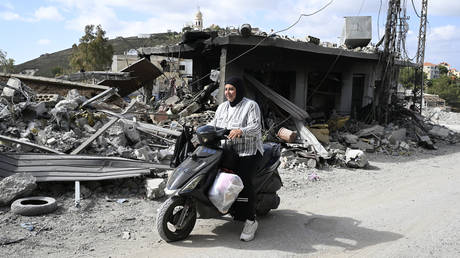
The dust in southern Lebanon has a smell. It is a mix of crushed limestone, wild thyme, and the sharp, metallic tang of spent ammunition. When the wind blows from the south, it carries the weight of a border that is less a line on a map and more a living, breathing entity that dictates when you sleep, when you run, and whether your home will survive the night.
In international newsrooms, conflicts are often reduced to sweeping declarations. A press release goes out. A map is shaded in blue or red. A spokesperson announces a withdrawal, a tactical shift, a victory. The ticker at the bottom of the screen flashes the update, and the world moves on to the next headline, assuming the reality on the ground shifted the moment the ink dried on the military communique.
But truth does not live in press releases. It lives in the mud. It lives in the quiet, tense rooms of local municipalities where mayors sit under flickering fluorescent lights, checking their phones every three seconds because a rumor on WhatsApp could mean the difference between life and death for their citizens.
The Mirage of the Empty Horizon
Consider the disconnect between a televised claim and a physical reality. When a military force announces it has pulled back from a specific sector, the global audience visualizes trucks rolling backward, soldiers packing up gear, and a sudden, palpable emptiness returning to the landscape.
But look closer.
Ali, a hypothetical farmer whose family has tended olive groves within sight of the border for three generations, knows better than to trust a television broadcast. For Ali, a withdrawal isn't real until he can hear the birds again. Right now, he hears nothing but the low, persistent drone of unmanned surveillance overhead—a sound that vibrates in the teeth.
From a high-altitude drone camera, a village might look abandoned, a zone cleared. To the bureaucrats analyzing the footage hundreds of miles away, the box is checked. The objective is met. The withdrawal is logged into the official record.
But on the ground, the mayor of that very region looks out his window at a ridge line that should be empty, but isn't. He sees the glint of glass in the distance. He notes the specific, unnatural stillness of a tree line that usually sways with the wind. He knows that a declaration of absence is often just a different, quieter form of presence.
The claim of a pullback becomes a ghost story. One side insists the spirits have left; the other side is still watching the doors slam and hearing the floorboards creak.
The Anatomy of the Claim
To understand why a local leader would openly question an official military narrative, you have to understand the geography of trust in a border zone. Trust is a luxury that was spent decades ago. In its place is a highly developed, deeply skeptical radar.
When a major military power states that its operations in a specific sector have concluded and forces have withdrawn, it relies on a specific definition of the word. A withdrawal might mean the main armored columns have moved back across a demarcation line. It might mean the primary offensive push has paused.
However, to the people who live in the shadow of those hills, that definition is dangerously incomplete.
If specialized units remain embedded in hidden positions, is it a withdrawal?
If sniper teams still hold the high ground overlooking the agricultural fields, is the land truly vacated?
If artillery remains dialed into the exact coordinates of the village square, ready to fire at the touch of a button, has the threat actually receded?
The mayor’s public skepticism isn't just political posturing. It is a defense mechanism. By challenging the narrative, he forces a confrontation between the abstract map used by international diplomats and the physical dirt his people have to walk on. He knows that if the world accepts the claim of a withdrawal too early, the international community stops looking. The cameras turn away. The aid slows down. And his village is left in a gray zone—declared safe by the media, but remaining a bullseye in reality.
The Burden of the Border Mayor
Imagine the weight of a title when the infrastructure beneath you is crumbling. A mayor in rural southern Lebanon isn't just managing zoning laws or trash collection. They are managing survival.
When a video surfaces showing a local official pointing toward a ridge, arguing with the official reports, you are witnessing a profound exhaustion. It is the exhaustion of a leader who must look into the eyes of displaced families asking if it is safe to return home, knowing that a wrong answer will cost lives.
The displaced are waiting in schools, in overcrowded apartments in Beirut, or in tents pitched on the edges of safer towns. They want to go back to their kitchens, their beds, their businesses. They hear the news of a withdrawal and they pack their bags. They want to believe it. The temptation to believe a comforting lie is immense when you have been sleeping on a gym floor for months.
But the mayor stands at the gate. He watches the road. He talks to the local scouts, the farmers who crept back under the cover of darkness to check on their livestock, the people who know every rock and ravine.
And what do they tell him? They tell him they saw movement in the old stone ruins on the hill. They heard Hebrew spoken over the wind near the old water tank. They saw the red dots of laser sights dancing across the walls of abandoned houses at dusk.
So the mayor makes a choice. He goes on camera. He risks looking obstinate, or uncooperative, or politically motivated. He states plainly that they haven't set foot there in the way the world thinks they have. He insists that the claim is a fiction designed for consumption abroad, while the reality remains a siege.
The Invisible Stakes
The danger of unverified claims extends far beyond the immediate tactical situation. It rewrites history in real-time. When a dominant narrative asserts that an area is clear, any subsequent violence in that area is viewed through a warped lens. If an incident occurs after a declared withdrawal, the side that claimed to leave can argue they were provoked, or that they were merely responding to an cross-border incursion, rather than admitting they never truly left in the first place.
This is how the cycle ensures its own survival. It is built on a foundation of shifting definitions and unverified milestones.
For the observer watching from afar, the lesson is one of media literacy and profound humility. It is a reminder that the loudest voice in a conflict—the one with the most sophisticated public relations apparatus, the cleanest graphics, and the most authoritative press briefings—is rarely the voice that possesses the unvarnished truth.
The truth is usually found in the cracked voice of a local official standing on a dirt road, pointing a calloused finger at a hill that looks completely empty to a satellite, but looks like a fortress to anyone who knows how to read the landscape.
The wind shifts again, carrying another gust of thyme and dust across the empty square. The mayor turns off his phone, its screen still reflecting the unblinking glare of a headline that claims the war has moved away from him. He looks at the ridge line. He waits for the sun to go down, because he knows the night always tells the truth about who owns the dark.