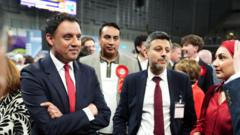
The air in a political briefing room rarely smells of anything other than stale coffee and the electric hum of high-stakes anxiety. But for Anas Sarwar, the scent that mattered most this week was the heavy, invisible weight of expectation. It is the kind of pressure that snaps lesser leaders, the sort that makes a person eye the nearest exit and wonder if a quiet life in dentistry—his former world—wasn’t actually the better deal.
He stood before the microphones not as a man looking for a way out, but as a leader digging his heels into the Scottish soil.
The question hanging in the room wasn't just about policy or polling. It was about survival. Specifically, whether the leader of Scottish Labour would stick around if the winds of the 2026 Holyrood election didn't blow exactly in his favor. Politics is a brutal business where loyalty is often traded for a momentary bump in the polls, and the "exit strategy" is usually the first thing a strategist drafts.
Sarwar, however, chose a different script.
He didn't offer the usual cagey, non-committal shrug of a career politician. Instead, he made a promise that felt uncomfortably personal in its grit. He declared he would "absolutely" remain at the helm, regardless of the hurdles thrown his way. It was a moment of rare, raw defiance in an era of calculated soundbites.
The Ghost of 2021
To understand why this matters, you have to look at the wreckage Sarwar inherited. When he took the job in early 2021, Scottish Labour wasn’t just losing; it was evaporating. The party that had once dominated the landscape of the north was being treated like a museum piece—curated, dusty, and largely irrelevant to the modern voter.
The struggle for the soul of Scotland had become a binary choice between the SNP’s dream of independence and the Conservative’s insistence on the status quo. Labour was the forgotten middle child, screaming for attention while the parents argued in the kitchen.
Sarwar stepped into that noise.
He didn't just inherit a party; he inherited a crisis of identity. Imagine being asked to captain a ship that is currently being sold for scrap metal. Most people would take one look at the hull and walk back to the pier. Sarwar didn't. He started patching the holes.
The Calculus of Persistence
The numbers tell a story of a slow, agonizing climb. Politics is often viewed through the lens of sudden "landslides," but the reality is much more like erosion. It’s the steady drip of convincing one disillusioned voter at a time that you aren't just the "lesser of two evils," but a genuine alternative.
Consider the hypothetical voter in a place like Rutherglen. Let's call her Jean. Jean has voted SNP for a decade because she felt Labour grew arrogant and distant. She doesn't care about Sarwar's internal party standing. She cares about her heating bill and whether her grandson can find a job that pays more than minimum wage.
For Jean, a leader saying they will "absolutely" stay on is a signal. It means the person asking for her vote isn't going to vanish the moment things get difficult. It’s the difference between a seasonal pop-up shop and a brick-and-mortar institution.
Sarwar’s commitment is a calculated gamble on the value of consistency. In a world of "here today, gone tomorrow" leadership, there is a certain power in simply refusing to leave the room. He is betting that the Scottish electorate is tired of the revolving door of leaders and craves a face they can recognize three years from now.
The Friction of Governance
But sticking around is only half the battle. The other half is the friction that comes with actually trying to move the needle.
The critics are already sharpening their pens. They point to the complexities of a Labour government in Westminster and how those decisions ripple up the M6 to affect Sarwar’s standing in Edinburgh. It is a delicate dance. He has to be a teammate to Keir Starmer while remaining his own man in Scotland.
It’s like walking a tightrope during a gale. If he leans too far toward London, he loses his Scottish soul. If he leans too far away, he loses the power of the UK-wide machine.
During his recent declarations, you could see the toll of that balance. There is a specific kind of exhaustion that settles in the eyes of a man who has to defend policies he didn’t write while building a future he hasn't yet reached. Yet, he spoke with a clarity that suggested he has made peace with the struggle.
The Human Toll of the Long Game
We often forget that politicians are, at their core, people who have chosen a life of public rejection. Every day, half the population—or more—is incentivized to tell them they are failing. To commit to staying on, even in the face of potential defeat, is an act of psychological endurance.
It isn't just about the 2026 election. It is about the years that follow. It is about being the person who has to walk into the office on a rainy Wednesday morning when the headlines are screaming for your resignation and saying, "Right, what’s next?"
There is no "seamless" transition in this kind of life. There is only the grind.
Sarwar is leaning into that grind. He is rejecting the idea that a leader's value is tied solely to a single election cycle. He is positioning himself as a foundational element, someone who is willing to be the floor that the party stands on while it tries to reach for the ceiling.
The Unwritten Chapter
The true test isn't happening in a televised debate or a glossy manifesto. It’s happening in the quiet moments between the big announcements. It’s in the conversations Sarwar has with party members who are tired of being in third place. It’s in the way he handles the inevitable setbacks that come with trying to revive a political brand that many had left for dead.
He knows the stakes. He knows that by saying he will stay, he has removed his own safety net. There is no graceful exit now. There is only the work, the results, and the judgment of a public that has grown cynical toward the very concept of political conviction.
The narrative of Scottish politics is shifting. The old certainties are brittle. The dominance of the SNP is no longer the immovable mountain it once was, and the Conservatives are grappling with their own internal shadows. In this vacuum of stability, Sarwar is trying to be the one constant.
He is no longer the new kid or the temporary fix. He is the man who looked at the hardest job in Scottish public life and decided that he wasn't finished yet.
Whether that persistence turns into power remains the Great Scottish Question. But for now, the answer to "Will he stay?" has been delivered with a finality that leaves no room for doubt.
He is staying.
He is fighting.
He is waiting for the rest of the country to decide if they are ready to join him.
The microphones have been turned off, the cameras have packed away their lenses, and the briefing room is empty once again. But the echoes of that "absolutely" remain, a stubborn reminder that in the volatile theater of power, sometimes the most radical thing a person can do is simply refuse to move.