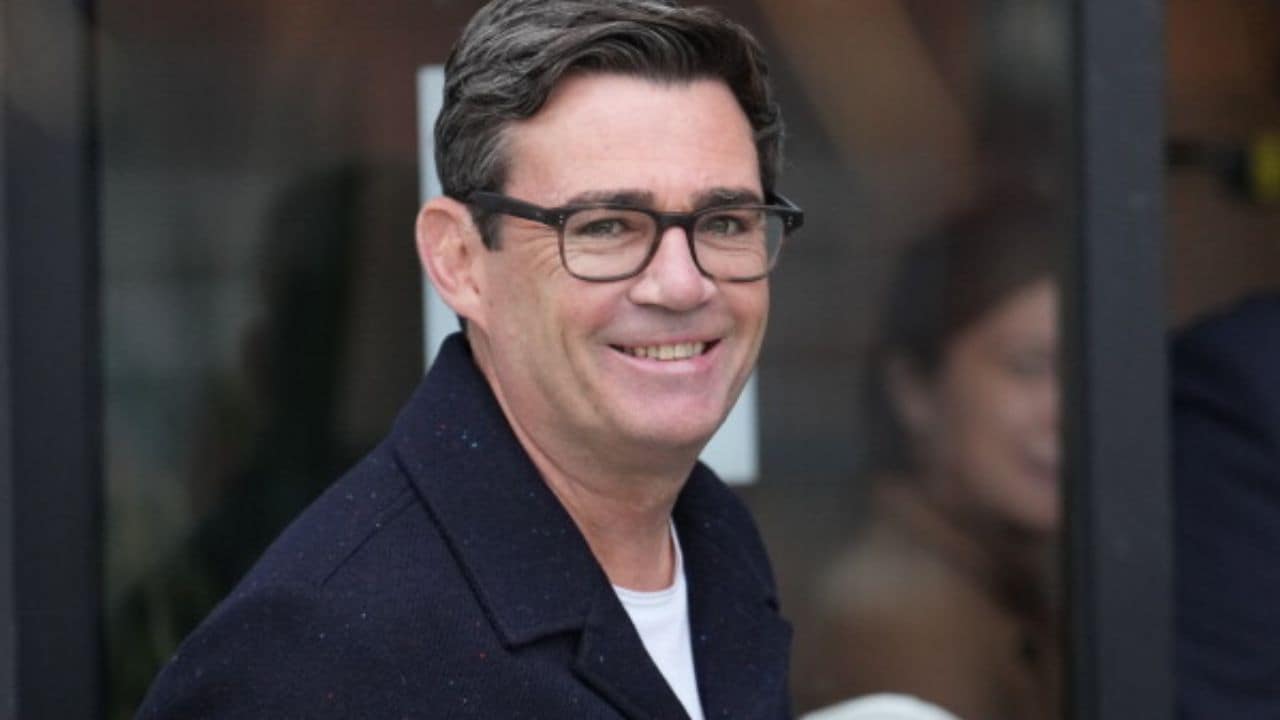
Rain was smudging the windows of the London-bound train as it pulled out of Piccadilly Station. On board, a fifty-six-year-old man in a dark T-shirt and jeans adjusted his glasses, looking at a phone that had not stopped vibrating for hours.
Andy Burnham was going back to Westminster.
Four days earlier, he had won a parliamentary by-election in Makerfield, securing 54.8% of the vote and defeating a surging Reform UK. That victory felt less like a local tally and more like a seismic shift. By Monday morning, the pressure on 10 Downing Street became unsustainable. Keir Starmer announced his resignation, ending a two-year premiership bruised by economic stagnation, internal party revolts, and high-profile political misjudgments. Almost instantly, Wes Streeting, Burnham’s most formidable potential rival for the leadership, stepped aside to endorse him. The path to the top of British politics, once a distant, twice-failed dream for the former Greater Manchester Mayor, had cleared into something resembling a coronation.
To understand how a man who walked away from parliament nine years ago is now poised to enter Downing Street, you have to look away from London. You have to look at a bus.
The Weight of the Yellow Bus
For decades, public transport in the north of England was a chaotic jigsaw puzzle of private operators, deregulated fares, and ghost schedules. If you lived in a suburb of Manchester and needed to get to a hospital or a shift work job, you didn't just look at a timetable; you gambled with your morning.
Consider a hypothetical commuter named John. John lives in Wigan and works in Salford. Under the old system, his daily journey required three different tickets from three different companies, costing him a significant portion of his weekly wage. If one bus was late, the connecting ticket was useless. The system didn’t care. It was a cold, corporate ledger that treated passengers as captured revenue rather than human beings trying to get to work.
When Burnham became the first Metro Mayor of Greater Manchester in 2017, he inherited this fragmentation. His response was the Bee Network.
He didn't just tweak the margins. He took control. He fought the private bus companies through the courts, endured the bureaucratic resistance, and brought the buses back under public control for the first time since the 1980s. Today, those bright yellow buses run on capped fares with integrated ticketing.
This isn't merely an administrative achievement. It is a philosophy. It is the practical application of what Burnham calls "Manchesterism"—the belief that the places ignored by central government deserve infrastructure that treats people with dignity.
The Radicalization of an Insider
Burnham was not always an outsider shouting at the gates of London. In fact, his resume reads like a standard blueprint for the political elite. He joined the Labour Party at fifteen, studied at Cambridge, and became an MP for Leigh in 2001. He rose through the New Labour ranks, serving as Health Secretary under Gordon Brown.
But Westminster can be an isolating mechanism. It polishes politicians until they sound like press releases.
When Burnham ran for the Labour leadership in 2010 and again in 2015, he was the candidate of the continuum. He wore the sharp suits. He spoke the modulated language of the television studio. He lost both times, finishing second to Jeremy Corbyn’s insurgent campaign in 2015.
The defeat was public, brutal, and clarifying. It became a turning point. Burnham realized that the political system he had spent his life navigating was broken, severed from the lived experience of the people he represented.
Leaving parliament in 2017 to become a regional mayor was viewed by many in London as an exile. Instead, it became his re-education.
Free from the constraints of the Westminster bubble, the suits vanished, replaced by open-necked shirts and denim. The stiff delivery dissolved into a relaxed, direct cadence. The insider had to leave the center of power to find his voice.
The Stand-Off
Every national political figure has a moment where their image hardens into something permanent in the public consciousness. For Burnham, that moment arrived in October 2020, during the height of the autumn pandemic lockdowns.
The Conservative government in London had decided to place Greater Manchester under the strictest Tier 3 restrictions. This meant closing businesses, ending livelihoods, and forcing workers onto reduced furlough pay. Burnham didn't object to the health measures; he objected to the math.
London was offering a financial package that would leave low-paid workers with just 67% of their wages. Burnham argued that you could not close people's workplaces by decree and then leave them unable to pay rent or buy groceries.
The image of Burnham standing on the steps of the Bridgewater Hall, surrounded by local leaders, checking his phone as the news broke that the government had walked away from negotiations, became iconic. He spoke with a raw, unscripted fury that wasn't about party lines. It was about fairness. He called it "provincial bullying."
The national media dubbed him the "King of the North."
Critics argued it was grandstanding, a calculated piece of political theater. But to the millions of people living through that anxiety-inducing winter, it felt like someone was finally standing between them and a cold, indifferent state. He lost the immediate financial battle, but he won a deep, enduring trust that extended far beyond traditional Labour voters.
The Mechanics of the Coronation
Now, the "King of the North" must govern the South, the East, and the West.
The challenge ahead is immense. The country is exhausted by years of low growth, declining public services, and a pervasive sense that nothing works quite as it should. The rapid transition toward a Burnham premiership—spurred by Wes Streeting’s tactical withdrawal—has avoided a summer of divisive infighting, but it deprives the new leader of a competitive contest to test his policy platform.
Skeptics point out that managing a regional authority of three million people is fundamentally different from steering a G7 nation of seventy million. The vague promises of local empowerment must now translate into hard treasury decisions. Every pound spent on northern infrastructure is a pound that cannot be spent on an overburdened hospital in the south-east.
Yet, his supporters believe he possesses the rare, undefinable quality missing from contemporary politics: the ability to speak human.
As the train rattled toward London, the landscape shifted from the industrial towns of Lancashire to the rolling fields of the midlands, and finally to the sprawling brickwork of the capital. The man in the open-necked shirt was arriving at the place he had rejected, carrying the expectations of a fractured nation on his shoulders.
The doors opened at Euston Station. The noise of London rushed in.