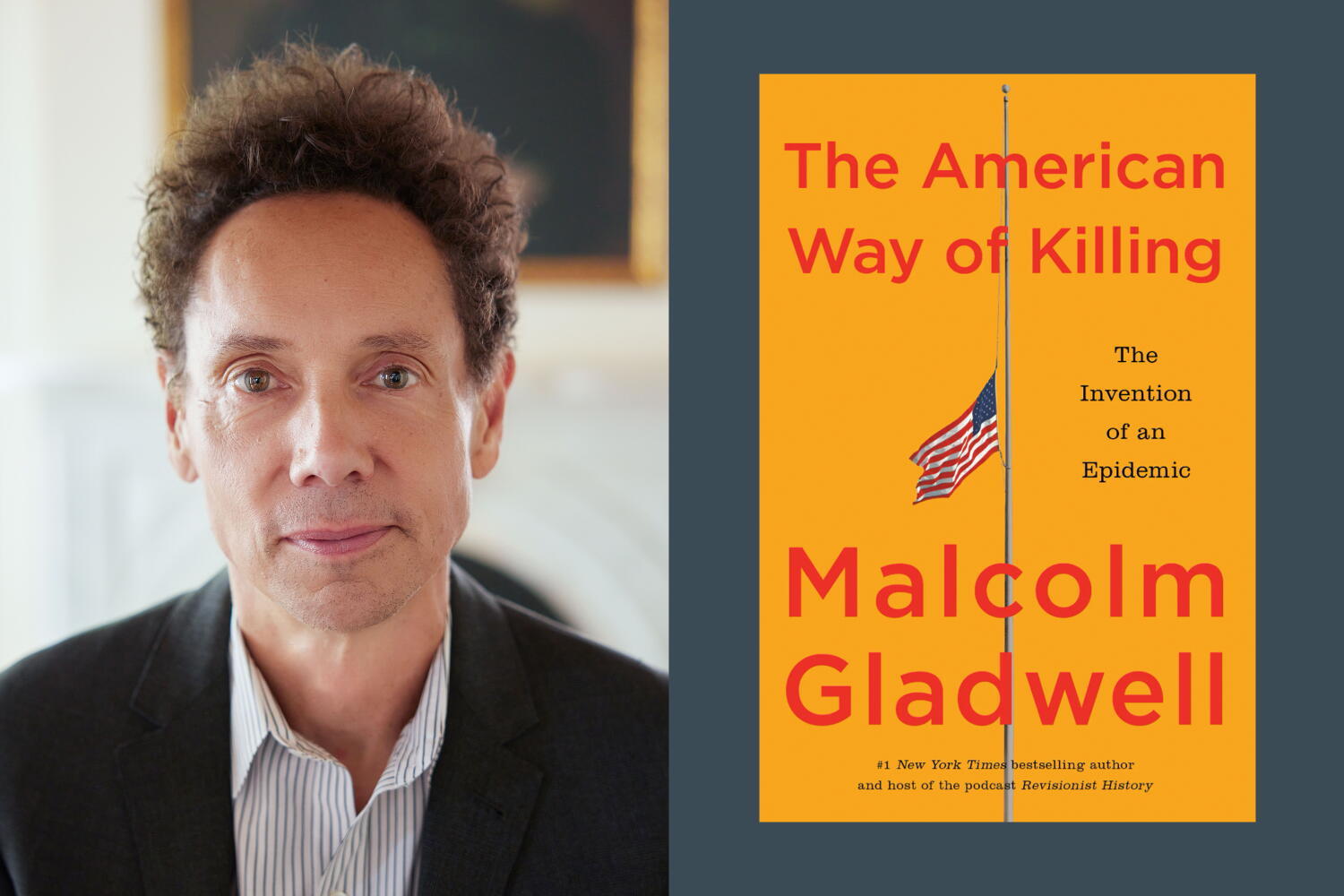
Malcolm Gladwell loves a neat little story. Give him a handful of sociology papers, a tragic headline, and thirty minutes behind a microphone, and he will package human chaos into a tidy, counter-intuitive narrative that makes dinner-party guests nod furiously.
He did it with the 10,000-hour rule. He did it with broken windows policing. And in his well-worn thesis on gun violence—specifically his obsession with Mark Granovetter’s "threshold model" of riots and school shootings—he did it again.
Gladwell wants you to believe that school shootings and mass violence are essentially slow-motion riots. According to his framing, there is no deep psychological mystery or structural policy failure at the root of the epidemic. Instead, it is a sociological contagion. One kid crosses a low threshold, commits an atrocity, and lowers the threshold for the next kid, creating a self-sustaining chain reaction of copycats.
It is clever. It is clean. And it is dangerously incomplete.
By reducing America’s firearm crisis to a behavioral contagion model, Gladwell commits the classic pundit sin of mistaking the spark for the gasoline. He ignores the cold, hard mechanics of lethality, flattens vastly different forms of violence into a single sociological bucket, and offers a fatalistic shrug disguised as intellectual enlightenment.
If you actually look at the data—not the cherry-picked case studies designed to sell audiobooks—you realize we are asking the wrong questions entirely.
The Seductive Trap of the Contagion Theory
Let’s give credit where it is due. Gladwell didn’t invent the contagion theory of mass shootings, nor is it entirely wrong. Researchers like Sherry Towers and Adam Lankford have published peer-reviewed studies showing a temporary clustering effect—roughly two weeks—following high-profile mass shootings. Media sensationalism acts as an accelerant. When networks plaster a shooter’s face and manifesto across every screen in the country, isolated, grievance-fueled young men take notes.
Gladwell’s specific angle relies on Stanford sociologist Mark Granovetter’s 1978 paper on collective behavior. Granovetter argued that people join a riot based on how many others are already participating. The instigator has a threshold of zero. The next person has a threshold of one. Eventually, the crowd reaches critical mass, and ordinary people do things they would never do alone.
Gladwell applies this to school shooters, stretching the timeline from hours to years. Eric Harris and Dylan Klebold at Columbine had a threshold of zero. Subsequent shooters had thresholds of five, ten, or fifty.
Here is where the wheels come off the wagon.
A riot is a synchronous, physical crowd event driven by immediate social pressure and anonymity. A school shooting is an asynchronous, solitary act of premeditated mass murder. Comparing the two isn't an insight; it’s a category error. When a teenager spends six months building a tactical loadout and writing a manifesto in his bedroom, he isn't swept up in crowd psychology. He is executing a logistical plan.
More importantly, Gladwell’s framing subtly absolves the systems that put military-grade hardware into the hands of impulsive 18-year-olds. If the problem is simply an unstoppable cultural domino effect, then regulation feels futile. Why bother changing laws if we’re just dealing with a sociological virus? That kind of intellectual fatalism is music to the ears of people who profit from the status quo.
The Lethality Equation Nobody Wants to Discuss
I have spent years analyzing public health data and risk-management frameworks, and the single biggest mistake amateurs make is confusing intent with capability.
Every developed nation on Earth has angry young men. Every developed nation has mental health crises, violent video games, broken homes, and media contagion. Young men in London, Tokyo, and Sydney watch the exact same viral clips of American tragedies that young men in Texas and Michigan do. The sociological "virus" is global.
Yet the mass casualty numbers are uniquely American. Why?
Because violence is an engineering problem as much as a behavioral one. Criminologist Franklin Zimring proved this decades ago with his "instrumentality effect" research. In plain English: the weapon used in an assault determines whether the victim ends up in an ambulance or a morgue.
When a disaffected teenager in the UK reaches his "threshold," he grabs a kitchen knife. Three people get wounded, maybe one dies, and police tackle him in four minutes. When a disaffected teenager in the US reaches that exact same threshold, he walks into a gun store—or his father’s unlocked closet—and grabs a semi-automatic rifle with a 30-round detachable magazine.
The difference isn't the sociology. The difference is muzzle velocity and kinetic energy.
A 9mm handgun round travels at roughly 1,100 feet per second. It pokes a hole through tissue. An AR-15 round (.223 Remington or 5.56 NATO) travels at over 3,000 feet per second. At that speed, the bullet doesn't just pierce organs; it creates a massive temporary cavitation wave that shreds tissue, shatters bone, and turns survivable wounds into instant fatalities. Trauma surgeons like Dr. Peter Rhee have testified repeatedly about the stark, gruesome difference between treating handgun wounds and high-velocity rifle wounds.
Gladwell’s contagion model glosses over the physics. You can study the psychology of the match all day long, but if you ignore the fact that the room is filled with open barrels of jet fuel, you aren't doing serious analysis. You're writing entertainment.
Mass Shootings Are a Distraction from the Real Body Count
If you want to dismantle the lazy consensus around gun violence, you have to confront an uncomfortable statistical truth that both cable news and celebrity authors ignore: mass shootings account for roughly 1% to 2% of annual gun deaths in the United States.
Read that again.
We spend 90% of our national oxygen debating a statistical anomaly while ignoring the slow, grinding carnage happening every single day out of the spotlight. According to data from the Centers for Disease Control and Prevention (CDC) and the Gun Violence Archive, the vast majority of the 40,000+ annual firearm deaths in America break down into two entirely different categories:
- Suicides (roughly 55% to 60%): Over 24,000 Americans take their own lives with a firearm every year.
- Everyday Street Violence and Domestic Homicides (roughly 35% to 40%): Concentrated heavily in disinvested urban neighborhoods and behind closed doors in abusive relationships.
Gladwell’s Granovetter threshold model explains zero percent of these deaths.
A middle-aged veteran in rural Montana dying by suicide is not participating in a slow-motion riot. A woman murdered by an estranged partner in an apartment in Chicago is not mimicking Columbine. Two teenagers shooting at each other over a disrespected post on Instagram in St. Louis are operating under entirely different social incentives than a nihilistic loner shooting up a suburban mall.
When thought leaders treat "gun violence" as a monolith explained by a single quirky theory, they actively sabotage policy solutions. You cannot solve urban retaliatory violence with the same tools you use to prevent rural firearm suicides, and neither of those responds to the media-blackout strategies designed to stop copycat school shooters.
Dismantling the Myths You Actually Believe
Most public debates on this issue rely on tired talking points that fall apart the second you apply basic logic. Let’s look at the questions people actually ask—and why the standard answers are dead wrong.
"Isn't gun violence really just a mental health crisis?"
No. And repeating this line is an insult to the millions of people living with mental illness who never hurt a soul.
Research from the American Psychiatric Association and epidemiological studies—including landmark work by Dr. Jeffrey Swanson at Duke University—consistently show that severe mental illness alone accounts for less than 5% of all violent crime. People with schizophrenia or bipolar disorder are vastly more likely to be victims of violence than perpetrators.
What drives gun violence isn't clinical psychosis; it’s impulsivity combined with lethal access.
A suicidal crisis is often acutely temporary. Studies of survivors who jumped off the Golden Gate Bridge show that the overwhelming majority regretted the decision the second their hands left the railing. Suicide attempts with pills or cutting have a fatality rate under 5%, giving the person a second chance at life. Suicide attempts with a firearm have a fatality rate hovering near 90%. There is no second chance. Calling that a "mental health issue" while ignoring the tool that removes the margin for error is willful blindness.
"Don't criminals ignore gun laws anyway?"
This is the classic bumper-sticker objection, and it fundamentally misunderstands how black markets work.
Criminals do not manufacture their own Glock pistols or AR-15s in underground bunkers. Every illegal gun on the street started out as a legal gun sold by a licensed dealer. They enter the illegal market through three primary channels: straw purchases (where someone with a clean record buys guns for someone who can't), negligent private sales without background checks, and theft from legal owners—particularly from unlocked vehicles.
Economist Philip Cook at Duke University has spent decades studying the underground gun market in cities like Chicago. His findings are unambiguous: illegal guns are expensive, scarce, and risky to acquire when surrounding jurisdictions enforce strict supply-side regulations. When laws are lax, the price of an illegal handgun drops, and availability skyrockets. Laws don't need to stop 100% of criminals to work; they just need to raise the friction, cost, and risk of acquisition enough to disrupt impulsive violence.
"Wouldn't arming more good guys stop the bad guys?"
Imagine a scenario where a gunman opens fire in a crowded grocery store. Panic erupts. People are screaming, running, and diving behind aisles. Now imagine three different legally armed civilians draw their weapons without uniforms, badges, or communication.
How does Civilian A know Civilian B isn't the shooter? How do arriving SWAT officers tell the difference between the active shooter and the three armed shoppers?
Even in controlled, high-stress simulations run by police academies, trained law enforcement officers miss the majority of their shots during dynamic gunfights. Expecting an accountant who goes to the shooting range twice a year to execute precision marksmanship while hyperventilating under live fire is a Hollywood fantasy. Data from the FBI’s active shooter reports show that unarmed bystanders tackle or subdue shooters far more frequently than armed private citizens do. Adding more bullets to a chaotic room rarely improves the survival rate.
What Actually Works (And Why Nobody Wants to Do It)
If we strip away the partisan theater and the Gladwellian storytelling, we actually know how to reduce gun deaths dramatically. We know because other countries—and specific U.S. states—have already run the experiments.
Here is the unvarnished truth about what moves the needle, along with the trade-offs that advocates rarely admit:
- Permit-to-Purchase Licensing: States that require prospective buyers to apply in person with local law enforcement, undergo fingerprinting, complete safety training, and wait a mandatory cooling-off period see dramatic drops in both homicides and suicides. When Connecticut passed its permit-to-purchase law in 1995, firearm homicides dropped by 28% and firearm suicides fell by 33% over the next decade. When Missouri repealed its permit law in 2007, firearm homicides jumped by nearly 25% almost immediately.
- The Downside: It creates genuine bureaucratic friction and financial cost for law-abiding citizens, disproportionately impacting lower-income residents who want a firearm for legitimate self-defense in under-policed neighborhoods.
- Extreme Risk Protection Orders (Red Flag Laws): These allow family members or police to petition a judge to temporarily remove firearms from someone exhibiting acute warning signs of violence or self-harm. Data from Indiana and Connecticut show that roughly one suicide is prevented for every 10 to 20 gun removals under these orders.
- The Downside: They rely on ex-parte hearings—meaning a person’s property and constitutional rights are temporarily suspended before they get to argue their case in court. Without strict due-process guardrails, they are vulnerable to malicious abuse during bitter divorces or family disputes.
- Focused Deterrence Programs: On the street-violence side, programs like Group Violence Intervention (pioneered by criminologist David Kennedy) recognize that less than 0.5% of a city's population drives the vast majority of its shootings. Instead of mass incarceration or blanket stop-and-frisk, police, community leaders, and social workers bring those exact high-risk individuals into a room, offer them immediate job and social support, and deliver a crystal-clear warning: if your group shoots someone, every single member faces immediate, maximum federal prosecution. Cities like Boston, Oakland, and Richmond saw 30% to 50% drops in shootings using this exact model.
- The Downside: It is labor-intensive, requires deep trust between police and marginalized communities, and falls apart the moment city funding shifts or political leadership loses focus.
- Mandatory Safe Storage Laws: Requiring firearms to be locked in a safe or secured with a trigger lock when not in use directly targets youth suicides, accidental shootings, and stolen guns.
- The Downside: Enforcement is almost entirely reactive—police only know a gun wasn't locked up after a kid brings it to school or shoots themselves.
Stop Looking for a Clever Story
Malcolm Gladwell’s greatest talent is making smart people feel like they’ve uncovered a hidden truth without ever having to confront an uncomfortable reality. Turning gun violence into a quirky tale about riot thresholds allows readers to nod thoughtfully, blame "the media" or "the culture," and walk away feeling intellectually satisfied.
Real solutions aren't cinematic. They don't fit neatly into a podcast episode. They look like boring administrative friction, targeted community policing, locked steel boxes, and strict supply-chain accountability.
Until we stop treating mass murder like a fascinating sociological puzzle and start treating firearm lethality like the public-safety engineering failure it actually is, the body count won't budge.


