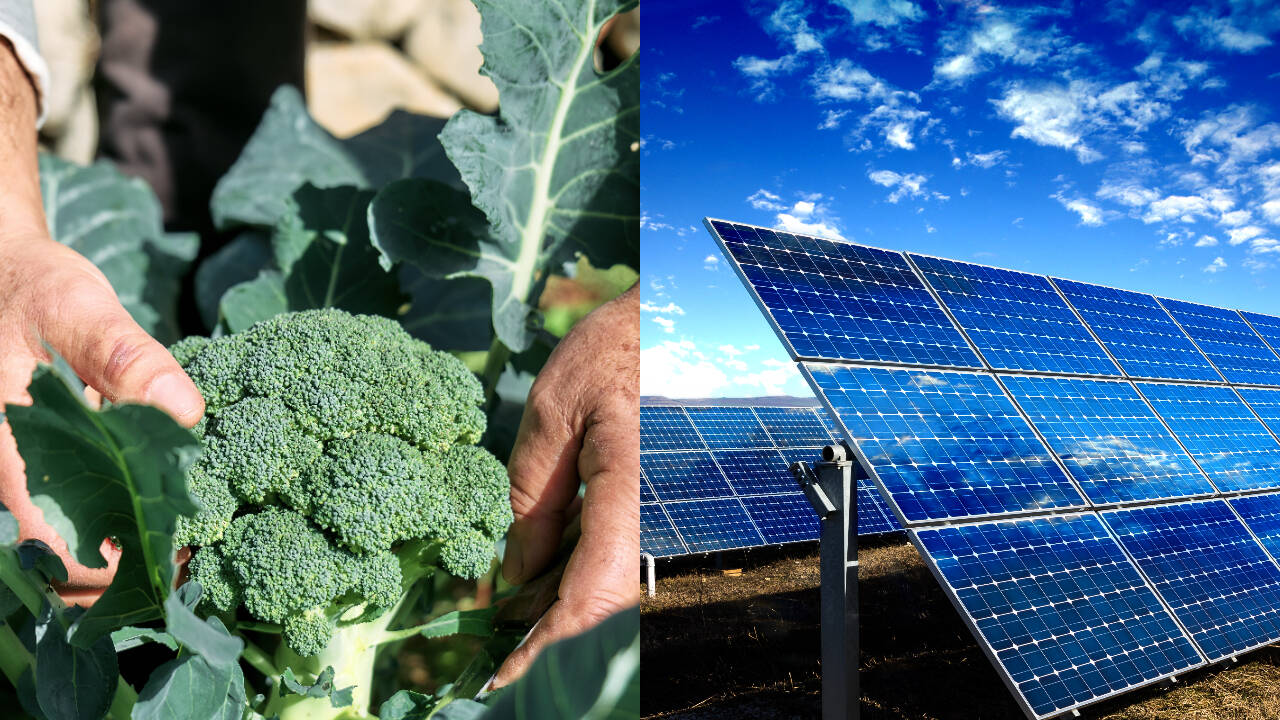
We usually treat farming and solar energy as fierce competitors for open land. You either plant crops in the dirt or pave over the field with heavy photovoltaic arrays. But a group of researchers recently tested an idea that blurs those boundaries completely. They placed semi-transparent magenta solar panels directly over growing broccoli.
The results caught plenty of agronomists off guard. The broccoli plants under the pinkish tint used sunlight 4.5 times more efficiently than standard crops sitting out in the open sun.
The Core Problem with Traditional Agrivoltaics
Traditional solar farming creates a brutal shadow over the earth. Standard opaque panels block out almost all direct sunlight. While that works fine for generating electricity, it tends to starve crops of the exact light wavelengths they need to thrive. Plants aren't greedy for every single part of the solar spectrum. They mostly rely on red and blue light to power photosynthesis, while largely reflecting or ignoring green light.
Most agrivoltaic setups force a messy compromise. Crops get shaded, yields drop, and farmers have to juggle reduced harvests just to harvest clean energy from the same acreage.
Researchers at sites like the Kärrbo Prästgård farm in Sweden decided to test a smarter filter system. Instead of blocking light indiscriminately, they used semi-transparent cadmium telluride thin-film solar panels tinted magenta. These panels absorb specific parts of the light spectrum while letting the preferred red and blue wavelengths drop down to the vegetation below.
How Broccoli Adapted to the Pink Tint
Broccoli makes an ideal test subject for this kind of experiment. It is physically robust, culturally widespread, and heavily dependent on predictable seasonal light.
When researchers placed the broccoli beneath the denser 50-percent-transparency magenta panels, the plants didn't just survive. They adapted. They managed to squeeze a 4.5-fold increase in light-use efficiency out of the filtered rays.
Yet, biology rarely hands out free lunches without a catch. There was a notable trade-off. While the panel-grown broccoli eventually matched the final size and yield of open-air broccoli, it took its sweet time getting there. The shaded plants needed an extra 25 days to reach full maturity.
For a commercial farmer operating on tight seasonal margins, waiting nearly a month longer for a harvest is a massive consideration. Time is money, and delayed crop rotation can throw off an entire yearly schedule.
Current Limitations of Experimental Tinted Solar Tech
Before you picture every farm in the country swapping out regular glass for rose-colored panels, it pays to look at the practical hurdles.
First, the technology remains strictly experimental. These magenta panels aren't sitting on commercial shelves ready for bulk order. Prototypes require precise manufacturing, and the current design actually wastes some of the green light energy that the panels filter out rather than converting it into usable electricity.
Second, crop responses vary wildly. Broccoli handled the color shift well, but other vegetables might wither, bolt, or produce unmarketable yields under the exact same filter. Climate, local weather patterns, and latitude will dictate whether a pink-tinted canopy helps or hurts a harvest.
Right now, large-scale deployment across hundreds of acres of commercial farmland doesn't make financial sense. Instead, systems like this point toward smaller, high-value applications. Think community gardens, specialized research plots, or integration directly into commercial greenhouse roofs where climate control is already managed.
What This Means for Dual-Use Land
The broader takeaway isn't just about broccoli or the color pink. It represents a shift in how we think about land use. As demand for renewable energy and food production both climb, conflicts over acreage will only intensify.
If engineering teams can refine these semi-transparent materials to capture more of the filtered spectrum while keeping crop maturation times stable, the future of farming looks entirely different. Farmers won't have to choose between putting food on the table and feeding power into the local grid. They can do both on the exact same patch of dirt.


