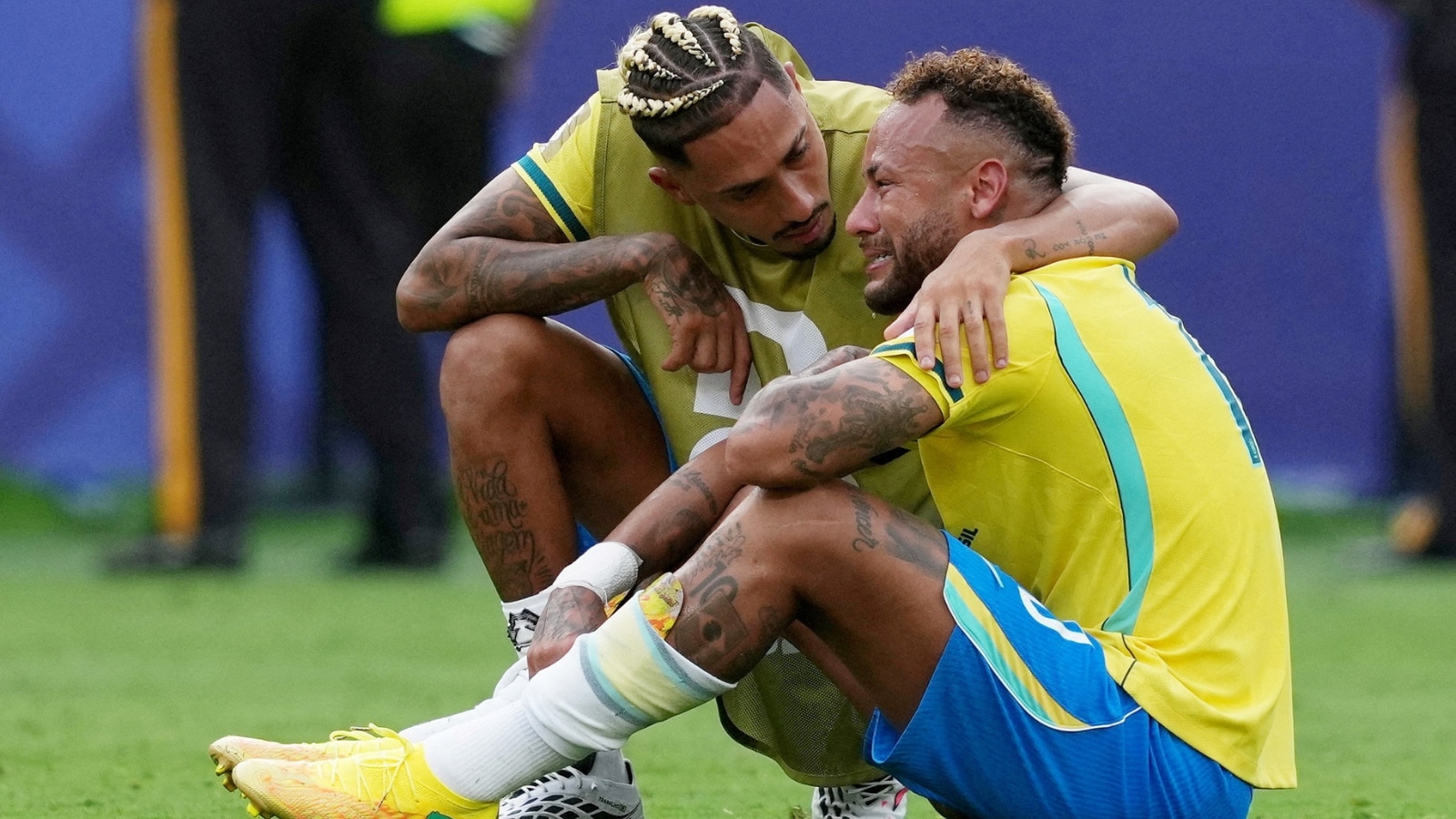
Neymar da Silva Santos Júnior’s international retirement following Brazil’s 2-1 defeat to Norway in the 2026 World Cup Round of 16 is not merely a poignant narrative of a superstar bowing out where his journey began. It represents the final closure on an era defined by a structural bottleneck: the systemic reliance on an individual savior to offset structural inefficiencies within the Brazilian football apparatus.
The data confirms the end of a historic tenure. Neymar departs as Brazil’s all-time leading men's goalscorer, with 80 goals in 129 international appearances spanning 16 years. Yet, his final tournament metrics expose the diminishing returns of a physical asset altered by chronic injury. Limited by a persistent right calf injury, Neymar registered just two appearances in the 2026 campaign—both as a second-half substitute—accumulating a brief cameo against Scotland in the group stage and a late penalty conversion against Norway at MetLife Stadium.
To evaluate his departure solely through the lens of emotional frustration or incomplete legacy is an analytical failure. His international exit must be decoded using three distinct frameworks: structural dependency risk, the compounding cost of physical degradation, and the strategic reallocation of tactical capital for Brazil’s next generation.
The Monopolistic Dependency Model
For over a decade, the Brazilian Football Confederation (CBF) operated under a high-risk talent architecture. Neymar functioned as a monopolistic asset, absorbing an asymmetrical share of possession, tactical responsibility, and psychological pressure. This centralization created a systemic vulnerability. When a single player commands the focal point of an entire tactical ecosystem, opposing managers face a simplified optimization problem: neutralize that node, and the entire offensive distribution network collapses.
This dependency produced a clear statistical paradox throughout Neymar's four World Cup campaigns:
- 2014: The structural collapse following his lumbar fracture against Colombia exposed a squad entirely devoid of secondary creative mechanisms, culminating in a historic 7-1 semi-final deficit against Germany.
- 2018: A rushed recovery from a fractured fifth metatarsal limited his lateral mobility, choking Brazil’s transition speed in the quarter-final exit to Belgium.
- 2022: Despite localized brilliance, recurring ankle sprains created an operational bottleneck in extra-time game management against Croatia.
- 2026: A persistent right calf injury relegated him to a low-leverage substitute role under Carlo Ancelotti, leaving the squad structurally unequipped to match the physical intensity and defensive block of Norway.
The reliance on Neymar altered the development vector of complementary attackers. Young talents entering the senior setup were structurally disincentivized from executing primary playmaking functions. Instead, they were configured as auxiliary support pieces designed to feed the primary engine, stalling their growth into elite decision-makers on the world stage.
The Physical Cost Function of Modern International Football
The divergence between Neymar’s international career and the prolonged longevity of contemporaries like Lionel Messi or Cristiano Ronaldo is explained by a stark physical cost function. Neymar's stylistic signature—predicated on high-frequency dribbling, close-control deceleration, and drawing contact in tight spaces—subjected his musculoskeletal system to immense mechanical stress.
International football at the tournament level has intensified its physical demands, characterized by aggressive defensive transitions and suffocating tactical fouls. Neymar became the most fouled player across multiple tournament cycles. The compounding effect of these impacts, coupled with severe ankle, metatarsal, and calf injuries, fundamentally altered his physiological output.
By the 2026 cycle, the decline in high-intensity sprinting capacity transformed Neymar from a dynamic, space-creating winger into a stationary central distributor. Carlo Ancelotti’s pragmatic tactical implementation sought to mitigate this deficit by utilizing Neymar as a late-game substitute. The strategy aimed to leverage his elite penalty execution and final-third vision against tired defensive blocks without exposing the team to his defensive transition liabilities.
The late stoppage-time penalty against Norway proved the tactical validity of this specific usage profile, but it also demonstrated its strategic insufficiency. A squad cannot reliably navigate a knockout tournament when its highest-leverage creative asset lacks the physical durability to sustain 90 minutes of elite tactical pressing.
The Next Era: Structural Reallocation and Tactical Capital
Neymar’s departure forces an immediate, mandatory restructuring of Brazil’s tactical portfolio. For the first time since 2010, the Seleção must transition from an asset-centralized model to a decentralized, collective pressing system.
Captain Marquinhos’ immediate post-match plea for patience signals an awareness of the operational frictions ahead. The current pool of young Brazilian talent possesses immense ceiling potential, yet it features a radically different profile than the individualistic creators of the past. The modern Brazilian vanguard relies on elite spatial awareness, high-volume pressing, and devastating transition speed.
The elimination of the Neymar bottleneck allows the coaching staff to implement several critical systemic adjustments:
- Possession Democratization: Without a singular star requiring high-volume touches, the offensive progression can be distributed fluidly across a front three, increasing unpredictable attacking vectors and complicating opposition defensive assignments.
- Defensive Structural Integrity: Modern tactical systems require a synchronized out-of-possession press. Replacing a stationary, post-injury veteran with high-output, two-way forwards allows Brazil to restore the aggressive counter-pressing that defined their most historically dominant eras.
- Psychological Decentralization: The institutional weight of carrying a five-time champion nation will no longer rest on one set of shoulders. This distribution reduces the single-point-of-failure anxiety that hampered the squad during high-stress knockout matches over the past 12 years.
The analytical verdict on Neymar’s international career cannot be reduced to a binary evaluation of success or failure. He achieved historical goal-scoring supremacy while operating within an era of structural organizational decline for Brazilian football. His retirement closes the chapter on the myth of the solitary savior, forcing the CBF to confront an undeniable reality: future international success will be dictated by systematic tactical cohesion, physical durability, and collective operational efficiency, rather than the isolated brilliance of a single superstar.