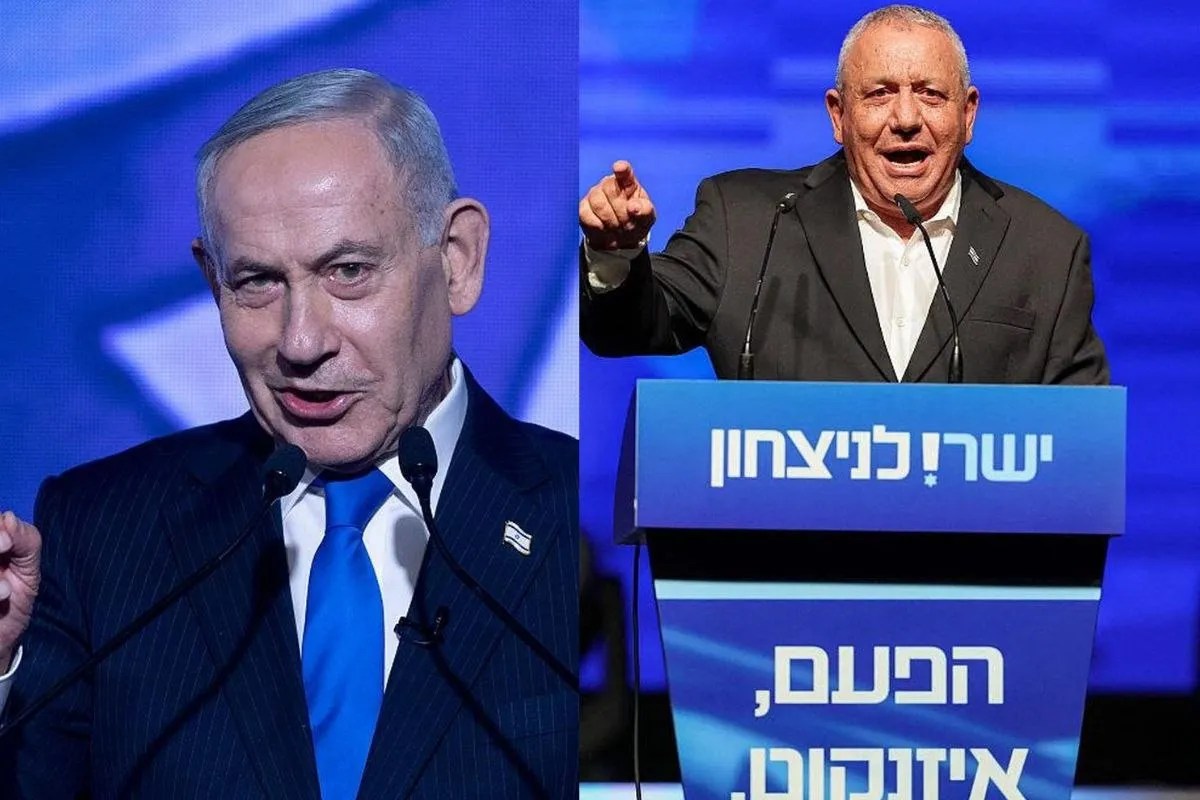
Losing a parliamentary majority looks like a funeral on television. It isn't. In Israeli coalition arithmetic, a thin or broken majority is often just the excuse a seasoned operator needs to shed dead weight, rewrite the rules of survival, and pull a heavyweight like Gadi Eisenkot into the room on terms that look generous on paper and lethal in practice.
Standard commentary on headlines like "बहुमत खोने के बाद बैकफुट पर नेतन्याहू, क्या विरोधी आइजेनकोट से मिलाएंगे हाथ?" treats coalition politics like a playground headcount. One side drops below 61 seats. The prime minister is supposedly on the back foot. The only question left is whether an opposition figure with military credibility and centrist appeal will throw a lifeline or deliver the coup de grâce.
That framing is lazy. Worse, it misses how power actually moves in Jerusalem.
A prime minister isn't weak just because his existing bloc cracks. He is weak when he has no alternative path to a governing mandate, no control over the legislative calendar, or no leverage over rival ambitions. Benjamin Netanyahu has survived enough near-death experiences in Israeli politics to understand something amateurs keep forgetting: losing a majority is only fatal if you can't turn the crisis into a realignment.
And Gadi Eisenkot isn't a simple walk-on character in that story either.
The Myth of "Back Foot" Politics
Watch enough cable panels and you start believing every political setback is a domino falling in slow motion. Loss of majority equals panic. Panic equals concessions. Concessions equal collapse.
Reality in the Knesset works differently. A coalition in Israel is never a single ideological family holding hands. It is a transactional marriage of factions that barely tolerate one another, held together by ministerial portfolios, budget allocations, judicial or religious red lines, and mutual fear of early elections. When that majority slips away, the pressure doesn't land exclusively on the prime minister. It lands on every party leader who suddenly faces voters who might punish them for causing instability—or reward them for cutting a deal.
I have watched political strategists and corporate boardrooms alike burn millions of dollars misreading leverage during a crisis. They assume the party that just lost a vote or a headcount is desperate and easy to roll. Half the time, the person standing in the rubble is already pricing in the next bargain while everyone else is still mourning the old math.
To understand whether Netanyahu and Eisenkot could ever link up—and what such a move would actually mean—we have to define our terms cleanly. In Israeli politics, coalition survival is not the same thing as ideological harmony. Emergency or unity alignments have historically formed out of shared existential or security pressures, or out of cold calculation when rival blocs deadlock. They rarely erase deep policy disagreements. They suspend or repackage them so the machinery of state keeps turning.
The lazy consensus assumes a politician who loses his majority is automatically cornered. Sometimes he is. Sometimes he just got permission to stop listening to his most reckless allies.
Why Gadi Eisenkot Changes the Equation
Gadi Eisenkot is not just another opposition lawmaker looking for a microphone. As a former Chief of Staff of the Israel Defense Forces (IDF) and a seasoned political figure who has navigated both opposition benches and wartime decision-making circles, he carries a specific kind of currency: institutional and security credibility.
In Israeli politics, security credentials don't solve every argument, but they change the temperature in the room. A leader facing criticism over war management, hostage negotiations, strategic direction, or national resilience faces a very different political calculation when talking to a former IDF chief than when talking to a purely partisan rival.
Let's be clear about what Eisenkot represents—and what he doesn't. He is not a blank slate who exists to rescue Netanyahu's career out of charity. Any serious politician in his shoes knows the cost of entering a government led by a polarizing figure. Voters who backed the opposition to replace Netanyahu will punish anyone who looks like a prop. Voters who value stability and security, however, may look at the situation through a colder lens: if the country is facing severe security and diplomatic strain, does staying purely in opposition accomplish anything, or does holding key levers inside the room matter more?
That tension is the real story. Not a soap opera about who is smiling at whom in a Knesset corridor.
What People Actually Ask When a Majority Cracks
Whenever a majority wobbles and a name like Gadi Eisenkot enters the conversation, the same predictable questions pop up across search bars and living rooms. Most of them start from a flawed premise.
- "Is Netanyahu finished if he loses his majority?" That asks the wrong question. Losing a majority ends that coalition formula; it does not automatically end the politician. Netanyahu's durability has always rested on exploiting divisions among his opponents as much as rallying his base. He is only finished when a rival bloc can actually assemble and hold a durable alternative—or when his own core collapses simultaneously.
- "Would Eisenkot join hands with Netanyahu?" Framing it as "joining hands" romanticizes something that, if it ever happens, would look far more like a hard-nosed contract. Politicians in high-stakes environments rarely hold hands; they trade guarantees, veto power, portfolios, and timelines.
- "Does a unity or centrist addition fix deep political divides?" No. Bringing a centrist or security-focused figure into a coalition may broaden its legitimacy or shift specific decisions, but it doesn't magically erase disputes over governance, judicial authority, coalitions with hardline factions, or long-term strategy. Often, it simply moves the argument inside the cabinet instead of keeping it outside.
- "Why do opposition figures even consider talking when the government looks weak?" Because opposition from the sidelines can feel like yelling at a wall while consequential decisions are made behind closed doors. Influence without formal authority is fragile.
A Thought Experiment in Coalition Mechanics
Imagine a scenario where a prime minister loses his bare majority due to a coalition walkout over a domestic bill, while regional security tensions remain elevated and the opposition remains split into competing factions that cannot agree on who should lead an alternative government.
On paper, the prime minister looks cornered. In practice, look at the incentives on both sides.
If the opposition is fractured—say, center-right, centrist, and other factions pulling in different directions—no single alternative leader has a clean path to 61 seats without awkward compromises. Meanwhile, an early election carries real risk for lawmakers who aren't sure they'll keep their seats or who fear voter fatigue.
In that environment, reaching toward a figure like Gadi Eisenkot isn't an admission of surrender. It is an attempt to widen the base, project steadiness to nervous allies and international partners, and break a stalemate. Conversely, for Eisenkot, engaging—or refusing to engage—is a high-stakes test of leverage: step in too cheaply and you become political cover; stay out when national security demands action and critics say you chose posture over responsibility.
That is how real political leverage works. It isn't neat. It isn't noble. It is math wrapped in pressure.
| Political Lens | Lazy Consensus View | Sharp Insider Reality |
|---|---|---|
| Losing a Majority | The prime minister is weak, cornered, and on the way out. | The old coalition formula failed; leverage shifts and new bargains become possible. |
| Gadi Eisenkot's Role | A simple lifeline or a pure rival waiting to strike. | A high-credibility actor weighing influence against reputational cost. |
| Potential Alignment | Proof of sudden ideological agreement. | A transactional move driven by stalemate, security, or survival calculus. |
| Opposition Leverage | Guaranteed victory just because the government slipped. | Only real if opponents can unite without tripping over their own egos. |
Lessons From High-Stakes Negotiations (And Where My Take Can Backfire)
Political analysts and business executives make the exact same mistake during moments of turbulence: they confuse visible discomfort with imminent collapse.
In corporate turnarounds and M&A standoffs, I have seen seasoned executives misread a rival's retreat. A founder steps back from a board seat or gives up a controlling stake in one entity, and everyone celebrates a total victory—only to discover six months later that the founder shed liabilities, kept the intellectual property, and positioned themselves as the indispensable operator in the next round.
Scholars of comparative politics and coalition theory—from Maurice Duverger's classic work on party systems to modern research on minority and oversized cabinets in parliamentary democracies—have long shown that formal seat counts only tell part of the story. Agenda control, veto players, and the credibility of outside options often matter more than a razor-thin majority on paper.
Still, I need to be honest about the downside of betting on cleverness and realignment.
Contrarian analysis has a classic trap: over-indexing on tactical genius. Sometimes a leader isn't playing four-dimensional chess. Sometimes the arithmetic really is broken. Sometimes hardline allies refuse to budge, voters genuinely want an exit, and a figure like Eisenkot has every incentive to keep his distance rather than absorb blame for someone else's mess. If you assume every crisis is secretly an opportunity for the incumbent, you can miss the moment the trap actually snaps shut.
What to Do Instead of Guessing Headlines
If you follow Israeli politics—or any high-stakes negotiation where power looks shaky—stop reading majority losses as final verdicts. Read them as repricing events.
- Track the alternatives, not just the deficit. A prime minister at 58 seats isn't doomed if the opposition is stuck at 52 with three incompatible agendas. Watch who can actually form a government, not just who lost a vote.
- Watch the price of admission. If a figure like Gadi Eisenkot ever moves closer to a coalition table, don't look at the handshake photos first. Look at what demands are attached—decision-making authority, war or security cabinet roles, policy guardrails, or clear exit ramps.
- Separate noise from binding commitments. Trial balloons, media leaks, and polite meetings are cheap in politics. Binding agreements, legislative votes, and cabinet appointments are what actually move power.
- Price in the risk of miscalculation. Never assume a seasoned operator has everything under control, and never assume an opposition leader lacks the discipline to say no. Both sides can misread the room.
When a majority breaks, the loudest voices usually predict an immediate collapse. Usually, the quieter game is just starting.