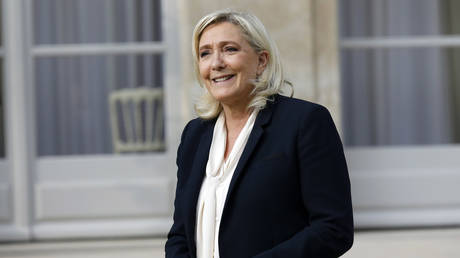
The rain in Hénin-Beaumont does not fall so much as it hangs, a damp, grey weight over the shuttered red-brick terraces of France’s former coal-mining heartland. Decades ago, this town beat to the rhythm of industrial machinery and socialist anthems. Today, it moves to a different cadence. It is here, among the quiet streets and the lingering scent of espresso and tobacco from the local tabac, that the modern architecture of French nationalism was perfected.
For years, Parisian elites treated this region as a cautionary tale, a forgotten corner of the map to be visited only during election cycles. But one woman saw it as a foundation. Marine Le Pen did not stumble into her position as the permanent challenger of French politics; she built it brick by brick, outlasting presidents, surviving scandals, and turning political defeat into a masterclass in political endurance.
To understand the current state of French politics is to understand a strategy based entirely on patience. While traditional parties splintered and meteoric political stars burned out into public indifference, Le Pen simply waited, refined her image, and watched the tide come in.
The Ghost on the Wall
Every family business has its inheritance, but few are as heavy as the one handed to Marine Le Pen. For decades, the National Front was defined by her father, Jean-Marie Le Pen—a man who relished the role of the political pariah, prone to provocative statements and comfortable on the fringes of the republic. The party was a protest vehicle, designed to shock rather than to govern.
When his daughter took the reins, she recognized an absolute truth: you cannot walk through the front doors of the Élysée Palace if the public views you as an insurgent at the gates.
What followed was a methodical, painful public decoupling. She stripped away the overt radicalism, changed the party’s name to the National Rally, and eventually expelled her own father from the movement he founded. It was a cold, calculated act of political fratricide, executed under the glaring lights of the national media. It signaled to the French electorate that her ambition was not to throw rocks at the institution, but to occupy it.
This process of normalization was not merely cosmetic. It required a complete overhaul of how the party spoke to the ordinary citizen. Consider the shift in tone: the old angry rhetoric regarding identity was replaced by an intense, protective focus on purchasing power, local public services, and the defense of the secular republic. She transformed a hard-right ideology into a shield for the working class against the perceived indifference of globalized capital.
The Anatomy of a Voter
To see how this works in practice, look away from the television studios of Paris and consider a hypothetical citizen named Marc, a forty-five-year-old logistics worker living in the outskirts of Amiens.
Marc does not read radical political tracts. He cares about the price of diesel, the closure of the local maternity ward, and the fact that his adult children cannot afford to buy a home in the town where they grew up. For years, Marc voted for the left because they promised to protect him from the market. Then he voted for the center because they promised modernity and efficiency. Neither delivered the stability he craved.
When Le Pen speaks, she addresses Marc directly. She does not lecture him on global economic indicators or European integration. Instead, she validates his sense of loss. She frames the modern world not as an opportunity, but as a series of threats to his way of life. By shifting the conversation from racial grievance to economic survival, she made voting for her party feel respectable, even defensive.
This is how the old "republican front"—the traditional alliance of left and right voters who would unite in the second round of an election to block her family—crumbled. The taboo vanished. Voting for the National Rally became an ordinary act of political dissatisfaction.
The Architecture of Defeat
Most politicians do not survive three unsuccessful runs for the presidency. In the brutal arena of French democracy, a single major loss is usually enough to trigger an internal party coup or a quiet retirement into corporate consulting. Yet Le Pen has turned her defeats into a staircase.
In 2017, her performance in the final televised debate against Emmanuel Macron was widely criticized as erratic and unstatesmanlike. The conventional wisdom declared her career over. But instead of retreating, she returned to the drawing board. She studied her failures, softened her presentation, and elevated a new generation of polished, media-savvy politicians—most notably Jordan Bardella—to handle the daily partisan brawling.
By 2022, she had closed the gap significantly. The margin of victory for the political center shrank from a chasm to a bridgeable distance. Each election cycle left her party with more seats in the National Assembly, more local mayors, and a vastly expanded treasury funded by taxpayers.
Her strategy relies on the steady accumulation of political gravity. While her opponents must defend the messy compromises of governance, she remains the steady alternative, waiting for the inevitable exhaustion of the incumbent power.
The View From the Horizon
The halls of the Élysée Palace are filled with history, gold leaf, and the ghosts of grand ambitions. For decades, the presidency was protected by an unwritten rule that the extremes would always be turned away at the final moment. That certainty has evaporated.
The challenge facing France is no longer about a single political figure or an isolated election. It is about a profound, systemic fatigue with the status quo. The electorate is tired of technocratic solutions to deeply human anxieties. They are tired of being told that their economic precarity is a necessary price for global competitiveness.
Le Pen’s strength lies in her permanence. She has outlasted three presidents and seen the political map of France redrawn multiple times. She understands that power in the modern era belongs to those who can endure the longest without breaking.
As the country moves toward its next major political crossroads, the question is no longer whether her movement can win, but whether the traditional political structures have anything left to offer a skeptical public. The siege has been long, the defenses have worn thin, and the woman outside the gates has no intention of walking away.