The Weight of the Locked Door
Consider a man named Elias. He is forty-two, a veteran of two tours, and a father who has forgotten how to play. For the last decade, his life has been defined not by the world outside, but by the gray perimeter of his bedroom. He has tried every pill the modern pharmacy can offer. He has sat through countless hours of talk therapy that felt like trying to empty the ocean with a thimble. For Elias, and millions like him, depression isn't a "bad mood." It is a physical weight, a neurological cage that has rusted shut.
The science of the last fifty years has largely focused on managing the symptoms of this cage. We built better bars, perhaps painted them a softer color, but we rarely found the key to the lock.
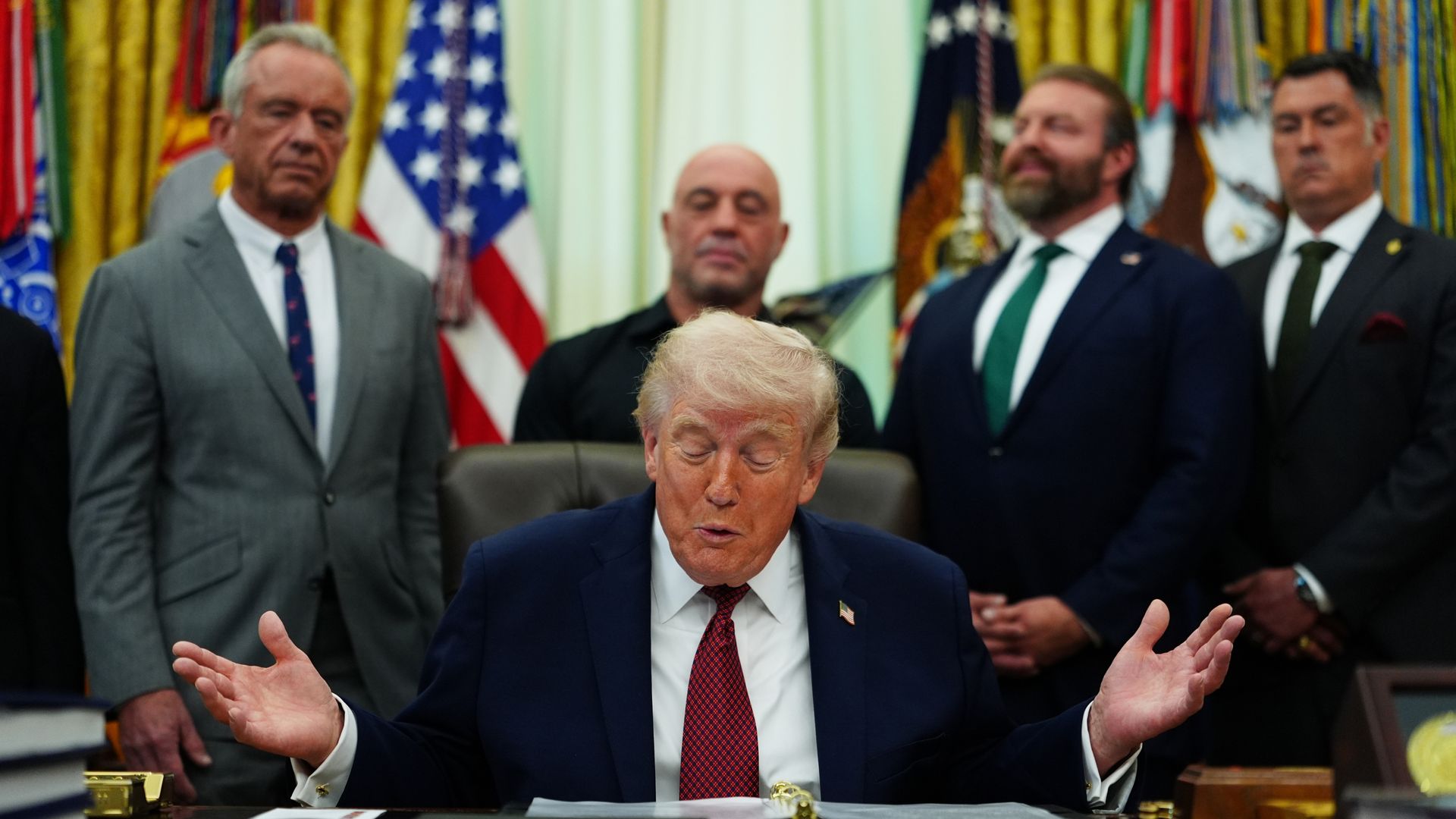
That changed with a stroke of a pen in the Oval Office.
President Trump recently signed an executive order designed to shatter the bureaucratic glass wall between terminal or treatment-resistant patients and the potential of psychedelic medicines. It is a move that shifts the conversation from "someday" to "right now." For people like Elias, "someday" was a luxury they could no longer afford.
The Chemistry of a Shattered Perspective
To understand why this order matters, we have to look past the counter-culture baggage of the 1960s. We have to look at the brain itself.
In a healthy brain, thoughts move like water through a delta, finding new paths and nourishing the soil. In a brain ravaged by severe PTSD or clinical depression, those paths have become deep, jagged canyons. The water only goes one way. This is the Default Mode Network (DMN) on overdrive—the part of your brain responsible for self-reflection and "mind-wandering" becomes a loop of self-loathing and trauma.
The substances targeted by this executive order—psilocybin, MDMA, and other breakthroughs—act as a temporary flood. They don't just "get a person high." They physically suppress the DMN, allowing the brain to bypass those jagged canyons for a few hours. It is a biological reset.
But the FDA’s traditional approval process moves at the speed of a glacier. While scientists saw the data, and while clinical trials showed recovery rates that dwarfed standard antidepressants, the red tape remained thick. The new order specifically instructs federal agencies to "expand access" to these therapies for those who have exhausted every other option. It isn't a free-for-all. It is an emergency exit.
The Invisible Stakes of Bureaucracy
We often talk about government policy in terms of budgets and "order signatures," but the real stakes are measured in the quiet of a Tuesday morning. They are measured by the person who decides to stay in the world because they finally felt a glimmer of connection to something larger than their pain.
The "Right to Try" was the ideological ancestor of this move. That law allowed terminally ill patients to access experimental drugs. This new order takes that logic and applies it to the invisible terminal illness of the mind. If your brain is a house on fire, you don't wait for the fire department to finish their three-year safety audit of a new type of extinguisher. You use the tool that works.
Critics often worry about the "Wild West" of drug use. Their concern is rooted in a valid fear of the unknown. However, the order doesn't remove medical oversight; it demands that the oversight stop being an obstacle to survival. It forces the Department of Health and Human Services and the VA to prioritize the integration of these treatments into actual clinical settings.
A Hypothetical Walk Through the New Reality
Imagine Elias again.
Under the old system, he would wait another five to seven years for MDMA-assisted therapy to clear every final hurdle of the federal bureaucracy. By then, his children would be grown. His marriage might be a memory.
Under the new mandate, Elias’s doctor at the VA can look at his ten-year history of failed treatments and say, "There is a path." He enters a clinic. He isn't handed a bag of mushrooms and sent home. He is placed in a supervised, clinical environment with two trained therapists. He takes a precise, pharmaceutical-grade dose.
For six hours, the walls of his trauma become transparent. He doesn't just remember his deployment; he processes it without the paralyzing fear. He sees the "self" that existed before the war.
The next day, he isn't "cured" in the way a broken bone is set, but the cage is open. He has a map. The executive order is the bridge that gets him to that clinic before he gives up entirely.
The Economic Ghost in the Machine
Beyond the heart-wrenching human stories lies a cold, hard logic that even the most cynical accountant can appreciate. Treatment-resistant depression and PTSD cost the global economy billions in lost productivity, disability payments, and emergency room visits.
The current model of mental health care is a subscription service. You take a pill every day for the rest of your life. It manages the gray, but it rarely invites the color back in.
Psychedelic-assisted therapy is a paradigm shift toward "interventional" medicine. It is often a handful of sessions that produce long-lasting results. By speeding up access, the administration isn't just being "bold" or "edgy"—they are responding to a massive failure in the medical marketplace. When the old tools stop working, the market demands new ones. When the government gets in the way of those tools, the government must be moved.
The Risk of the Unknown
We must be honest. These are powerful substances. They are not a "magic bullet" that works for everyone, and for a small percentage of people with underlying psychotic disorders, they can be dangerous. This is why the clinical framework is so vital.
The fear has always been that by opening the door, we might lose control. But we have to ask: what does "control" look like right now? It looks like a suicide epidemic among veterans. It looks like an opioid crisis born from people trying to numb a pain that no one else could see. It looks like a generation of people who feel "fine" but have forgotten what it means to feel alive.
The executive order recognizes that the risk of the drug is now significantly lower than the risk of the status quo.
The Silence at the End of the Hall
History will likely look back on this era of mental health as we now look back on the days before antibiotics. We used to treat infections with bloodletting and prayer. We used to treat the soul with isolation and sedation.
The signing of this order is a signal that the era of sedation is ending.
It is a recognition that the human mind has a staggering capacity to heal itself, if only we give it the right environment to do so. It turns the "Right to Try" into the "Right to Recover."
Think of the thousands of hallways in thousands of homes where the lights have been off for years. The father who can't come out. The sister who can't stop shaking. The son who has become a ghost in his own life.
The pen moved across the paper, and for the first time in a generation, the air in those hallways changed. The lock didn't just click. The door actually moved an inch.
Somewhere, in a room that has been dark for too long, a man like Elias is looking at the handle. He is breathing. He is waiting. And for the first time in a decade, he has a reason to reach out and turn it.