The coffee in Arthur’s mug went cold hours ago. He didn’t mind. Outside his office window in Ottawa, a biting November wind whipped wet snow against the glass, blurring the limestone facades of Parliament Hill into gray smudges. Inside, the radio hummed with another broadcast about executive orders, renegotiated tariffs, and the unpredictable weather patterns of Washington politics.
Arthur is not a politician. He is a trade analyst who has spent thirty years watching the invisible seams that hold North America together fray and tighten, fray and tighten, in an endless rhythmic cycle. But this year felt different. The rhythm had broken.
When your entire economic life is tethered to a single, massive neighbor, you learn to read the shifts in its posture the way sailors read the sky. For generations, the Canadian script was simple: sell wood, oil, cars, and wheat south across an undefended border. Trust the rules. Trust the institutions. Sleep soundly.
Then the rules started bending like warm wax.
Every morning brought fresh reminders that proximity is both a blessing and a cage. Tariffs dropped without warning like summer squalls. Supply chains built over half a century were treated as bargaining chips in domestic political theater. In boardrooms from Toronto to Calgary, the quiet panic turned into urgent arithmetic. If you sell seventy-five percent of your goods to a partner who can change the locks on a whim, you are not trading. You are surviving at someone else’s pleasure.
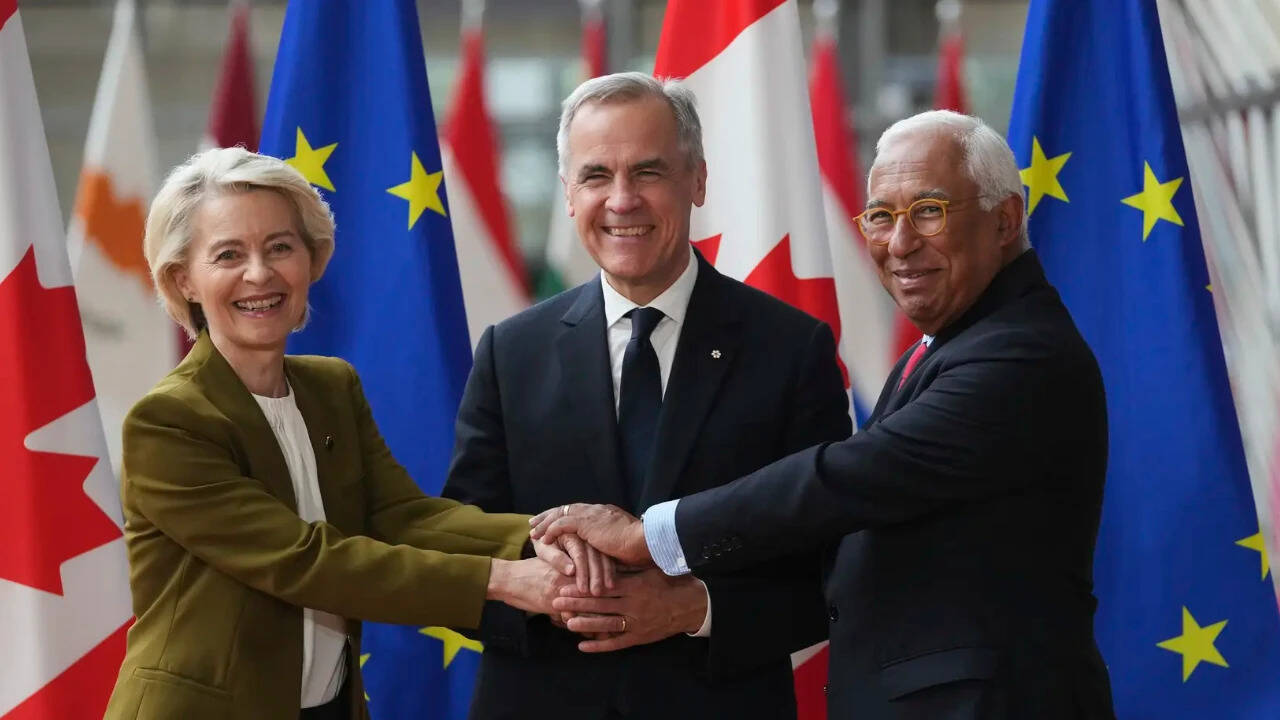
So, whispers that once lived only in academic seminars and backroom diplomatic cables began to surface. Associate membership. The European Union.
To the casual observer, the idea sounds like geography gone mad. Europe is thousands of miles away across a black, churning ocean. Canada occupies the northern crown of the Americas, stitched historically, culturally, and linguistically to the New World. Why look eastward when the Atlantic is wide and deep?
Because distance is relative when trust erodes.
Consider what happens when a nation of forty million people wakes up to the realization that its primary economic shelter is no longer stormproof. You look for new rafters. You look across the water.
The European Union is no stranger to complex unions. It is a sprawling, bureaucratic empire of twenty-seven nations bound by shared laws, open markets, and a stubborn belief that pooling sovereignty makes small countries strong against global giants. It already maintains deep trade pacts with Ottawa through the Comprehensive Economic and Trade Agreement, known quietly as CETA. But CETA was built for an era of normal diplomacy. It was built when trade agreements were treaties signed with gold-nibbed pens and left undisturbed on mahogany shelves.
Associate status is something else entirely. It is closer, stickier, more profound. It implies a deeper alignment of regulatory standards, institutional ties, and strategic solidarity. It is a way of saying: we share your values, we share your standards on labor, environment, and data privacy, and we want a seat at your table when the rules of the twenty-first-century world economy are written.
Yet, stepping into that orbit requires swallowing some bitter pills.
European regulation is notoriously dense. Brussels does not hand out exemptions easily. To harmonize regulations with the EU means rewriting domestic rulebooks, enduring endless directives, and accepting a European court’s ultimate arbitration on trade disputes. For a proud nation fiercely protective of its sovereignty, trading one dominant partner for another across an ocean can feel like jumping from the frying pan into an ancient, very orderly fire.
Down in the industrial heartland of southern Ontario, in towns where automotive assembly lines hum twenty-four hours a day, workers do not talk about associate membership using diplomatic jargon. They talk about job security.
Take Elena, a shift supervisor at an auto parts plant outside Windsor. Her grandfather built transmissions here when the auto pact was signed in the sixties. Her father weathered the storms of the first NAFTA negotiations. Elena knows the hum of the CNC machines better than her own heartbeat. But lately, her sleep is interrupted by the kind of anxiety only modern economic vulnerability can produce.
When Washington hints at border taxes or demands domestic content quotas that render Canadian manufacturing uncompetitive overnight, Elena’s plant feels the tremor before the politicians in Ottawa even draft a press release.
"We are tired of holding our breath," she said, wiping grease from her hands during a brief shift change. "Every four years, we hold a national referendum on whether our livelihood is legal. We need stability. If Europe offers a floor beneath our feet instead of a tightrope, I don't care how many miles of ocean are in the way."
Her sentiment is echoed in unexpected corners of the country. In the high-tech corridors of Vancouver, software developers gaze toward European privacy standards not as restrictions, but as a gold standard of digital ethics. In the agricultural cooperatives of Saskatchewan, farmers who have seen their grain shipments weaponized in diplomatic spats look at European markets with a new kind of hunger.
History is full of these sudden magnetic realignments. Countries do not change their geography, but they can alter their gravitational pull.
When the British Empire pivoted toward Europe in the mid-twentieth century, breaking old imperial trade preferences, Canadians felt abandoned. They had to invent a modern economic identity from scratch, diversifying their exports, building homegrown institutions, and stepping onto the global stage with quiet confidence.
Now, the wheel turns again.
The United States remains Canada’s closest friend, its cultural mirror, and its irreplaceable neighbor. Families straddle the border. Friendships cross the 49th parallel. Security is deeply integrated through NORAD and NATO. No diplomatic exploration in Brussels can erase a history written in shared languages, shared music, and shared blood.
But friendship and economic hostage-taking are two different things.
Exploring associate membership is not an act of divorce. It is an act of insurance. It is Canada walking to the edge of its traditional porch, looking out at the wider horizon, and realizing that the world has grown too large and too volatile to keep all its grain in one barn.
European capitals have received the initial diplomatic probes with a mixture of polite intrigue and cautious realism. Brussels is currently consumed by its own internal crises, climate transitions, and Eastern security anxieties. Bringing a North American goliath into even an associate tier of integration would upend institutional assumptions that took decades to build.
Yet, strategic logic has a way of cutting through bureaucratic hesitation. In a fractured global economy where superpowers weaponize supply chains and trade is routinely used as a bludgeon, middle powers must band together or be picked apart piece by piece. Canada and the EU share a worldview: a belief in multilateralism, the rule of law, and a rules-based international order that currently feels perilously close to collapse.
Back in Ottawa, the snow continued to pelt the parliament buildings, coating the iron roof of the Peace Tower in white.
Arthur closed his briefing binder and rubbed his eyes. The memo on his desk outlined the legal frameworks of European association, the hurdles of regulatory alignment, the political opposition from domestic factions who feared foreign interference, and the sheer logistical audacity of bridging the Atlantic economic space.
It was ambitious. It was fraught with risk. It might take a decade of grueling negotiations to achieve anything tangible.
And yet.
The old world was gone. The certainty of the post-war American-led economic consensus was not coming back. Nations were retreating behind walls, hoarding critical minerals, and treating trade allies like adversaries.
Canada had two choices. It could hunker down, brace for the next storm, and hope the southern winds stayed calm. Or it could look out across the dark water, raise a hand to old friends, and begin building a bridge that nobody thought was possible.
The wind rattled the windowpane one last time, sharp and insistent, calling attention to the cold night outside. Arthur stood up, switched off his desk lamp, and walked out into the quiet corridor, leaving the map of the world open to the vast blue expanse between two shores.