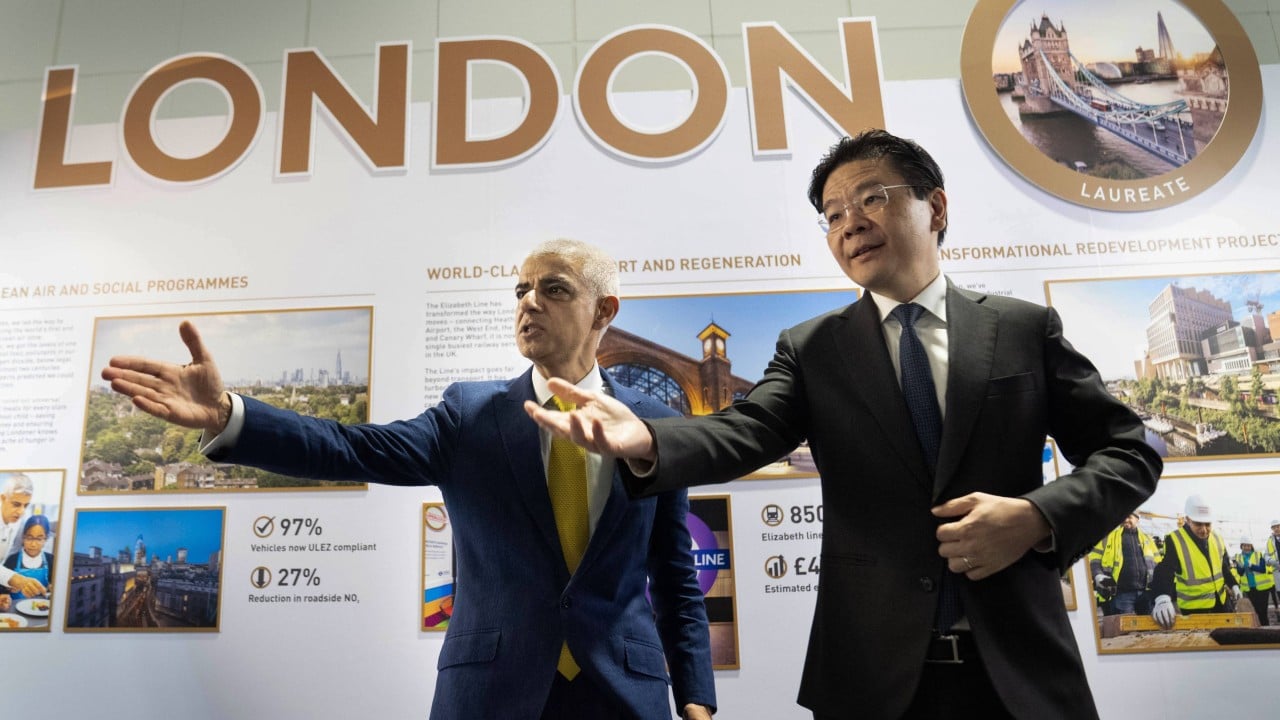
When London Mayor Sadiq Khan stood in the heart of Southeast Asia in June 2026 to collect the prestigious Lee Kuan Yew World City Prize, the optics looked perfect. Here was the leader of one of the planet’s oldest democratic capitals accepting a massive accolade from one of the world’s most hyper-efficient city-states. Then came the social media videos. Khan was filmed eating satay at Lau Pa Sat, pulling teh tarik, and visibly grimacing after tasting his very first bit of durian.
It made for great internet fodder. But behind the friendly diplomatic handshakes and culinary experiments, a massive reputational battle was quietly brewing.
Khan quickly used his platform to announce a new public housing strategy for East London. He explicitly branded it as a Singapore-inspired initiative. Back home, critics immediately scoffed at the comparison. The announcement triggered an intense debate about the actual state of both cities. It forced a raw comparison between London’s messy, historic democracy and Singapore’s tightly controlled corporate efficiency.
This isn't just a simple story about a politician going on a far-flung trade mission. It reveals a deep friction between two global hubs trying to define what a successful city looks like in 2026.
The Myth of the Plug and Play Singapore Housing Model
Politicians love importing shiny foreign ideas. It sounds great in a press release. Khan announced that City Hall would inject 100 million pounds into the Silvertown Partnership in East London to support the construction of 7,000 new homes. He promised that 30 per cent of these would be genuinely affordable. He pointed directly to Singapore's Housing & Development Board as the ultimate inspiration for this new era of British housebuilding.
The comparison falls apart the second you look at the actual mechanics.
Singapore’s public housing system works because the state has total dominance over the local property market. Roughly 80 per cent of Singapore’s resident population lives in these government-built flats. It is a massive, highly regulated ecosystem where the government dictates who buys, who sells, and at what price.
London cannot do this. The British capital operates on a fragmented planning system that relies heavily on private developers to build anything at all. When a mayor wants to build affordable housing in London, they must haggle with corporate land owners, navigate complex local council borough rules, and face endless legal objections from local residents. Trying to fix London's housing crisis by copying Singapore without changing the entire legal system is like trying to put a Ferrari engine into a bicycle. It won't fit. The wheels will come off.
The Absolute Power of 90 Per Cent Land Ownership
Let’s look at the actual data points that make these two cities completely different beasts. Property economists quickly pointed out the massive flaw in the mayor’s grand vision. Singapore’s government owns roughly 90 per cent of the land within its national borders.
Think about that figure. Ninety per cent.
This total ownership allows the Singaporean state to execute long-term urban planning strategies across decades. They don't have to worry about political policy shifts every four years. If the state decides a new train line or a massive block of high-rise flats needs to go up in a specific district, it happens.
London is the exact opposite. Land ownership in the British capital is a messy patchwork. Pieces of the city are owned by ancient aristocratic estates, offshore private equity funds, thousands of individual homeowners, and separate railway companies. City Hall owns an incredibly tiny fraction of London’s actual dirt.
Because of this, the London planning process is slow, expensive, and constantly tied up in courtrooms. A private developer in London can spend five years just trying to get permission to break ground on a single tower block. In Singapore, the state simply draws a line on a map and begins construction. Calling a 100 million pound investment in East London a Singapore-style model ignores the fundamental economic reality of how land works in the United Kingdom.
Fighting Global Disinformation From a 203 Foot Billboard
The clash over city reputations took a weirder turn during the visit. Khan chose his Singapore trip to launch a brand new 7 million pound international tourism and investment campaign. He did this by unveiling a massive 203-foot digital billboard right inside the Suntec Singapore convention venue.
The goal of the campaign? To fight back against what the mayor called a global scourge of online disinformation targeting London.
According to City Hall research, social media users across Asia are being heavily targeted by coordinated online narratives that paint London as a dangerous, declining, and crime-ridden wasteland. This online campaign is designed to project a confident, outward-looking image to combat those specific fears. It is an acknowledgment that a city's reputation is highly fragile in the internet age.
This highlights a massive contrast in how both cities handle public safety and global perception. Singapore is famous for its near-zero crime rate, strict laws, and heavy surveillance network. It rarely has to worry about international press coverage claiming its streets are unsafe. London has to constantly defend its reputation on the global stage while managing real domestic challenges regarding knife crime, underfunded public services, and political instability following Brexit.
Launching a defensive public relations campaign in Singapore feels incredibly deliberate. It shows London is fully aware that it is losing the reputational narrative to hyper-safe Asian hubs.
The Real Cost of Green Urbanism
During his trip, Khan also spent time wandering through Gardens by the Bay, praising Singapore's City in a Garden vision. He called the green infrastructure an inspiration for London's own skyline. Again, the sentiment is nice, but it completely overlooks the massive financial chasm between the two locations.
Singapore can afford to pour billions of dollars into futuristic vertical gardens and climate-resilient architecture because it runs a massive budget surplus. Its economy is structured like a highly profitable multinational corporation.
London is broke. Local government councils across the British capital are facing bankruptcy. The central government is tightly squeezing public spending. The idea that London can simply deploy massive green infrastructure projects across its boroughs is a fantasy.
When London attempts large-scale green initiatives, they usually result in intense political warfare. Look at the expansion of the Ultra Low Emission Zone. It caused a massive political backlash from working-class drivers who couldn't afford to upgrade their vehicles. Singapore manages its traffic through an expensive electronic road pricing system and a certificate of entitlement that makes car ownership cost more than a literal house. Londoners would riot if a politician tried to implement those exact same rules in the UK.
Diversity Versus Total Order
The core of this reputational clash comes down to a fundamental philosophical disagreement about what makes a global city great.
During an interview with regional media at the summit, Khan argued that London’s radical diversity makes it stronger, not weaker. He claimed that despite years of political upheaval, the capital's ability to attract global talent from every corner of the earth keeps it at the top of the food chain.
Singapore takes a very different approach to social engineering. It manages its diversity through strict racial quotas in public housing blocks to ensure distinct ethnic groups don't cluster into segregated neighborhoods. It values order, predictability, and social cohesion above absolute personal expression.
This is the real clash that nobody wants to talk about on camera.
- London thrives on chaos. It is creative, loud, politically messy, and culturally rebellious. It produces global trends because it allows friction.
- Singapore thrives on control. It is clean, perfectly manicured, safe, and deeply predictable. It attracts global wealth because it eliminates risk.
You cannot easily borrow the policy successes of one without accepting the political philosophy of the other.
How to Judge the Success of an Urban Hub
If you are an investor, business owner, or a professional choosing where to base yourself in 2026, you shouldn't buy into the polished PR narratives pushed by visiting politicians. Both cities are playing completely different games.
Do not expect London to magically solve its housing crisis using Asian policy methods. It just won't happen. The structural barriers are too deep. If you are looking at property markets or business expansion, you have to accept London for what it is. It is a high-yield, high-friction environment dominated by private capital and complex local politics.
If you want absolute certainty, long-term policy stability, and state-backed infrastructure, Singapore remains the undisputed king. But that predictability comes at the cost of operating in an environment where the state controls almost every single variable of civic life.
The next time a politician claims they are importing a world-class model from abroad, look directly at the land registry data. Look at the balance sheets. The real story of a city is never found on a giant digital billboard in a convention center. It is found in the unglamorous realities of local property laws and municipal budgets. Look at those cold hard facts before you buy into the political hype.


