The incense smoke had long since cleared by the time the neighbors noticed the silence. In the village of Korichha, tucked away in the Jhenaidah district of southwestern Bangladesh, silence is rarely a good sign. It is a place where the rhythmic clang of temple bells usually signals the start of the day, a reliable heartbeat for a community that has lived on the edge of uncertainty for generations.
Shyamananda Das was the keeper of that heartbeat. At 50 years old, his life was measured in the simple, repetitive motions of devotion. He lived on the grounds of the Radhamadan Gopal Moth, a Hindu temple that served as a spiritual anchor for the local minority population. He wasn't a man of political ambition or great wealth. He was a caretaker. His hands were calloused from sweeping stone floors and tending to the ritual needs of a faith that, in this part of the world, often feels like a fragile flame flickering in a high wind.
One morning, the flame went out.
Villagers found him in a way that no man of peace should be found. He lay near the temple, the victim of a brutal machete attack. The attackers had come on a motorcycle—three men, silent and swift—leaving behind a scene that has become a recurring nightmare across Bangladesh. It wasn't just a murder. It was a message.
The Geography of Fear
To understand why a single death in a remote village matters, you have to look at the map of the human soul in South Asia. Bangladesh is a nation born of a bloody struggle for secular identity, yet it remains a place where the demographic tides are shifting violently. Hindus, who once made up nearly 30% of the population in the middle of the last century, now account for roughly 8% to 9%. That decline isn't just a statistical curiosity. It is the result of a thousand small cuts, of which the death of Shyamananda Das is a particularly deep and jagged one.
The numbers tell a story of attrition. According to data from the Bangladesh Hindu Buddhist Christian Unity Council, attacks on minorities often spike during periods of political transition or social unrest. In recent years, the country has witnessed a chilling pattern of "machete murders" targeting secular bloggers, professors, and religious minorities. Between 2013 and 2016 alone, over 40 people were killed in similar fashion.
When a caretaker is killed, the temple doesn't just lose a worker. The community loses its sense of sanctuary. The gate that Shyamananda used to open every morning now feels like a barrier. People look at their neighbors differently. They wonder who was watching the temple at dawn. They wonder if the motorcycle they hear in the distance is just a traveler or a harbinger of the next strike.
The Invisible Stakes
Imagine a family living three houses down from the Radhamadan Gopal Moth. Let’s call the father Animesh. He is a hypothetical composite of the men I spoke to during my time reporting on the ground in these districts. Animesh doesn’t care about international geopolitics. He cares about whether his daughter can walk to school without being harassed and whether his small plot of land will be seized because he belongs to the "wrong" faith.
For Animesh, the death of the caretaker is a signal to pack a bag. He keeps it under the bed. It doesn't have much in it—some papers, a little cash, a change of clothes. He doesn't want to leave. His ancestors are buried in this soil. But when the state fails to protect the man who sweeps the temple, what hope does a farmer have?
The stakes are the survival of pluralism itself. Bangladesh is at a crossroads. One path leads toward a rigid, monolithic identity that has no room for the "other." The other path—the one the nation was founded upon—is a messy, vibrant, multi-faith democracy. Every time a perpetrator of these attacks vanishes into the night without being brought to justice, the first path becomes wider and easier to walk.
The Weight of a Demand
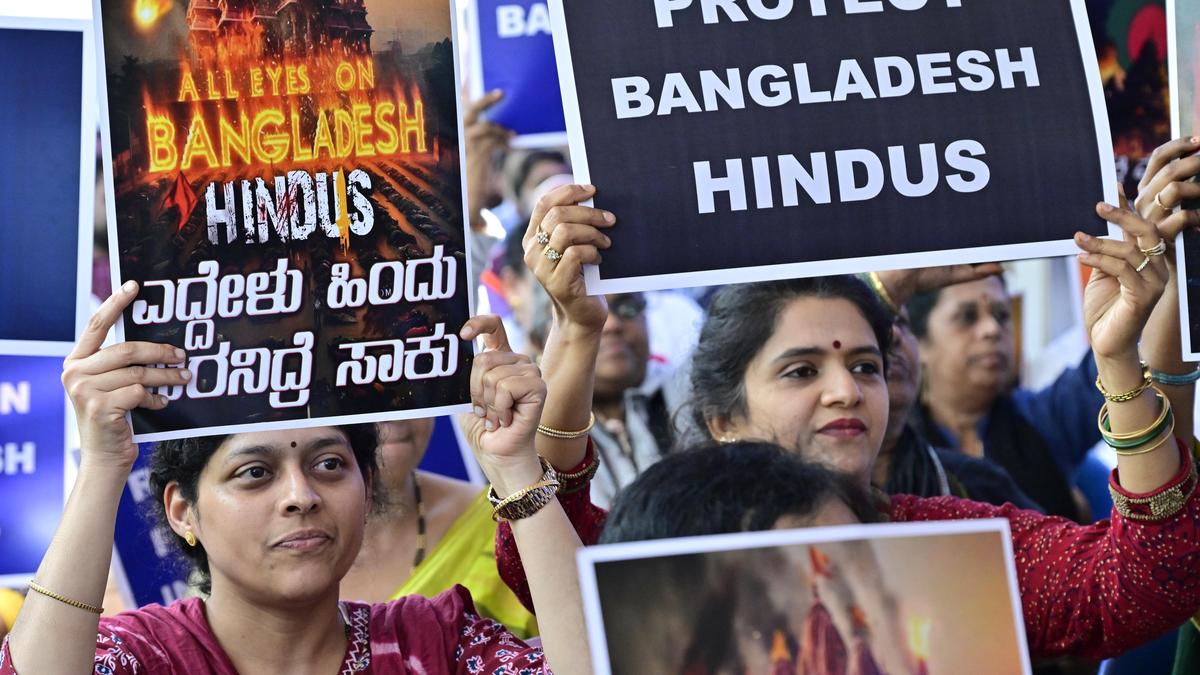
In the wake of the killing, Hindu minority groups didn't just mourn. They marched. They demanded "strong action," a phrase that sounds like bureaucratic jargon until you realize it is a plea for the basic right to exist.
What does "strong action" actually look like? It isn't just more police patrols for a week. It is a fundamental shift in the judicial culture. It means investigating the ideological roots of the groups that radicalize young men on motorcycles. It means ensuring that land-grabbing—often the hidden motive behind the intimidation of minorities—is prosecuted as a high crime.
The Bangladesh Hindu Buddhist Christian Unity Council (BHBCUC) has long argued that the culture of impunity is the greatest enemy. When arrests are made, they often target low-level suspects while the masterminds remain in the shadows. For the survivors in Jhenaidah, justice isn't an abstract concept found in a law book. It is the ability to sleep through the night without jumping at the sound of an engine.
A Pattern of Silence
The tragedy of Shyamananda Das is that he was part of a sequence. Just weeks before his death, another priest in a nearby district was decapitated. A Christian grocer was hacked to death. A Sufi Muslim leader was murdered.
These are not random acts of violence. They are a targeted effort to hollow out the middle ground of Bangladeshi society. By striking at the symbols of religious diversity—the priests, the caretakers, the local scholars—the attackers aim to create a vacuum of fear. In that vacuum, extremism grows like mold in the dark.
The government often blames "local elements" or political opposition for these crimes, while international monitoring groups point toward a growing footprint of global extremist networks. The truth likely lies in a murky intersection of both. But for the person standing in the dusty courtyard of the Jhenaidah temple, the origin of the blade matters less than the fact that the blade was allowed to strike at all.
The Echo in the Courtyard
The sun sets early in Jhenaidah. The shadows of the palm trees stretch across the temple grounds, reaching toward the spot where the caretaker fell.
There is a specific kind of grief that comes with being a minority in a land that is increasingly hostile. It is a quiet, heavy grief. It doesn't always shout; sometimes it just withdraws. It stops going to the festival. It stops singing the old songs. It shrinks its life until there is nothing left but the four walls of a home and a bag packed under the bed.
The death of Shyamananda Das is a test. It is a test for the local police, for the national government, and for the global community that claims to care about human rights. If the response is merely another "standard statement of condemnation," then the message sent to the attackers is clear: proceed.
But if the response is a genuine reckoning with the safety of those who have no one else to protect them, then perhaps the gate can be unlocked again. Perhaps the bells of the Radhamadan Gopal Moth can ring without sounding like a funeral dirge.
Until then, the silence in Korichha is a scream that the world refuses to hear. The incense is cold. The floor is unswept. And the man who kept the light burning is gone, leaving the rest of us to wonder how much darkness we are willing to tolerate before we finally decide that enough is enough.
The motorcycle is gone, but the dust it kicked up has settled on everything, coating the lives of the living with the gray film of terror.



