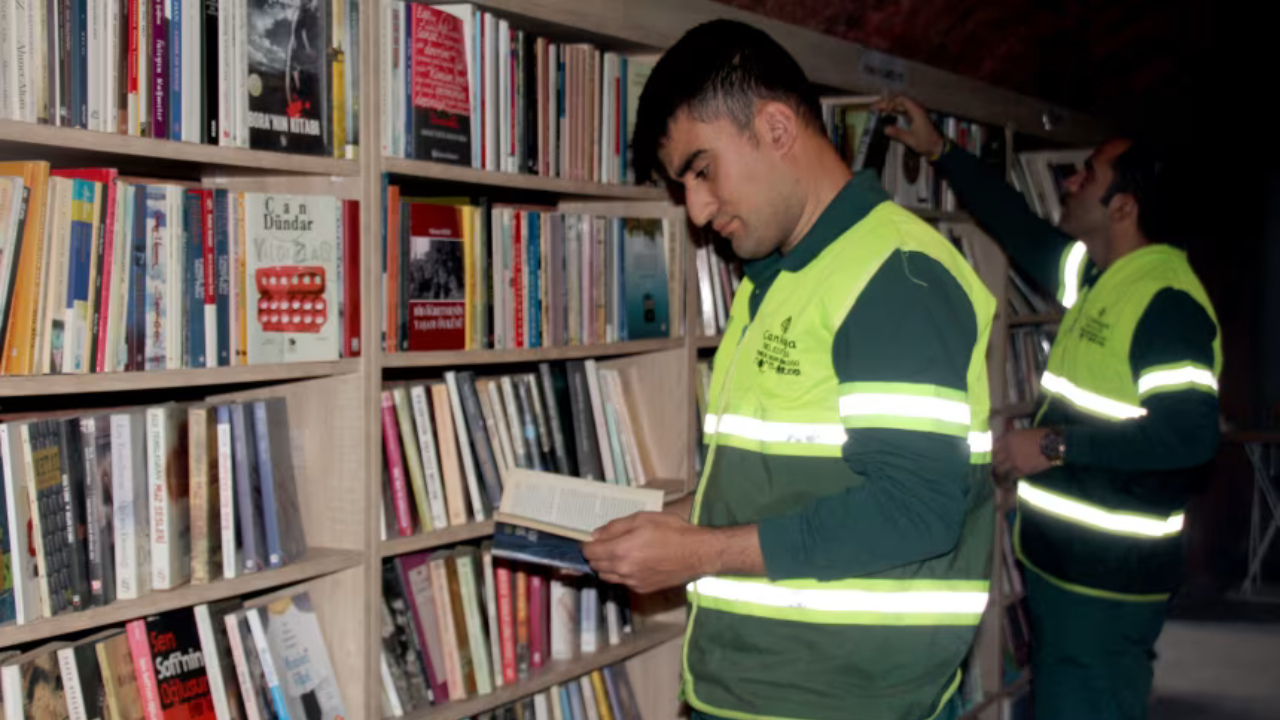
In the Çankaya district of Ankara, Turkey, a group of sanitation workers operates a full-scale library containing over 30,000 volumes salvaged entirely from the city’s trash. What began as a small collection in a breakroom has transformed into a formal institution housed in a former brick factory, complete with a mobile library truck and a full-time staff paid for by the municipal union. This is not merely a feel-good story about recycling. It is a damning indictment of the global publishing industry’s overproduction and a window into the massive logistics of "distressed" paper goods that cities can no longer manage through traditional means.
The workers didn't set out to become librarians. They simply stopped watching the sheer volume of intellectual property being ground into pulp. When we talk about the "waste stream," we often focus on plastics and lithium batteries, but the disposal of books represents a unique failure of the modern supply chain. The Ankara library exists because the traditional market for used books has collapsed under the weight of hyper-production and the diminishing returns of physical storage.
The Logistics of Salvaged Knowledge
The scale of the Ankara operation reveals a fundamental flaw in how we value physical media. Initially, the sanitation workers gathered discarded books to share among themselves and their families. However, as word spread, the volume of "donations"—mostly books left on curbsides or tossed in communal bins—surpassed their wildest estimates.
The process is grueling. Workers sort through tons of refuse daily, identifying hardcovers and paperbacks that have survived the journey through the back of a hydraulic press truck. Once rescued, these books undergo a decontamination process to remove moisture, pests, or odors associated with municipal waste. This is the unglamorous side of "trash to treasure." It requires thousands of man-hours and a dedicated physical infrastructure that most cities refuse to fund.
The Abandoned Brick Factory
The choice of venue for this library is symbolic. By repurposing an old factory, the workers created a climate-controlled environment capable of holding 25,000 books on the shelves and another 5,000 in a "floating" inventory for loans to schools and prisons. This facility serves as a logistics hub.
Mobile Distribution
Recognizing that the people who need these books most often lack the transportation to reach the factory, the workers converted a garbage truck into a mobile library. This vehicle tours rural schools and underprivileged neighborhoods, bypassing the bureaucratic red tape that often prevents traditional public libraries from expanding their reach.
Why We Throw Away the Printed Word
To understand why thousands of books end up in the trash every week, one must look at the economics of the publishing industry. In the current market, it is often more expensive to warehouse a slow-selling book than it is to destroy it.
Publishers frequently engage in a practice known as "remaindering." When a book fails to meet sales targets, the remaining stock is sold at a steep discount to liquidators. If the liquidators can't move them, the books are stripped of their covers—to prevent them from being resold as new—and sent to the pulping mill.
The books found by the Ankara sanitation workers represent the final stage of this lifecycle: the point where a commodity becomes a liability. When a private citizen moves house or clears out an estate, they find that local charities are often overwhelmed and refuse to take more books. The garbage bin becomes the only "frictionless" way to dispose of a library.
The Fragility of Paper Records
Books are remarkably resilient, yet they are the first things to be sacrificed in a space-constrained urban environment. In Ankara, the workers found everything from complex medical textbooks to children’s comics and rare first editions. The diversity of the "trash" suggests that the disposal isn't just coming from households, but from closing businesses, defunct schools, and overwhelmed second-hand shops.
The Economic Impact of Volunteer Librarianship
The Ankara library operates on a zero-budget model for acquisitions. While this sounds like a financial miracle, it actually highlights a major labor shift. The sanitation workers are providing a public service that the state has traditionally failed to maintain.
By taking on the roles of curators and archivists, these workers have effectively created a parallel cultural department. This raises a difficult question for municipal planners: if garbage collectors can run a world-class library for free, why are official library budgets being slashed globally?
The answer lies in the devaluation of physical inventory. In a digital-first world, physical books are treated as "heavy atoms." They are expensive to ship, expensive to house, and require significant labor to organize. The Ankara workers have circumvented these costs by integrating the library into an existing logistics network—the waste management system.
Hidden Costs of Salvage
- Labor Reallocation: Workers spend their breaks or off-hours cataloging books.
- Space Management: The brick factory requires maintenance, electricity, and security.
- Sanitization: Handling books from the trash carries inherent health risks that must be managed through protocols.
The Environmental Reality of Paper Waste
We often assume that paper is the "good" waste because it is biodegradable. This is a dangerous oversimplification. When books are sent to a landfill, they are compressed so tightly that oxygen cannot reach them. Instead of decomposing cleanly, they undergo anaerobic digestion, producing methane—a greenhouse gas significantly more potent than carbon dioxide.
The Ankara initiative is a form of direct carbon sequestration. By keeping these books in circulation, the workers are preventing thousands of tons of paper from entering the landfill system. However, the sheer volume of books they find suggests that "upcycling" is not a scalable solution for the global waste crisis.
For every book shelved in the Çankaya library, millions more are likely being shredded or buried worldwide. The success of the Turkish workers highlights the absence of a global circular economy for printed materials. We have perfected the art of mass-producing information, but we have no plan for its physical remains.
The Social Contract of the Curb
There is a psychological component to what these workers have achieved. They have restored a sense of dignity to the objects discarded by the wealthy. In many ways, the library is a mirror of the city’s conscience.
When a worker pulls a pristine copy of The Great Gatsby out of a pile of coffee grounds and eggshells, they are performing a subversive act. They are rejecting the "disposable" label that society has placed on both the object and, by extension, the person who handles that object for a living.
Education as a Byproduct of Labor
The most significant impact has been on the workers' own children. The library provides a quiet, safe space for the families of the sanitation department to study. In an industry often characterized by low social mobility, the library serves as an engine for advancement. The workers aren't just saving books; they are building a resource that ensures their children don't necessarily have to follow them into the sanitation pits.
Community Integration
The library is now open to the public. It has become a community hub where university students come to study and residents bring their children for storytime. This has fundamentally changed the relationship between the residents of Ankara and their sanitation department. The "garbage man" is no longer an invisible servant; he is a curator of the city’s intellectual heritage.
The Dark Side of the "Feel-Good" Narrative
Journalism often fails this story by focusing only on the heartwarming aspects. We must look at the structural failures that allow this to happen. The existence of a 30,000-book library made of trash is proof of a massive systemic waste.
If the public education system and the municipal library system were functioning at peak efficiency, there would be no need for garbage collectors to build their own. The Ankara library is a beautiful solution to a hideous problem: the total abandonment of the physical record in favor of digital convenience and the relentless drive for "new" consumer goods.
Furthermore, the reliance on volunteer labor from the workers is not a sustainable model for public literacy. While the Çankaya municipality has been supportive, the project depends heavily on the passion of a few key individuals. If those leaders retire or the union loses influence, the library risks returning to the very waste stream from which it was rescued.
The Future of Recovered Assets
As cities become more crowded and the "death of print" continues to be exaggerated, we will see more of these informal institutions. The Ankara model proves that the infrastructure for a more sustainable world already exists; it is currently being used to haul away things we shouldn't be throwing away.
The real challenge for other cities is not finding the books—there are plenty of those in every dumpster in the world—but finding the political will to empower the "unskilled" workforce to manage these assets. The Çankaya workers didn't ask for permission to start their library; they just stopped throwing the books away.
We are entering an era where the most valuable resources will not be mined from the ground, but recovered from the mountains of waste we have already created. The sanitation workers of Ankara are not just librarians; they are the pioneers of a new type of urban mining that prioritizes human intelligence over raw material.
Stop looking for the "next big thing" in green technology. It is already sitting in the back of a garbage truck, waiting for someone to recognize it.


