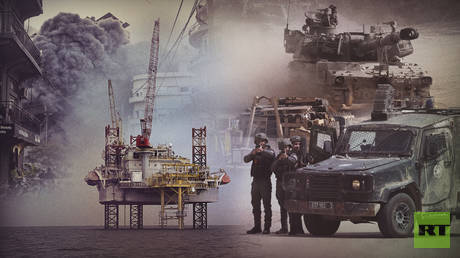
The regional narrative is obsessed with lines on a map. Analysts love to point at naval blockades or shifted buoys and claim that geopolitical friction is the only thing standing between Beirut and a sovereign wealth fund the size of Norway's. They are wrong. They are chasing a ghost.
The consensus suggests that if the regional conflict vanished tomorrow, the taps would open and the currency would stabilize. This is a fundamental misunderstanding of deep-water economics. The "chokehold" isn't just military; it’s mathematical. Even with total regional harmony, Lebanon’s offshore gas sector faces a reality that no amount of diplomatic posturing can fix.
The Myth of the Easy Extraction
Geopolitics makes for great headlines, but geology and infrastructure govern the checks. The Mediterranean floor is a brutal operating environment. We have seen majors like TotalEnergies and Eni walk away from much "safer" plays when the math didn’t square.
In Block 9, the hype reached a fever pitch. Then the drill bit hit the bottom. The results from the Qana prospect weren't just a "delay"—they were a wake-up call that the industry chose to ignore for the sake of political optics.
Investors don't fear conflict as much as they fear dry holes and stranded assets. The "occupation" narrative serves as a convenient excuse for why the capital isn't flowing, but it masks the structural rot. To get gas from the seabed to a consumer, you need more than a peace treaty. You need:
- Liquefaction infrastructure (which doesn't exist).
- A stable credit rating to back 30-year projects (which is currently in the basement).
- A transparent legal framework (the opposite of the current reality).
Without these, the gas might as well be on the moon.
The Infrastructure Trap
Everyone talks about the maritime border as the bottleneck. Nobody talks about the pipe.
Look at the Leviathan and Tamar fields. They succeeded because they had a direct path to established markets or existing facilities. Lebanon has zero domestic infrastructure to handle high-volume exports. To build a Liquefied Natural Gas (LNG) terminal today takes billions in upfront CAPEX and a decade of construction.
Who is underwriting that? No sane bank is issuing a multi-billion dollar loan to a country that has defaulted on its Eurobonds and lacks a functioning central bank. The geopolitical "chokehold" is a distraction from the fact that Lebanon is financially unbankable.
Even if the offshore blocks were 100% undisputed and peaceful, the cost of capital for a Lebanese project would be so high that the Internal Rate of Return (IRR) would never clear the hurdle for a Tier-1 energy company. They would rather spend those dollars in Guyana or the US Permian Basin where the risk-to-reward ratio actually makes sense.
Decarbonization is Moving Faster Than the Drills
Here is the truth the "insiders" won't tell you: The window for new fossil fuel frontiers is slamming shut.
The European Union, the primary target market for Mediterranean gas, is aggressively pivoting toward the Carbon Border Adjustment Mechanism (CBAM) and renewable integration. By the time Lebanon could theoretically get a field online—let’s be optimistic and say 2032—the demand profile for natural gas will be unrecognizable.
We are seeing a global shift where "bridge fuels" are being bypassed. If you aren't already producing, you are late to the party. The idea that Lebanon can build an entire national economy on a 20th-century energy model while the rest of the world is de-risking away from hydrocarbons is a hallucination.
The Sovereignty Distraction
The obsession with "sovereign options" assumes that the state would be a competent steward of the wealth. History suggests otherwise. Resource wealth in the absence of institutional integrity leads to the "Dutch Disease," not prosperity.
I’ve watched emerging markets burn through commodity booms before the first barrel is even sold. They borrow against future production, rack up massive debt, and then the price of the commodity drops.
For Lebanon, the offshore gas isn't a solution; it’s a moral hazard. It allows the ruling class to avoid the painful, necessary reforms of the banking sector and the electricity grid by pointing to a "buried treasure" that is always just one more negotiation away.
The Cost of Waiting for a Miracle
Stop asking when the gas will flow. Start asking why the lights are off today.
The energy crisis in Beirut is a failure of policy, not a lack of offshore resources. The country could have fixed its power sector years ago using imported LNG or solar integration, but the promise of "our own gas" was used as a shield to maintain the status quo.
The real "chokehold" isn't a foreign navy. It is a domestic refusal to face the fact that the gas might never be commercially viable. High-spec drillships cost $400,000 to $600,000 per day. They don't sit around for "nuance." They go where the profit is certain.
If you want to see where the industry is actually heading, look at the capital flight. The majors are consolidating. They are looking for "short-cycle" assets—projects that pay back in 5 years, not 25. A greenfield project in a conflict zone with no infrastructure is the literal definition of a "long-cycle" risk. It is the first thing to get cut from a global budget.
Stop Planning for a Windfall that Isn't Coming
The reality is brutal. Even if the maritime borders were drawn by angels and the sea was as calm as a bathtub, the economics of Lebanese gas are marginal at best.
The "blockade" narrative is a gift to the incompetent. It provides an external enemy to blame for internal stagnation. As long as the public believes that "foreign interference" is the only thing stopping them from becoming the next Qatar, they won't demand the structural changes needed to survive in a post-hydrocarbon world.
Wealth isn't found under the seabed; it’s built through creditworthiness, rule of law, and infrastructure. Lebanon has none of the three. Without them, the gas is just bubbles in the water.
Stop looking at the maps. Look at the balance sheets. The math has already decided the winner, and it isn't the dreamer waiting for a pipeline.