The black leather jacket has always been an armor of absolute certainty. For more than three decades, Jensen Huang wore it on stage like a rock star who happened to build the nervous system of modern artificial intelligence. When he spoke, markets moved. When he promised a future of accelerated computing, sovereign nations lined up with blank checks.
Then, in the span of twenty-five days in late 2026, the armor cracked.
It began not with a rival chipmaker outmaneuvering Nvidia’s silicon, nor with a sudden collapse in data center demand. It began with a secret—and then another, and another—unspooling from the pages of The New York Times into the halls of Congress, the corridors of the White House, and the living rooms of ordinary retail investors watching their retirement accounts evaporate in real time.
To understand what happened when Jensen Huang was toppled by revelations of extramarital affairs—only to be resurrected eleven days later in one of the most audacious corporate reversals in Wall Street history—you have to look past the ticker symbols. You have to look at what happens when the line between a founder’s private appetites and a superpower’s national security disappears.
The Architecture of a Fall
Consider a hypothetical engineer—let’s call her Maya—sitting at her desk in Santa Clara on the morning of November 12, 2026. For seven years, Maya has worked eighty-hour weeks debugging CUDA libraries, fueled by late-night takeout and the quiet pride of believing she is building the engines of the future. She owns shares of Nvidia in her employee stock plan. She has watched her boss, Jensen, greet employees in the cafeteria with the warmth of a patriarch who remembered where he came from—a kid who washed dishes at Denny’s before co-founding a graphics chip startup in 1993.
On November 12, Maya refreshes her browser and sees the press release: Jensen Huang Resigns. Chief Financial Officer Colette Kress is named interim CEO.
Gone. Just like that.
To grasp the shockwave that hit Maya’s desk—and wiped over $1 trillion from Nvidia’s market valuation—you have to trace the dominoes that fell in the two weeks leading up to that Thursday.
Late in October, investigative reporting brought a name into the public glare: Alice Huang, also known as Huang Le. No relation to Jensen, she was a former managing director of Megaspeed International, a Singapore-based cloud computing outfit that had quietly purchased billions of dollars’ worth of Nvidia’s most sought-after chips and servers. For two years, the two had been photographed socializing at industry gatherings—an attachment so noticeable that a sharp-eyed investor had questioned their unusually close relationship back in May.
In a normal corporation, a chief executive’s romance with a major customer’s executive is a governance headache. A board convenes, lawyers review conflict-of-interest policies, and someone writes a stern memo.
Nvidia is not a normal corporation, and 2026 is not a normal era.
According to U.S. intelligence assessments reported by The New York Times and The Wall Street Journal, Alice Huang had maintained contact with China’s Ministry of State Security during her affair with Nvidia’s chief executive. While intelligence officials noted that the evidence did not prove she had been formally tasked with extracting secrets from Jensen, the implication landed in Washington like a live grenade. Nvidia’s H200 and Blackwell-class processors are not mere consumer electronics; they are the strategic chokepoint of the twenty-first century, the digital uranium that determines which nation leads in military logistics, autonomous weapons, and frontier AI models.
Suddenly, an intimate indiscretion looked like a national security breach.
When the Dam Breaks
If the story had stopped with Alice Huang, perhaps the company’s formidable public relations machinery could have contained the blast. On November 8, Jensen sent a raw, unvarnished letter to employees—published simultaneously as a press release—admitting he had been unfaithful to Lori, his wife of more than forty years.
"My actions hurt her and our children," he wrote. "There is no excuse for what I did. I am deeply sorry."
I have spent years watching corporate crises unfold from the inside, and there is a specific, unmistakable smell to a containment strategy failing in real time. It is the smell of cold coffee in a war room at 3:00 a.m. when the lawyers realize the client hasn't told them everything yet. You think you have built a seawall around a single scandal, only to discover the tide is coming up through the floorboards.
Three days after Jensen’s apology, the floorboards gave way.
Reports surfaced that Jensen had also been romantically involved with Kimberly Powell, Nvidia’s vice president of healthcare—a senior executive who reported directly to him. Surveillance footage from a hotel during a conference earlier in the year had captured the two being openly affectionate. Hours later, Reuters reported a third affair, this time with another unnamed Nvidia employee.
Think of the human wreckage inside that building in Santa Clara. Every promotion, every budget allocation, every performance review suddenly felt suspect. When the person at the very top of a pyramid—a man whose authority is so total that sixty direct reports answer to him without layers of middle management—crosses romantic lines with subordinates, gravity shifts for everyone underneath.
By the evening of November 12, the pressure became insurmountable. The Department of Justice had opened an inquiry. The Securities and Exchange Commission was circling. Lawmakers on Capitol Hill were demanding closed-door briefings and threatening subpoenas. Nvidia’s board of directors accepted Jensen’s resignation.
The king was off the board.
The Anatomy of an Irreplaceable Man
Why did the market react to Jensen Huang’s departure not as a routine leadership transition, but as an existential cardiac arrest?
To understand that, imagine a symphony orchestra where the conductor didn't just wave the baton—he personally wrote the score, forged the brass instruments by hand, and memorized every musician’s breathing pattern. That is an analogy for modern founder-led technology giants, and nowhere was it truer than at Nvidia.
Unlike traditional Fortune 500 companies designed to survive the loss of any single executive, Nvidia was built around Jensen’s singular nervous system. He rejected conventional corporate hierarchies. He held no one-on-one meetings with his direct reports, preferring massive, transparent group sessions where anyone could learn from everyone else’s mistakes. For thirty-three years, he had willed the company forward through near-bankruptcies in the 1990s, mocked bets on graphics processors in the 2000s, and an all-in gamble on AI software architecture a decade before Wall Street knew how to spell "neural network."
Without him, investors didn't just see a vacant corner office. They saw a $3 trillion colossus suddenly missing its spine.
Over the next ten days, a strange, revealing panic swept through Silicon Valley and Washington alike. More than 180,000 people—including tech titans like Elon Musk—signed a petition demanding Jensen’s return. Portfolio managers went on television warning that Nvidia could permanently shed a third of its value without its founder at the helm. Meanwhile, behind closed doors, a different kind of calculation was taking place.
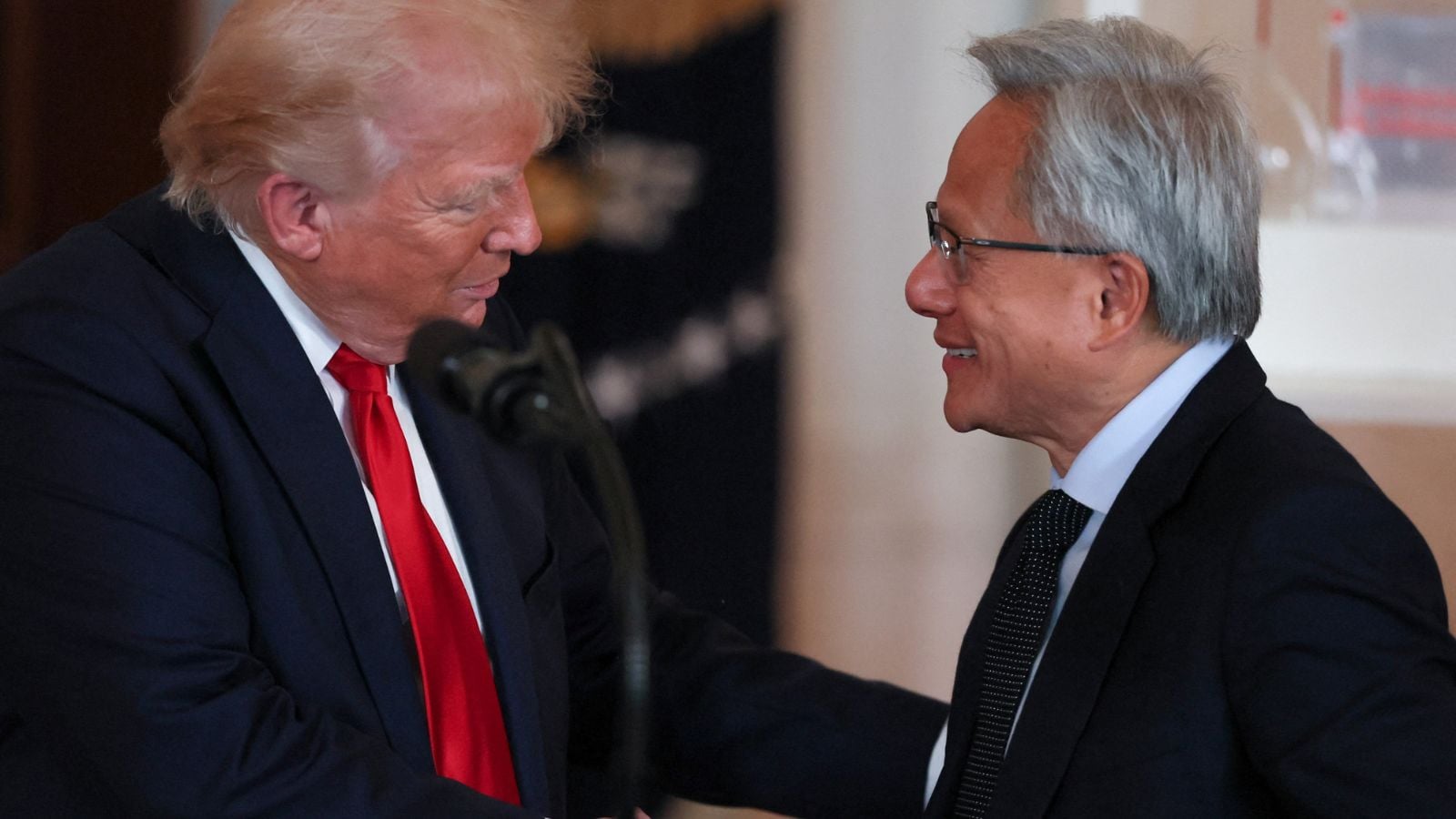
In Washington, President Donald Trump—who had flown with Jensen on Air Force One to Beijing earlier in the year and awarded him the National Medal of Science in October—weighed the geopolitical math. U.S. intelligence had briefed the White House on Alice Huang back in 2025 and again in May 2026. Trump had chosen not to intervene then, and in the days after Jensen’s ouster, he began working the phones with Nvidia’s board.
"I convinced them," Trump later told CNBC. "I made the deal."
Whether you view that intervention as pragmatic industrial policy or a troubling blurring of political favor and corporate oversight, the underlying message was unmistakable: in the global AI arms race against Beijing, Washington decided it could not afford to bench its star quarterback—even if he had fumbled off the field.
The Sunday Confession
Before the board could bring Jensen back, however, there had to be a reckoning behind closed doors.
On Sunday, November 22, Jensen Huang sat before Nvidia’s directors for several grueling hours. There were no cameras, no leather jacket swagger, no keynote slides showing exponential compute curves. Just a sixty-three-year-old man laying bare the full inventory of his private failures.
During that meeting, according to The Wall Street Journal, Jensen disclosed that there hadn't been just two or three affairs. There had been at least a fourth—and possibly more—previously unknown relationships.
Pause and sit with the sheer audacity of that moment. Most executives who confess to a fourth affair in front of their board are handed a cardboard box and escorted to the elevator by security. The governance textbooks are clear on this: serial dishonesty, blurred workplace boundaries, and entanglement with a foreign intelligence suspect form the textbook definition of an uninsurable liability.
Yet on Monday morning, November 23, Nvidia issued an announcement that stunned the business world: NVIDIA Board Reinstates Jensen Huang as President, CEO and Board Director.
The board stated it was satisfied with his candor, reassured by input from senior U.S. government officials that his return posed no national security threat, and announced the creation of a new Chief Compliance Officer role to tighten internal guardrails. Almost simultaneously, the U.S. government placed Megaspeed—Alice Huang’s former company—onto a trade blacklist, severing the commercial artery at the heart of the espionage fears.
When the opening bell rang on Wall Street that Monday, Nvidia’s stock surged more than 30 percent, clawing back roughly $1 trillion in lost value in a matter of hours.
The Price of Being Untouchable
I’ll admit something that makes me uncomfortable as an observer of business and human nature: part of me understands why the board folded. If you sit in one of those leather chairs on Nvidia’s board of directors, you carry a fiduciary duty to millions of pensioners, index fund holders, and employees whose life savings rise and fall with every tick of NVDA. Firing Jensen felt principled on November 12. Watching a trillion dollars vanish into thin air while rivals circle like sharks makes principle feel terribly expensive by November 23.
Still, there is an invisible bill coming due here, and we would be fools to pretend the market rally paid it off.
First, there is the question that refuses to die in Washington. Republican and Democratic lawmakers alike reacted to Jensen’s reinstatement with visceral skepticism. "No national security risk? Based on what?" Senator John Cornyn asked publicly. The House China Committee continued pressing for testimony, threatening subpoenas if answers aren't forthcoming. Even with Megaspeed blacklisted, the episode exposed a glaring vulnerability in how America protects its crown-jewel technologies: you can build the strictest export controls in history, yet a single human vulnerability at the top of the org chart can turn a fortress into a sieve.
Second, there is the quiet erosion of corporate accountability. For years, business schools have preached that no individual is bigger than the institution—that rules apply equally to the mailroom clerk and the corner office. Jensen’s eleven-day exile shattered that comforting fiction. It established a new, unspoken rule in modern capitalism: if your company is vital enough to national security and the stock market, the ordinary laws of corporate gravity simply stop applying to you. A Chief Compliance Officer can audit expense reports and enforce mandatory HR training, yet everyone inside the building now knows where the real power lives.
Third—and hardest to quantify—is the human cost inside the walls of Nvidia itself.
On Tuesday, November 24, his second day back on the job, Jensen stood before an all-hands meeting of Nvidia employees. Gone was the triumphant showman who usually commands arenas in front of cheering developers. He told the room that facing them was the second-hardest meeting of his life.
"The hardest meeting I've ever done was with my wife," he said.
Lori Huang, the woman who stood beside him when Nvidia was nothing more than a three-man idea sketched out over booth coffee at a roadside diner, has remained entirely silent in public. She has filed no divorce papers, issued no statements, offered no easy absolution for the cameras. Her silence hangs over the entire saga like a quiet accusation that no 30 percent stock surge can answer.
Think back to Maya, our hypothetical engineer in Santa Clara. When she logs into her workstation this week, her stock portfolio is whole again. Her company is once again the undisputed titan of the AI age. The crisis, by every financial metric Wall Street knows how to measure, is over.
Yet when Maya walks past the executive wing, or sits in a review meeting wondering why one colleague got tapped for a coveted project over another, something subtle has permanently changed. Trust, unlike market capitalization, does not bounce back 30 percent at the sound of a morning bell. You cannot issue a press release to restore it, and you cannot hire a compliance officer to manufacture it from scratch.
Jensen Huang got his company back, his title back, and his trillion-dollar empire back. The black leather jacket is back on his shoulders. Only now, every time he steps under the stage lights, the crowd isn't just looking at the man who built the future—they are looking at the cracks in the armor, wondering what else is hidden underneath.