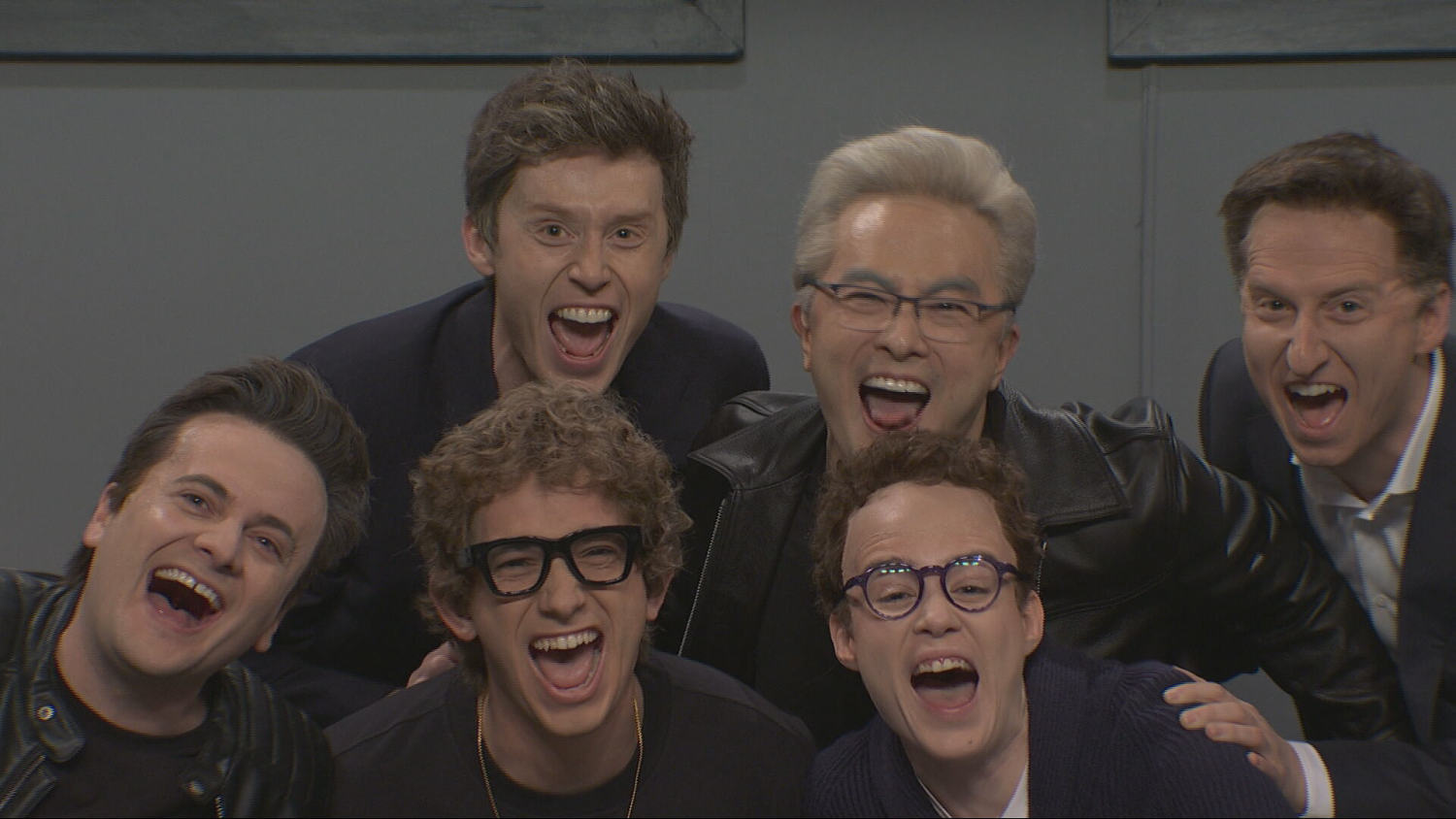
The studio lights at 30 Rockefeller Plaza do not flatter anyone, least of all a billionaire pretending to be a rock star.
When Bowen Yang stepped onto the Saturday Night Live stage—returning to the show that made him a household name, clad in a gleaming, aggressively zippers-heavy faux-leather moto jacket—the audience laughed before he even opened his mouth. They recognized the uniform immediately. Silver-streaked hair. Black T-shirt. That specific, slightly hunched posture of a man who has spent three decades staring at silicon wafers and suddenly found himself treated like Elvis by Wall Street analysts.
Yang was playing Jensen Huang, the co-founder and CEO of Nvidia. And the timing could not have been sharper, or darker.
Just days before the broadcast, the tech world had been rattled by news of an espionage scandal involving Nvidia—a story thick with corporate intrigue, intellectual property theft, and the quiet, desperate paranoia that defines the modern artificial intelligence arms race. On paper, it was a dry business-page headache: allegations of stolen trade secrets, leaked architecture, and rival firms trying to reverse-engineer the crown jewels of modern computing.
On SNL, however, it became something else entirely. It became a mirror.
The Anatomy of a Punchline
To understand why Yang’s return hit such a specific nerve, you have to remember how we used to treat tech moguls.
For twenty years, Silicon Valley executives were untouchable gods of optimization. We memorized their morning routines. We bought their biographies. When Steve Jobs wore a black turtleneck, people wrote breathless essays about minimalist genius. When Mark Zuckerberg wore a gray hoodie, it was hailed as the uniform of a disruptor too busy changing the world to pick out a tie.
Then the bill came due.
I remember sitting in a cramped press room in San Jose a few years back, watching a keynote speech where the crowd cheered for a graphics card the way people in the 1960s cheered for the Beatles. The air smelled like stale espresso and static electricity. Back then, the narrative was pure magic: faster chips meant better video games, smarter cars, cures for diseases we couldn't yet name. Nobody in that room was thinking about national security, supply-chain choke points, or corporate spies slipping proprietary schematics onto encrypted drives.
That innocence is gone. Today, a semiconductor is no longer just a piece of hardware; it is geopolitical ammunition.
Which brings us back to Bowen Yang under the fluorescent glare of Studio 8H.
Yang has always possessed a rare comedic gift: he plays delusion with absolute sincerity. Whether he is inhabiting the iceberg that sank the Titanic or a frantic PR rep trying to spin a disaster, Yang never winks at the camera. He lets the absurdity breathe until the audience realizes the joke isn't on the character—it’s on us for ever taking the character seriously.
In his portrayal of Huang, Yang leaned into the bizarre theatricality of modern tech leadership. He paced the stage like a televangelist hawking miracle tonic, waving invisible microchips in the air while brushing off questions about corporate espionage with the breezy, practiced charm of a man whose company’s valuation fluctuates by the GDP of small European nations before lunch.
"Spies?" Yang’s Huang seemed to say, adjusting his cuffs with theatrical nonchalance. "Why steal our secrets when you can just buy three million of our chips and pray they don't melt your power grid?"
The laugh from the studio audience was immediate, loud, and slightly nervous. Because behind the caricature was an uncomfortable truth: nobody in that room actually understood how Nvidia’s hardware works, yet every single person’s retirement account, smartphone, and future job security is quietly tethered to it.
What We Mean When We Talk About Spies
Let’s strip away the Hollywood glamour from the phrase "corporate espionage."
When most people hear about a spy scandal at a trillion-dollar tech firm, they picture trench coats, dead drops in rainy European train stations, and miniature cameras hidden inside fountain pens. Reality is far more mundane, and infinitely more unsettling.
Imagine a mid-level engineer—let’s call him David, a hypothetical composite of the dozens of real-world defendants who have cycled through federal courtrooms in Northern California over the last decade. David isn't a villain twirling a mustache. He’s tired. He’s paying a mortgage in a zip code where a three-bedroom fixer-upper costs two million dollars. He has spent six years writing verification code for next-generation chip interconnects—the microscopic highways that allow thousands of processors to talk to one another without bottlenecking.
One Tuesday, a recruiter from a rival firm—or a foreign-backed startup flush with venture capital—reaches out on a messaging app. They don't ask David to steal anything. Not at first. They just offer him triple his base salary and a signing bonus that would pay off his student loans in an afternoon.
All he has to do is bring his "expertise."
In the pressure cooker of modern chip design, the line between a human being’s memory and a corporation’s intellectual property is razor-thin. When David downloads a few hundred gigabytes of simulation logs onto a personal cloud drive during his final week of notice—just to have as "reference material"—he doesn't feel like James Bond. He feels like a guy hedging his bets.
Until the forensic audit triggers an alert at 2:00 AM.
That is the invisible reality behind the headlines that framed Bowen Yang’s sketch. Nvidia’s dominance in artificial intelligence wasn't built overnight; it was built over decades of painful, expensive trial and error, particularly in its proprietary software ecosystem, CUDA, which locks developers into its hardware the way Apple’s ecosystem locks consumers into the iPhone.
If a competitor wants to catch up organically, it takes ten years and tens of billions of dollars. If they can quietly siphon off the blueprints—or hire away the people who drew them—they might shave five years off the timeline. In the AI race, five years isn't a head start. It’s the whole ballgame.
The Comedy of Incomprehensible Scale
Why does comedy work so well when the stakes are this high?
Because human brains are not wired to process trillions of dollars or billions of transistors. Tell someone that a single company lost or gained three hundred billion dollars in market cap in a single afternoon, and their eyes glaze over. The number is too big; it loses all texture. It becomes weather.
Tell them a joke about a guy in a shiny leather jacket bragging about how his microchips are basically magic beans, and suddenly the entire power dynamic snaps into focus.
Satire has always functioned as society’s pressure valve when institutions grow too large to hold accountable. In the late nineteenth century, editorial cartoonists drew John D. Rockefeller as a giant octopus wrapping its tentacles around the White House and the Capitol building. People couldn't audit Standard Oil’s ledgers, but they understood the octopus immediately.
Bowen Yang’s Jensen Huang is the modern equivalent of that octopus—except instead of tentacles, he’s wearing bespoke outerwear and pitching a future where every human interaction is mediated by a neural network running on his silicon.
What made Yang’s return to SNL particularly resonant wasn't just the topicality of the espionage scandal; it was the sense of fatigue hanging over the whole tech spectacle. For the past three years, ordinary people have been told that artificial intelligence is going to revolutionize medicine, education, art, and commerce. Meanwhile, what most people have actually experienced is worse customer service chatbots, search engines clogged with synthetic junk, and anxious emails from their bosses about "upskilling" before their departments get downsized.
There is a widening chasm between the euphoric rhetoric on keynote stages and the gritty reality on the ground. And comedy lives right inside that chasm.
When Yang stood on stage, grinning through the chaos of corporate leaks and regulatory scrutiny, he captured the exact tone of Silicon Valley in the mid-2020s: a relentless, almost manic optimism used as a shield against genuine accountability. No matter how messy the reality gets—whether it’s stolen trade secrets, environmental strain from massive data centers, or the quiet dread of workers wondering if they are training their own replacements—the keynote must go on. The jacket stays zipped. The smile never wavers.
The Stage Behind the Stage
There is a specific vulnerability in admitting how lost most of us feel right now.
I’ve spent years covering technology and culture, and I still catch myself staring at architectural diagrams of modern AI clusters like a medieval peasant trying to read a stained-glass window. You can learn the vocabulary—tensor cores, high-bandwidth memory, lithography, inference—and you can track the stock tickers and the federal indictments. Yet there remains a nagging suspicion that the people steering this ship are making up the rules as they go along, fueled by equal parts brilliance, hubris, and sheer terror of falling behind.
That terror is what drives the espionage scandals. It is why rival labs poach engineers like star quarterbacks, why governments slap export controls on advanced silicon like it’s enriched uranium, and why every major tech CEO suddenly dresses like they’re about to headline Coachella. They are selling certainty in an industry defined by radical unpredictability.
And then comes Saturday night in New York City.
A troupe of writers and actors—people who make their living out of cardboard sets, quick costume changes, and adrenaline—take all that heavy, suffocating corporate machinery and reduce it to five minutes of live television.
Yang didn't need to explain the intricacies of semiconductor supply chains or the legal nuances of trade-secret litigation to make his point. He just needed to hold the posture. He needed to capture that unmistakable blend of messianic confidence and corporate slipperiness—the way powerful people talk when they believe they are too big to fail and too smart to be caught.
Watching him work, you could feel the tension in the room loosen. Not because the problems went away—the lawsuits are still winding through the courts, the data centers are still humming in the desert, and the global race for compute power is only accelerating—but because naming the absurdity takes away a little bit of its power over us.
The Final Cue
Eventually, the applause fades. The stagehands rush in under the commercial break, stripping away the podium, rolling up the cables, resetting the floor for the musical guest.
In California, the lights in the cleanrooms never turn off. Millions of tiny lasers continue etching microscopic pathways onto silicon wafers, building the invisible infrastructure of the next decade, guarded by biometric scanners, non-disclosure agreements, and federal subpoenas.
Somewhere in a dressing room thirty floors above Midtown Manhattan, Bowen Yang unzips the faux-leather jacket, hangs it on a rolling rack next to a dozen other costumes, and washes the stage makeup off his face. Outside, the city hums on, indifferent to the algorithms deciding its future. For five glorious minutes, the billionaire in the leather jacket wasn't an untouchable architect of human destiny. He was just a guy standing on his mark, waiting for the cue card to flip.