Silence.
That is the first thing you notice when a multi-trillion-dollar company stumbles on the internet, right before the noise hits like a physical wave.
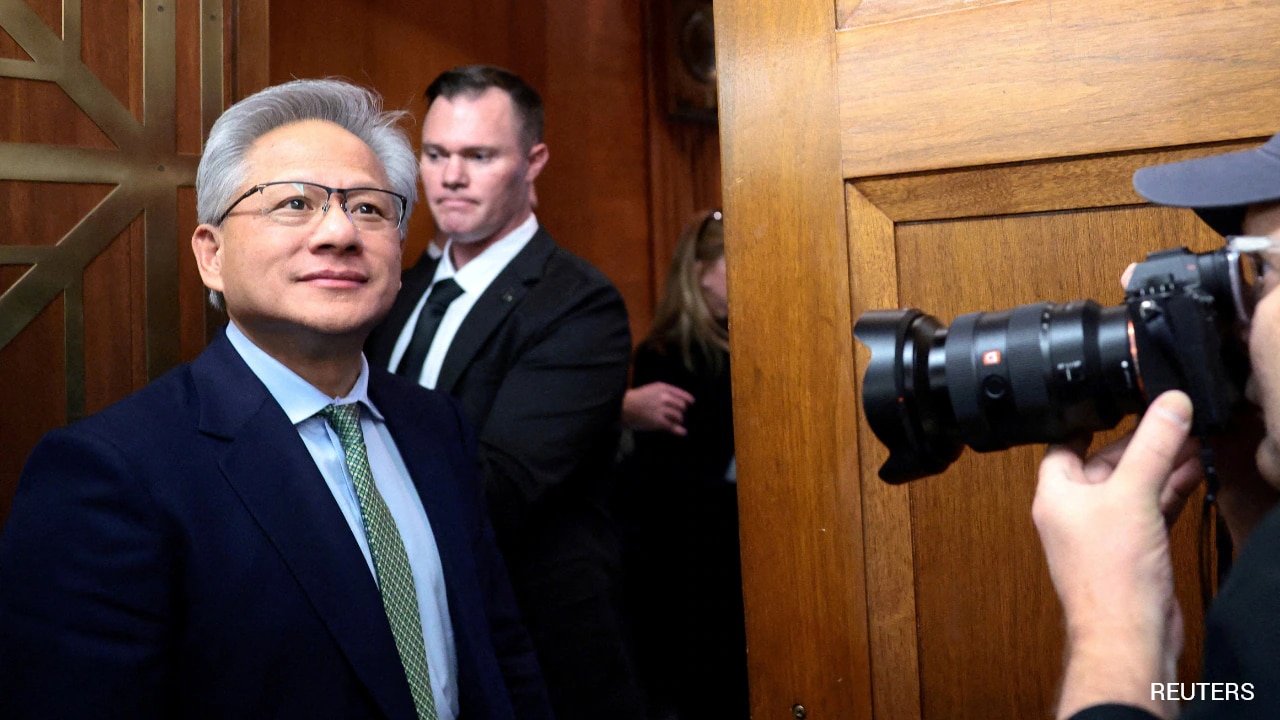
Picture a software engineer named Marcus—a hypothetical composite of a thousand exhausted coders staring at dual monitors in dimly lit apartments from San Jose to Bangalore. It is 2:00 AM. His coffee is cold. His entire startup’s burn rate is tied to compute credits, and for the past three months, the tech press has been whispering that the king of silicon had finally lost his fastball. Then, a clip hits his feed. Jensen Huang, sixty-something, silver-haired, draped in that familiar black Tom Ford leather jacket, steps back onto the stage with the kind of casual, unbothered swagger usually reserved for aging rock stars who still own the masters to every hit record.
Marcus doesn't cheer. He exhales. Then he opens X, Reddit, and Blind, and watches the timeline catch fire.
To understand why social media erupted over Jensen Huang’s latest resurgence at the helm of Nvidia, you have to look past the stock ticker. You have to look past the breathless CNBC chyrons and the dry press releases about Blackwell architectures, Rubin roadmaps, and hyperscaler capital expenditure. When people talk about a "comeback" for a founder who never technically left the building, they aren't talking about an executive returning from exile. They are talking about a narrative resurrection.
They are talking about what happens when the internet decides a titan is mortal, only to watch him walk back out and rewrite the rules of physics in front of a live audience.
The Anatomy of a Digital Panic
I have spent the better part of fifteen years watching Silicon Valley fall in and out of love with its own architects. You learn to recognize the smell of an impending hype-cycle hangover before the charts even turn red. It tastes like stale espresso and feels like a low-grade hum behind your eyes at 4:00 PM on a Tuesday.
For months leading up to Nvidia’s latest keynote spectacle, the collective mood online had curdled. The narrative had shifted. Early in the artificial intelligence boom, Nvidia was treated as an unstoppable force of nature—the guy selling shovels during a gold rush where the gold was infinite. By the time markets began questioning whether tech giants were burning hundreds of billions of dollars on data centers with no immediate return on investment, the wolves came out on social media.
Memecoins mocked the valuation. Armchair analysts on X posted intricate thread-storms predicting the collapse of GPU margins. Custom silicon from hyperscalers—Google’s TPUs, Amazon’s Trainium, Meta’s internal chips—was suddenly framed as the inevitable executioner of Nvidia’s near-monopoly. Every minor supply chain delay or thermal design rumor was amplified into an existential crisis.
If you were holding tech equities, building AI infrastructure, or simply trying to figure out if your career was tied to a bubble, the uncertainty was suffocating. Honestly, even for those of us who cover this industry daily, the math was starting to feel dizzying. How much compute does the world actually need? When does the spending stop?
Then Jensen walked out under the stage lights.
The Theatre of Silicon
Here is what traditional business reporting consistently misses about Jensen Huang: he is not merely a chief executive officer. He is a folk hero to a specific, deeply anxious subculture of engineers, gamers, and retail traders who view the modern economy as a casino rigged against them.
Think of Nvidia’s ecosystem not as a hardware supply chain, but as a massive, global railway network. For decades, Huang didn't just build the locomotives; he quietly laid the tracks—CUDA, the proprietary software layer that locks developers into Nvidia’s hardware—through middle-of-nowhere towns before anyone knew there was gold in the hills. When the AI train finally left the station, nobody else had tracks on the ground.
When rumors swirled that competitors were catching up, or that Nvidia’s pace of innovation was hitting the physical limits of Moore’s Law, the anxiety online wasn't purely financial. It was existential. If the architect of the AI revolution was faltering, what happened to the revolution itself?
Social media didn't react to Huang’s return to center stage with polite applause. It reacted with memes, worship, disbelief, and tribal fury.
Within minutes of his keynote kicking off, the timeline split into distinct, noisy factions:
- The Retail Faithful: On subreddits like r/wallstreetbets and r/NVDA_Stock, users treated the livestream like the Super Bowl. Screenshots of leather jackets flooded the threads. Every time Huang uttered the words "the more you buy, the more you save"—his famously audacious pitch that spending billions on faster chips actually lowers total data center operating costs—the comment sections detonated with rocket emojis and celebratory chaos.
- The Skeptical Pragmatists: On Hacker News and engineering corners of X, the tone was sharper, laced with grudging respect. Veteran systems architects dissected every architectural slide, arguing over interconnect bandwidth and power consumption while quietly admitting that Nvidia’s cadence—moving from a two-year product cycle to a ruthless one-year rhythm—was burying competitors alive.
- The Cultural Spectators: On TikTok and Instagram, people who couldn't tell a tensor core from a toaster were editing clips of Huang signing autographs on fan memorabilia, set to phonk music, turning a Taiwanese-American electrical engineer in his sixties into an unlikely icon of stoic masculine cool.
Why does a CEO wearing a black motorcycle jacket trigger that kind of visceral reaction? Because in an era of sanitized, focus-grouped corporate executives who speak in suffocating HR platitudes, Huang feels dangerously real. He stands on stage for two hours without a teleprompter, casually tossing out trillion-dollar projections while looking like a guy who still remembers what it felt like to scrub toilets at Denny's—which, as every profile of him loves to remind us, he actually did as a teenager.
The Invisible Stakes Behind the Memes
Beneath the jokes about leather jackets and "Jensen math," however, lies a far heavier reality.
Consider what happens when a single company becomes the load-bearing wall of the global economy. Historically, we have seen this kind of infrastructural dominance only a handful of times—Standard Oil in the late nineteenth century, Bell Labs in the mid-twentieth, Microsoft during the personal computer explosion of the 1990s. In every single case, the public’s relationship with the dominant player oscillates wildly between awe and resentment.
When Nvidia stumbled in public perception, the panic was real because the stakes are no longer confined to video game frame rates. Nvidia’s chips are now the foundational substrate for drug discovery, climate modeling, autonomous robotics, national defense, and every large language model currently reshaping white-collar labor.
If Huang’s "comeback"—his reassertion of total technological dominance on the global stage—had fallen flat, the shockwaves would have hit far beyond Wall Street. Pension funds, sovereign wealth budgets, university research labs, and thousands of AI startups would have faced an immediate reckoning.
Instead, Huang did what he has done since co-founding Nvidia in a booth at a San Jose Denny's in 1993: he doubled down when everyone else was hedging.
Years ago, back in the mid-2000s, Nvidia nearly went bankrupt betting the entire company on CUDA—forcing every graphics card to carry extra silicon for general-purpose computing long before anyone wanted it. Wall Street hated the move. The stock cratered. Huang refused to blink. Today, that stubbornness is the exact reason Nvidia commands gross margins that make software companies weep with envy.
Social media instinctively recognizes that kind of conviction. People online have finely tuned radar for fraud, hesitation, and corporate theater. When they watched Huang dismantle the bear case in real time—not with defensive PR spin, but with sheer engineering velocity and an unapologetic vision of "AI factories" replacing traditional data centers—the relief was palpable.
The Price of Crown-Wearing
Still, watching the internet canonize any living executive carries a quiet, familiar danger.
We have seen this movie before. We watched social media turn Elon Musk into Tony Stark before the inevitable, messy fracturing of that myth. We watched Sam Altman swing from savior to villain and back again over a single chaotic weekend in November. The internet loves a comeback story almost as much as it loves tearing down the person it just crowned.
If you scrolled deep enough into the replies during Huang’s victory lap, past the celebratory memes and bullish charts, you could feel that tension simmering just beneath the surface.
Developers complained bitterly about GPU scarcity and predatory cloud pricing. Open-source advocates warned about the suffocating grip of proprietary software locks. Even among Nvidia’s biggest customers—Microsoft, Meta, Google, Amazon—there is an unspoken desperation to break free from the "Nvidia tax," pouring billions into alternative silicon just to regain a fraction of leverage.
Marcus, our hypothetical engineer staring at his monitors at 2:00 AM, feels both sides of that blade. He is thrilled that the roadmap is accelerating because faster hardware means his models train in days instead of weeks. At the exact same time, he knows his startup’s survival depends entirely on the pricing mercy of one man in a leather jacket.
That is the real reason the internet couldn't stop talking about Jensen Huang’s resurgence. It wasn't just celebrity gossip for tech nerds. It was millions of people watching the single point of failure for the entire artificial intelligence era step up to the edge of the stage, look down at a terrified, skeptical, over-leveraged world, and smile as if he already knew how the next decade ends.
Somewhere in a server farm outside Ashburn, Virginia, ten thousand liquid-cooled racks hum at forty decibels, blinking green in the dark while the rest of the world argues about what comes next.