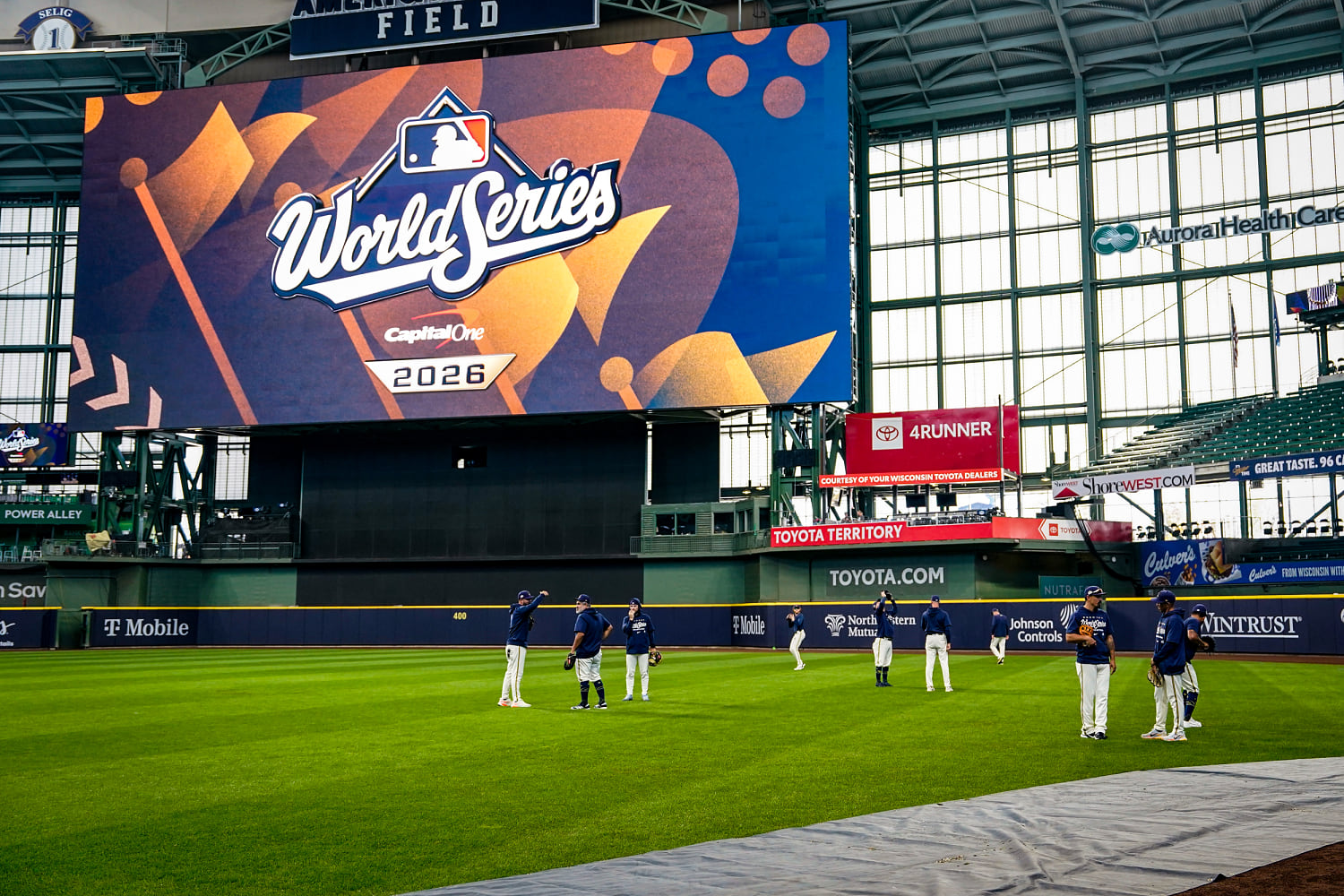
Scuff marks. That is what stays with you when the ballpark empties out in late October.
Not the roaring crowds or the brassy organ chords or the billion-dollar broadcast deals flashing across scoreboards. Just the dark, scuff-marked dirt around home plate where cleats dug in for nine innings, and the damp, cool air rolling off the outfield grass as the stadium lights click off one by one.
I have stood in quiet ballparks at midnight when the season ended early. You feel the weight of what was built and what might not be built again for a very long time. Now, as baseball prepares for a World Series between two small-market clubs with a Major League Baseball lockout looming right behind the final out, that familiar chill is creeping back into the dugout.
It is an odd, aching collision. On the field, two underdogs are fighting for a championship trophy they were told they could never afford to win. Behind the scenes, the sport itself is bracing for a work stoppage over money, payroll caps, revenue sharing, and who gets to claim the game's future.
Fans see bunting, fastballs, and ninth-inning drama. Owners and players see spreadsheets, collective bargaining agreements, and leverage. Between those two worlds sit thousands of people whose livelihoods depend on baseball simply being played.
When the Underdogs Crash the Party
Small-market baseball has always carried a quiet defiance. When a club operates in a smaller media market, it rarely commands the massive local television revenue or luxury-box windfalls available to big-city giants. To survive—let alone reach the World Series—these teams have to draft sharply, develop young talent patiently, trade shrewdly, and squeeze every drop of value out of every dollar on the roster.
Consider a hypothetical character to see how this plays out on the ground. Picture Elena, a veteran clubhouse attendant who has spent twenty-two springs and autumns folding jerseys, stocking sunflower seeds, and learning the quiet routines of players who arrive as wide-eyed prospects and leave as fathers. Elena does not sign multi-year contracts or negotiate collective bargaining terms. She knows the exact size shirt every pitcher wears and how a nervous rookie grips a bat before his first postseason plate appearance.
For a small-market franchise, reaching the World Series feels like catching lightning in a glass jar. Every scouting report that panned out, every low-cost free agent who found his swing again, every homegrown arm that developed into an ace comes together at once. It is thrilling. It is fragile.
The irony is hard to miss. Just as two small-market clubs prove that smart baseball and grit can topple heavyweights on the biggest stage, the looming lockout threatens to freeze the entire ecosystem. A championship celebration normally sparks parade plans, winter hot-stove dreams, and spring training anticipation. Instead, the confetti has barely settled before talks of stalled negotiations, frozen rosters, and darkened spring complexes begin to dominate the conversation.
To put this in plain terms, think of baseball like a neighborhood bakery that stays open all night. The bakers pour flour, shape dough, and pull warm loaves from the oven because people count on breakfast being ready. A lockout is like padlocking the front door in the middle of a rush because the owner and the staff cannot agree on how to split the profits at the end of the year. The ovens cool down. The regular customers walk past dark windows. Nobody wins while the doors stay shut.
The Invisible Stakes Behind the Boardroom Doors
Lockouts are easy to treat as abstract business disputes. Billionaires versus millionaires. Owners arguing over revenue sharing and competitive balance while players push back against salary suppression and service-time manipulation.
If you have never lived through a labor impasse up close, it can look like rich men squabbling over slices of a giant pie. I used to view it that way, too—until I watched what happens to the people standing nowhere near the bargaining table.
Consider another hypothetical figure: Marcus, a minor league hitting coach and single dad driving three hundred miles between affiliate towns in a beat-up sedan, living on modest seasonal pay and hoping one day to earn a full-time big-league spot. When a Major League Baseball lockout hits, the shockwaves do not stop at the major league clubhouse door. Uncertain schedules, frozen transactions, stalled promotions, and anxious families ripple outward in ways box scores never record.
Even local vendors feel it. The hot dog stand operator outside the stadium, the hotel housekeeper making up rooms for visiting crews, the youth coach watching kids imitate their favorite shortstop in the park—all of them participate in the rhythm of the season. When the game stops, that rhythm breaks.
Why do these standoffs happen so often in sports? Historically, labor conflicts flare up when economic incentives pull owners and players in opposite directions. Club owners often point to rising payroll disparities, smaller-market revenue limits, and long-term financial risk, arguing for tighter cost controls or revised revenue-sharing structures. Players, whose athletic careers are brief and physically punishing, resist anything they view as a cap on their earning power during their prime years.
Neither side enters a room without a grievance or a strategy. Both sides know that leverage is forged long before negotiations reach a deadline. Yet every time talks stall and a lockout looms, the sport risks testing the patience of the very fans who make the game valuable in the first place.
Confusing? Yes. Scary for people who rely on steady work? Deeply. And honestly, it is fair for fans to feel weary when business brinkmanship overshadows October baseball.
Why Small Markets Change the Math
When two small-market teams square off in the World Series with a lockout on the horizon, the contrast becomes sharper than ever.
Big-market clubs often absorb financial shocks differently. Large media markets, deep corporate sponsorships, and massive attendance bases give wealthier franchises a wider cushion. Small-market teams live closer to the margin. Building a contender takes years of careful planning, and a disrupted offseason or altered economic rules can reshape a front office's entire blueprint overnight.
Look at how fans react when two smaller-market clubs reach the fall classic. There is genuine pride in watching a city that rarely gets national spotlight command the whole sports world. Families gather in living rooms that usually see national broadcasts tilted toward coastal powerhouses. Local businesses light up. For a few weeks, the playing field feels level—or at least brave enough to challenge the status quo.
But that joy carries an undercurrent of dread when a work stoppage looms. A fan might ask: If my team finally breaks through and plays in the World Series, what happens next? Will free agency freeze? Will trades stall? Will the momentum that carried this roster to October evaporate behind closed doors in a hotel ballroom or league office?
Those are real questions. They are not cynical questions; they are the questions of people who care enough to invest their time, emotion, and money in a team.
In behavioral terms, people bond with stories of resilience. Small-market contenders embody resilience. A lockout represents institutional friction. When institutional friction threatens a story of resilience, the emotional whiplash hits harder. You are asked to cheer for triumph on Tuesday and brace for stalemate on Friday.
The Human Cost of a Frozen Game
Let us pause and look closely at what gets lost during a lockout, beyond standings and television ratings.
Baseball is a game of memory and continuity. A kid learns to keep score on a crinkled sheet of paper. A grandfather passes down a worn cap. A player spends a decade chasing a call-up, only to watch the calendar stall when spring should be waking up.
In a hypothetical scenario—strictly a thought experiment to illustrate the human toll—imagine a young outfielder on a small-market roster who has just experienced the rush of a deep postseason run. He is twenty-four years old. His athletic window is narrow; every healthy offseason is precious. Instead of refining his swing in structured camp environments or settling his next contract cleanly, he is caught in limbo, watching headlines about negotiations while working out on his own, waiting to see when baseball will officially reopen for business.
Multiply that uncertainty across hundreds of players, coaches, trainers, scouts, and support staff. Suddenly the "business of baseball" stops sounding like a headline and starts sounding like people trying to plan their lives around a moving target.
Owners have their own pressures, too. Running a franchise involves massive capital commitments, debt service, stadium maintenance, and long-term bets on markets that may not grow overnight. Understanding both sides does not mean ignoring the human cost; it means recognizing how stubborn entrenched economic interests can be when neither side wants to concede ground first.
What October Still Owes Us
There is a reason October baseball still captures people even when the sport's business feels messy.
Out on the mound, the pitcher does not care about collective bargaining proposals. In the batter's box, the hitter is not thinking about tax thresholds. When two small-market teams step onto the field for the World Series, the game strips away a lot of the noise. Nine innings. Three outs per half-inning. Execution under pressure.
Maybe that is why a World Series played under the shadow of a looming MLB lockout feels so poignant. It is a reminder of what the sport is when it works—and a warning of what stands in jeopardy if the people running it lose sight of the connection between diamond and stands.
Fans do not ask for perfection. They ask for honesty, fairness, and a game they can trust to be there when spring returns. They want the drama to happen between the foul lines, not in leaked negotiating positions.
As the final pitches of the season approach, two small-market teams stand ready to give everything they have for a title that means the world to their cities. Behind them waits the hardest conversation in baseball—one that will test whether leadership can protect the game's heartbeat while sorting out its balance sheet.
Listen closely on that final night when the stadium lights fade and the last cleat marks stay pressed into the dirt around home plate. Those scuff marks are a promise that the game was real, that people poured their hearts into every pitch, and that somewhere out in the dark, a kid is already gripping a bat and waiting for the first warm day to play again.