The ground beneath my boots is technically nowhere. It is a scar that refuses to heal. For decades, this strip of earth between East and West Berlin was a death trap—the Todesstreifen, the Death Strip—where concrete and barbed wire dictated the boundaries of human existence. Today, it remains a strange, liminal zone, a jagged piece of geography caught in a bureaucratic purgatory.
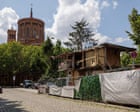
And right here, perched twelve feet above the scarred earth, sits a treehouse.
It is an unlikely architect of rebellion. Built from reclaimed wood and sheer, stubborn audacity, it clings to a tree that somehow survived the era of guards, dogs, and tripwire mines. The city authorities call it an illegal structure. They point to zoning permits, safety codes, and property lines. They see a violation of city ordinance.
But for those who have spent their lives navigating the ghosts of this city, the treehouse is not a structure at all. It is an argument. It is a stubborn reminder that even in a place defined by where you cannot go, someone eventually decides to stay.
The Geography of Ghost Lines
To understand why this treehouse matters, you must understand the silence of the wall. When the concrete finally fell in 1989, the world cheered for the reunification of a city. But cities are not just stones and mortar; they are memories.
After the Wall, Berlin entered a fever dream of reconstruction. Cranes clawed at the skyline. Historic districts were scrubbed clean. Developers looked at the empty spaces—the former no man’s land—and saw prime real estate. They saw an opportunity to replace the void with high-end glass towers and cold, functional office space.
The treehouse stands directly in the path of this erasure.
Consider the history of this specific spot. In the late 1980s, you could not stand here without risking your life. You were a target. You were a statistic. If you survived, it was through blind luck or desperate courage. Now, the danger has shifted shape. It is no longer about bullets; it is about erasure. The city wants to tidy up the remains of the conflict, turning the site of a brutal division into a pristine, sanitized pedestrian zone.
But history is not tidy.
When the original builder—let’s call him Elias, a man who grew up in the shadow of the Wall’s watchtowers—first nailed these planks into the bark, he wasn't looking for a weekend getaway. He was looking for a vantage point. He wanted to sit in the space where the Wall once stood and look out at a city that had been forcibly split in two.
The Physics of Defiance
I climbed the ladder a few weeks ago. The wood groaned under my weight, a reminder of the structure's fragility. Inside, it smells of sap and old books. The windows are mismatched panes of glass, looking out over the Berlin skyline—a view of shifting power, new wealth, and lingering trauma.
The city officials say the structure is unsafe. They have issued eviction notices. They have set deadlines. Each notice is a piece of paper that carries the weight of a thousand city ordinances. They treat the treehouse as if it were a rogue shed in a suburban backyard.
This is the fundamental disconnect.
The bureaucrats view the world through the lens of liability. They see an object that needs to be categorized, measured, and ultimately dismantled. They cannot account for the way a space changes when someone chooses to occupy it not for profit, but for witness.
If you treat a person as a data point, you can easily justify moving them. You can move them into a smaller office, a cheaper apartment, or a different city entirely. But if you acknowledge that the person is tied to the site—that their presence acts as a living monument to the city’s survival—the calculus changes.
The treehouse is a metaphor for the entire neighborhood. It is the last stand of a version of Berlin that was defined by grit, improvised art, and a collective refusal to be polished away. Every board nailed to that tree is a rejection of the idea that history can be sold to the highest bidder.
The Cost of Remaining
There is a cold irony in the fight to save this treehouse. To save it, it must become something the city understands. It needs status. It needs protection. It needs to be labeled a cultural monument.
But once it becomes a monument, the air changes. It becomes a tourist stop. It gets a plaque. It gets a fence. The very act of saving it threatens the organic, wild nature of its birth.
There is a woman, Anna, who lives nearby. She remembers the day the wall fell. She remembers the dust, the shouting, the sheer exhaustion of it all. She tells me that the treehouse is the only thing in the neighborhood that still feels honest. "Everything else is a museum," she says, gesturing to the gleaming glass storefronts nearby. "That treehouse is still breathing."
She is right. As long as the structure is threatened, it is alive. It is a focus point for the people of Berlin who feel like they are being squeezed out of their own history. Every time the city announces a new deadline for demolition, the locals gather beneath the branches. They don't protest with signs or chants. They just show up. They drink coffee, they talk, and they watch the sun set over the spot where the border once stood.
They are the true foundations of the structure.
The Echoes of the Wall
If the city succeeds in tearing it down, they will clear the patch of land. They will plant grass. They will install a bench or perhaps a tasteful informational display that explains, in three languages, exactly what happened here between 1961 and 1989. It will be safe. It will be predictable. It will be boring.
The irony is that the city thinks they are reclaiming the space for the public. They do not realize that the public has already claimed it.
I think back to my own life. I have moved through cities all over the world, always looking for these pockets of resistance. We are told that development is progress. We are told that old structures must make way for new needs. But we are never told what happens to the soul of a city when it loses its ability to surprise us. When every corner is planned, accounted for, and monetized, we lose the spaces where we can simply sit and exist without performing a role.
The treehouse is a reminder that the war didn't end in 1989. It just moved underground. It moved into the cracks of the zoning laws and the small, quiet acts of defiance that sustain a culture.
The wind kicks up, whistling through the branches. The wood beneath me shivers. Below, a group of teenagers sits on the roots of the tree, smoking cigarettes and looking up at the sky. They aren't looking at the city. They aren't looking at the history books. They are just sitting in a space that hasn't been told who it is supposed to be yet.
For a moment, the weight of the past and the uncertainty of the future vanish. There is only the rough, unyielding texture of the bark against my palm.
Somewhere, in an office building miles away, a stamp is hitting a piece of paper. The deadline is looming. The authorities are preparing their final argument. But looking out from this height, the city feels fragile, temporary, and entirely beautiful in its brokenness.
The treehouse is still there. For now, the ghosts have a place to sit. And perhaps, that is enough.