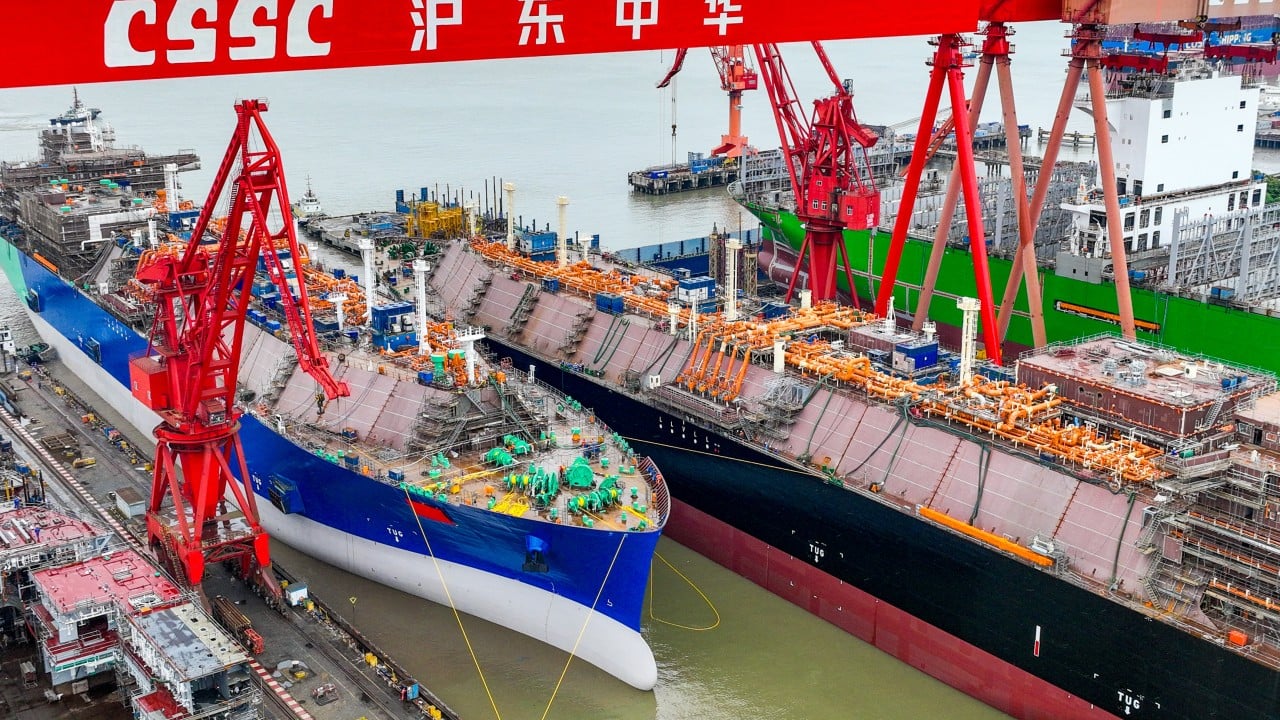
In October 2026, global shipowners placed orders for seven large liquefied natural gas carriers, and Chinese yards took five of them. South Korea, the undisputed heavyweight champion of cryogenic shipbuilding for two decades, walked away with two. Across the first ten months of the year, China captured 32 of the 76 large LNG vessels ordered worldwide, surging from a mere three vessels in all of 2025 to a 42.1 percent global market share. The crown jewel of maritime engineering is no longer an exclusive Korean club.
For years, executives in Seoul and Geoje dismissed Beijing’s maritime ambitions as a volume play built on cheap bulkers and container boxes. They insisted that ultra-complex, high-margin gas carriers required institutional muscle that state-backed Chinese yards simply could not replicate overnight. That comfort blanket is gone. While South Korea still holds a cumulative ten-month lead at 44 vessels, the gap has narrowed to 15.8 percentage points, and foreign shipowners are now placing repeat business directly in Shanghai and Dalian.
Why the Dam Finally Broke
A surge in global gas demand did not hand China this market on a silver platter. Capacity bottlenecks in South Korea did. Between massive multi-year commitments for QatarEnergy’s North Field expansion and steady replacement orders for aging steam-turbine tonnage, South Korea’s Big Three—HD Korea Shipbuilding & Offshore Engineering, Hanwha Ocean, and Samsung Heavy Industries—filled their dry docks years in advance.
When shipowners went shopping for delivery slots in 2028 and 2029, Korean yards offered high prices and long waitlists. Chinese builders offered immediate berths and aggressive discounts. By late 2026, Chinese yards were quoting roughly $225 million per standard 174,000-cubic-meter carrier, undercutting Korean rivals and forcing Samsung Heavy Industries to publicly acknowledge downward pressure on its newbuild pricing during third-quarter earnings.
Price gets a buyer into the room, yet reliability signs the contract. The turning point in October came when Malaysian shipping giant MISC ordered five 174,000-cubic-meter carriers from Shanghai’s Hudong-Zhonghua Shipbuilding. This was not a speculative gamble by a domestic Chinese state enterprise. MISC had ordered five identical vessels from Hudong-Zhonghua earlier in the year, and all ten ships are tied to 20-year charter contracts with Malaysian energy major Petronas. When an international energy major commits two decades of cash flow to a Chinese-built hull, the quality discount evaporates.
Inside the Cryogenic Bottleneck
To understand why China’s leap is so jarring, you have to look inside the hull. An LNG carrier is essentially a floating, self-propelled thermos bottle designed to keep natural gas liquefied at minus 162 degrees Celsius. Any structural failure or insulation flaw causes rapid boil-off, dangerous hull embrittlement, and catastrophic financial loss.
The technical barrier to entry comes down to three unforgiving components:
- Membrane Containment Systems Nearly 80 percent of the global orderbook relies on cryogenic membrane designs licensed by French engineering firm Gaztransport & Technigaz (GTT). Installing these corrugated stainless-steel or Invar alloy barriers requires thousands of hours of microscopic welding with zero tolerance for error.
- Dual-Fuel Propulsion Modern emissions rules from the International Maritime Organization have rendered older steam turbines obsolete. Today’s standard vessels run on high-pressure ME-GI or low-pressure X-DF dual-fuel engines that burn boil-off gas while keeping methane slip under strict limits.
- Dockyard Cycle Times Profit in shipbuilding depends on how fast a yard can assemble mega-blocks in a dry dock and float the hull out for quayside outfitting.
For a decade, Hudong-Zhonghua was the lone Chinese shipyard capable of consistently delivering large membrane carriers. Beijing solved that bottleneck by systematically qualifying new entrants. Jiangnan Shipyard and Dalian Shipbuilding Industry scaled up their cryogenic lines, securing major 2026 contracts from Shell, COSCO SHIPPING Energy, and Abu Dhabi’s ADNOC Logistics and Services. Even private newcomers are breaking in. Hengli Heavy Industry, which revived the bankrupt former STX Dalian yard, signed a technical assistance and licensing agreement with GTT to enter the membrane carrier arena.
The Numbers Behind the Shift
The scale of China's broader shipbuilding dominance provides the industrial gravity pulling LNG orders across the Yellow Sea. Across all merchant vessel categories from January through October 2026, Chinese shipbuilders captured 77 percent of global compensated gross tonnage, outpacing South Korea’s 15 percent by more than five to one.
| Metric (Jan–Oct 2026) | China | South Korea |
|---|---|---|
| Large LNG Carrier Orders | 32 vessels | 44 vessels |
| LNG Market Share (Unit Count) | 42.1% | 57.9% |
| October 2026 LNG Orders | 5 vessels | 2 vessels |
| Total Global Shipbuilding Share (CGT) | 77.0% | 15.0% |
| Average Yard Order Backlog | 4.2 years | 1.9 years |
This disparity in total backlog creates a massive supply-chain advantage. Chinese shipyards buy marine-grade steel plate, cryogenic pumps, and automated welding rigs at a scale that Korean yards cannot match. Even when Chinese yards import European containment materials or Korean sub-assemblies, their domestic steel and labor cost structure absorbs the premium.
Geopolitics Is the Wild Card Nobody Can Price
If pure economics dictated every ship order, South Korea’s market share would face an even steeper slide. Yet maritime trade does not happen in a vacuum, and Washington’s trade policy hangs over every newbuilding contract like a storm cloud.
In April 2025, the Office of the United States Trade Representative moved to impose punitive port fees on Chinese-built and Chinese-operated vessels calling at American ports. While Washington suspended those fees under a bilateral trade truce—and extended that pause through January 2027—the regulatory sword remains unsheathed.
This creates a bifurcated fleet strategy for global energy traders. Imagine a hypothetical European utility signing a 15-year off-take agreement for liquefied gas out of Corpus Christi, Texas. If that buyer needs ships dedicated to the U.S. Gulf Coast-to-Europe corridor, ordering a Chinese-built hull carries an uninsurable political risk. Should U.S. port fees snap back into force in 2027 or beyond, a Chinese-built carrier could face millions of dollars in extra port levies every time it loads American gas.
Conversely, cargoes moving from Qatar, Malaysia, Australia, or West Africa into Asian import terminals face zero American port exposure. Middle Eastern and Asian state energy firms are happily routing their orders to Shanghai to save tens of millions of dollars per hull, leaving South Korea heavily reliant on Western majors and North American export projects.
Operational Reality vs Orderbook Hype
Winning a contract is only half the battle; delivering a vessel on schedule without post-delivery warranty claims is what keeps a shipyard alive. South Korean executives quietly point out that a huge chunk of China’s 2026 order surge will not hit the water until late 2028 or 2029.
Delivering 32 complex cryogenic vessels across multiple newly expanded Chinese yards simultaneously will test China’s skilled labor pool to its absolute limit. Specialized cryogenic welders and cryo-insulation technicians take years to train. Furthermore, second-hand asset values still favor Korean steel. Lenders and maritime insurers historically assign higher residual values to vessels built at Ulsan, Okpo, and Geoje because their 20-year operational track records are proven across hundreds of hulls. Hanwha Ocean alone has delivered more than 200 LNG carriers. China’s newer LNG yards have delivered only a fraction of that total.
South Korea is responding by retreating up the technological value chain, much like Japan did when Korea conquered the market in the late 1990s. Korean yards are pouring capital into ammonia-ready propulsion, onboard carbon capture, ultra-large 200,000-cubic-meter designs, and high-margin floating LNG production units.
Yet history offers a sobering warning for Seoul. Every time South Korea has drawn a technological line in the sand—first in bulk carriers, then in ultra-large container ships, and later in dual-fuel tankers—Chinese shipbuilders have crossed it within five years. The October 2026 order numbers prove that the cryogenic barrier has fallen, and no amount of engineering nostalgia in Seoul will put the genie back in the bottle.