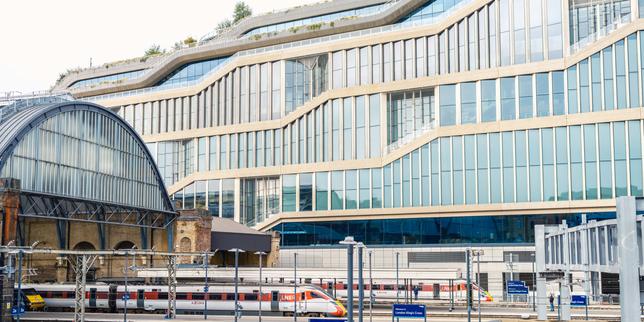
You won't find many spots in London that underwent a physical and economic identity shift as radical as King's Cross. Fifteen years ago, standing outside the station meant dodging construction dust, industrial grit, and a general neighborhood vibe that made you clutch your wallet a bit tighter. Today, that exact asphalt footprint holds one of the highest concentrations of artificial intelligence talent on the planet.
At the center of gravity sits DeepMind. When the lab set up its London headquarters right next to the Regent's Canal, it wasn't just planting a flag for British tech. It was accidentally triggering an urban gold rush that completely redefined the district's DNA.
Let's look past the glossy PR brochures. How does a decaying Victorian railway yard turn into a global machine learning hub? More importantly, can other cities replicate the formula, or was this a lightning-in-a-bottle moment driven by unique academic proximity and deep corporate pockets?
The Industrial Wasteland That Got a Tech Makeover
Urban regeneration projects usually fail because they lack soul. You drop a shiny new shopping center into a working-class neighborhood, slap on some expensive coffee shops, and watch the locals get priced out while the culture evaporates. King's Cross could have easily gone down that tired, generic path.
Instead, the master developers behind the 67-acre site kept portions of the industrial heritage intact while partnering directly with academic powerhouses. You have Victorian gasholders transformed into public parks sitting a five-minute walk from state-of-the-art computational labs.
Most property developments rely on financial firms or luxury retail to anchor their square footage. King's Cross took a different bet. They courted academia and deep tech early. They realized that proximity to University College London and the Francis Crick Institute created a natural talent pipeline. If you want top-tier minds, you don't build an office park in a boring suburb. You put them where the culture is already buzzing.
DeepMind and the Gravity Well Effect
It's impossible to talk about the tech transformation of King's Cross without talking about Demis Hassabis and the early days of DeepMind. Founded in 2010, the company didn't start in a mega-headquarters. They moved into the neighborhood when it was still rough around the edges, attracted by cheap rents and central transport links.
When Google acquired them in 2014 for roughly 400 million pounds, everything changed overnight. Suddenly, a small AI research outfit had the infinite balance sheet of a Silicon Valley giant, but they stayed put. They didn't pack up and move to Mountain View. They doubled down on London.
That decision created a massive gravity well.
- Top tier researchers stayed in Europe instead of automatically migrating to the US West Coast.
- Spin-off startups popped up in the surrounding blocks, founded by former engineers looking to build their own ventures.
- Venture capital firms opened offices within walking distance to hunt for the next big deal.
When you walk down Stable Street today, you aren't just walking past office buildings. You are navigating the physical epicenter of European AI policy, research, and commercialization. Every major tech player now feels compelled to have an address within a mile radius just to poach or partner with the ecosystem that grew up around DeepMind.
The Academic Engine Room
Corporate tech doesn't exist in a vacuum. The real secret weapon of King's Cross isn't real estate; it's the sheer density of brainpower pouring out of London's universities every single year.
UCL, Imperial College London, and King's College London pump out thousands of computer science and machine learning graduates annually. For decades, the tragedy of British tech was brain drain. Brilliant minds would graduate, look at the local job market, and immediately book a one-way flight to San Francisco or Seattle because the domestic funding and scaling opportunities weren't there.
DeepMind and the surrounding King's Cross cluster broke that cycle. Students realized they could stay in London, work on world-changing models like AlphaFold, and get paid competitive global salaries without leaving the UK.
Companies like Google DeepMind also actively fund PhD programs and research chairs, creating a closed-loop system where academic research feeds directly into commercial products, which in turn fund more academic research. It's a flywheel effect that took over a decade to spin up, but now it has massive momentum.
What Other Cities Get Wrong About Copying This Model
Every mayor in Europe wants their own "King's Cross AI hub." Paris, Berlin, and Amsterdam are pouring millions into innovation districts, hoping to trigger the same magic.
Most of them fail because they treat tech development like real estate development. They build glass towers, offer tax breaks, and wonder why the next billion-dollar startup hasn't moved in.
Innovation doesn't work that way. You can't zone a neighborhood for genius.
- You need open-source academic collaboration. The European model thrives when universities and private labs share porous boundaries, unlike the hyper-litigious corporate fortresses of some US tech hubs.
- Urban density matters. Engineers want to walk out of an office and grab a pint or a coffee in a vibrant public square. Sterile suburban office parks kill creativity.
- Patience is non-negotiable. The King's Cross transformation took over twenty years of planning, funding, and construction. Governments obsessed with quarterly political cycles rarely have the stomach for investments that take decades to bear fruit.
The Bottlenecks Facing the Neighborhood Now
Success brings its own unique set of headaches. The transformation of King's Cross from a neglected railway hub into a global tech capital created massive socioeconomic friction.
Housing costs in the surrounding boroughs skyrocketed out of reach for average Londoners. Local independent shops got squeezed out by high-end chains catering to well-compensated software engineers and researchers. The very culture that made the area edgy and interesting is slowly being polished away by corporate uniformity.
Furthermore, energy demands are becoming a serious bottleneck. Training massive neural networks requires staggering amounts of power and cooling capacity. Urban computing hubs place immense strain on local grid infrastructure, forcing developers to look for innovative ways to power their facilities sustainably.
Despite these growing pains, the momentum is locked in. The neighborhood is no longer just a physical place on a map; it's a global brand representing Europe's capacity to compete in the most important technological race of our century.
If you want to understand where artificial intelligence in Europe is heading next, don't look at a government white paper or a corporate earnings report. Just take a walk down the canal behind Granary Square, grab a coffee, and watch the future being coded in real time.