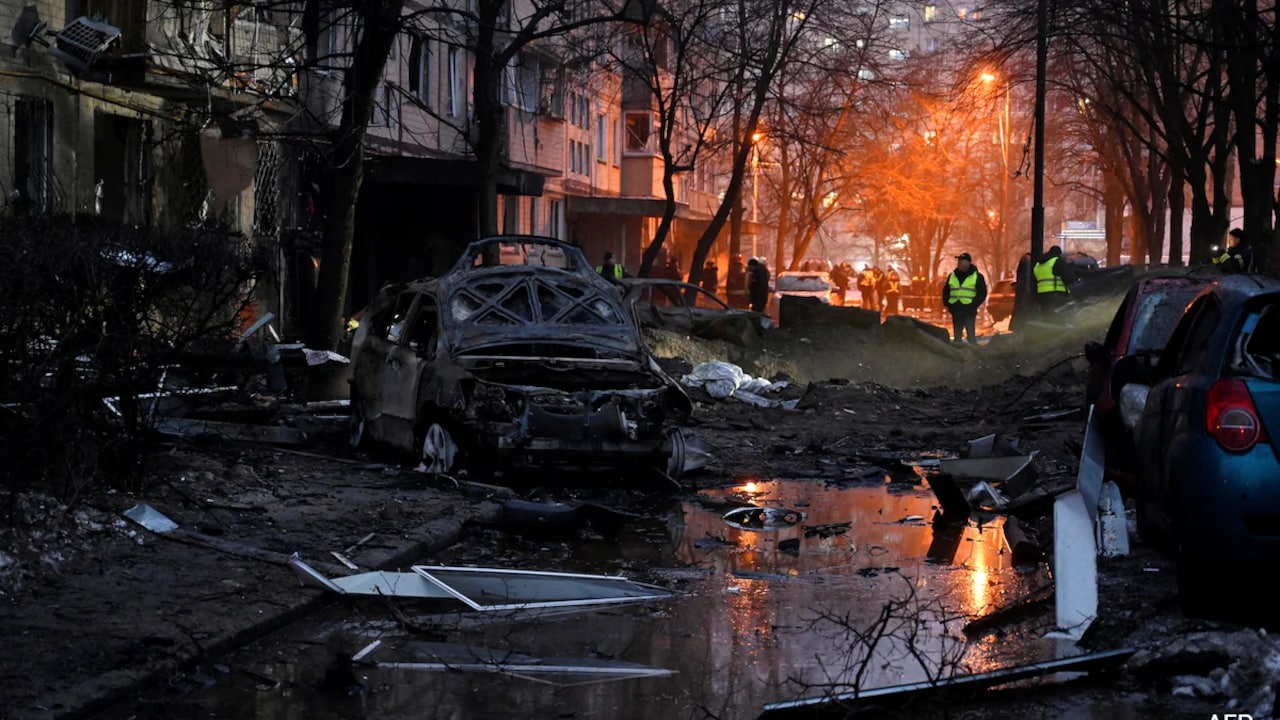
When a ballistic missile descends upon an urban center, the event represents the terminal phase of a complex technological and economic equation. Recent predawn strikes on Kyiv by Russian forces, confirmed by Mayor Vitali Klitschko, underscore the persistent vulnerability of high-density population zones to high-velocity vector attacks. Rather than isolated acts of random destruction, these strikes operate within a structured logic of aerospace attrition, inventory management, and geopolitical signaling. Deconstructing this dynamic requires moving past surface-level reporting to examine the structural mechanics governing modern missile warfare, defense saturation, and regional escalation.
The Kinematics of Ballistic Impact
Ballistic missiles follow a suborbital trajectory characterized by a powered ascent phase, a free-fall midcourse phase, and a high-velocity terminal descent. Unlike cruise missiles or uncrewed aerial vehicles, which fly at subsonic speeds within the atmospheric boundary layer and rely on aerodynamic lift, ballistic systems exit or graze the upper atmosphere. This grants them velocities often exceeding Mach 5 upon re-entry. Building on this topic, you can find more in: Why India and Vanuatu Are Quietly Building a Stronger Partnership.
The kinetic advantage of this velocity profile is twofold. First, it compresses the operational window for target detection, tracking, and interception. Second, the sheer terminal momentum ensures that even intercepted missiles often deposit massive kinetic energy and hazardous shrapnel across urban footprints, as demonstrated by debris-ignited structural fires in Kyiv districts like Sviatoshynskyi and Obolonskyi.
The primary utility of deploying such systems against a heavily defended capital lies in weaponizing time. Defenders operate under severe temporal constraints, where automated command-and-control nodes must calculate intercept vectors within seconds. When interceptors fail to achieve kinetic hit-to-kill parameters in the upper atmosphere, the burden shifts to point-defense systems operating in the terminal phase, drastically increasing the probability of collateral damage from falling debris. Observers at TIME have shared their thoughts on this trend.
The Attrition Cost Function
At the heart of the ongoing air war over Ukraine lies an asymmetrical economic cost function. Missile defense operates on principles of high-cost asymmetry against low-cost offensive saturation. Advanced interceptor missiles deployed by air defense batteries represent sophisticated engineering feats involving millimeter-wave radar guidance, high-impulse divert thrusters, and complex guidance packages. Their unit costs vastly exceed the marginal production cost of standardized ballistic or cruise munitions.
Strategic planners in Moscow exploit this expenditure disparity. By pairing high-velocity ballistic assets with decoy payloads or synchronized drone waves, attacking forces force defenders into a difficult resource-allocation dilemma. Every defensive launch depletes finite stockpiles that rely on foreign industrial supply chains.
- The Defense Expenditure Vector: High unit cost, restricted manufacturing output, absolute necessity for asset preservation.
- The Offensive Depletion Vector: Standardized production lines, lower unit thresholds, designed to overwhelm engagement channel capacity.
When presidential warnings precede these barrages, pointing directly to the delayed delivery or limited volume of allied air defense licenses and batteries, they highlight a mathematical reality. A defensive network functions as a finite queue. If the arrival rate of incoming high-speed threats exceeds the processing and engagement rate of the defense system, saturation occurs. The system cannot intercept what it lacks the physical interceptors to engage.
Regional Spillover and NATO Airspace Mechanics
The shockwaves of strategic strikes on urban capitals extend far beyond immediate blast radii, altering the operational posture of neighboring sovereign states. The decision by Poland to scramble fighter jets and activate ground-based air defense and radar reconnaissance systems in response to strikes on western Ukraine illustrates the immediate regional security fallout.
This posture reflects a calculated risk-mitigation strategy rather than passive observation. Modern high-speed munitions frequently deviate from predicted flight paths due to mid-course corrections, guidance degradation, or electronic countermeasures. Consequently, airspace management along the NATO-Ukraine frontier operates under tight margins of error.
- Preventive Vector Activation: Fighter aircraft establish combat air patrols to track trajectory anomalies.
- Sensor Grid Synchronization: Early warning radar systems achieve maximum operational readiness to classify cross-border vectors instantly.
The institutional response of neighboring states demonstrates that an attack on an interior capital triggers immediate concentric circles of defensive readiness across international borders. The operational friction generated by these strikes forces regional actors to continuously expend flight-hour resources and maintain high alert states, compounding the broader economic and military drag across Eastern Europe.
The Strategic Equilibrium
The persistence of ballistic strikes against urban infrastructure confirms that modern deterrence relies less on static protection and more on industrial resilience and supply chain velocity. As long as the asymmetry between offensive manufacturing capacity and defensive replenishment rates persists, capital cities like Kyiv remain focal points of high-stakes technological attrition. The strategic trajectory depends entirely on whether manufacturing outputs for advanced interception architecture can scale to match or exceed the deployment rate of high-velocity offensive vectors.