Salt gets everywhere. It crusts on the windowpanes long after the gale has blown itself out. It leaves a bitter, metallic taste on the back of the tongue when the wind shifts off the Atlantic. If you have ever stood on the edge of the Rockaways or watched the gray swells heave themselves against the outer rim of Staten Island during a nor'easter, you know the precise texture of that vulnerability. You realize, with a cold, sinking clarity, that the map of New York City is written in pencil.
Water remembers where it wants to go. And for decades, the city spent billions trying to argue with it.
We built walls. We drove steel sheet piling deep into the seabed. We poured concrete breakwaters that stood like grey teeth against the surf, only to watch the water find the gaps, slip behind the defenses, and pool in basements where boilers hissed and drowned. Concrete is arrogant. Concrete assumes the ocean is a problem to be solved with an elbow.
Then came the autumn of 2012.
The air turned a bruised, metallic purple before the surge even hit. When the water retreated, it left behind more than ruined drywall and slicked-down subway tokens. It left a profound psychological fracture. We looked at our coastline and saw how fragile the illusion of permanence really was. The old ways of protecting the shoreline—massive engineering projects that took decades to fund and environmental reviews that dragged on until the next hurricane breached the levies—were failing under the weight of a changing climate.
Enter a handful of teenagers with mud caked to their sneakers.
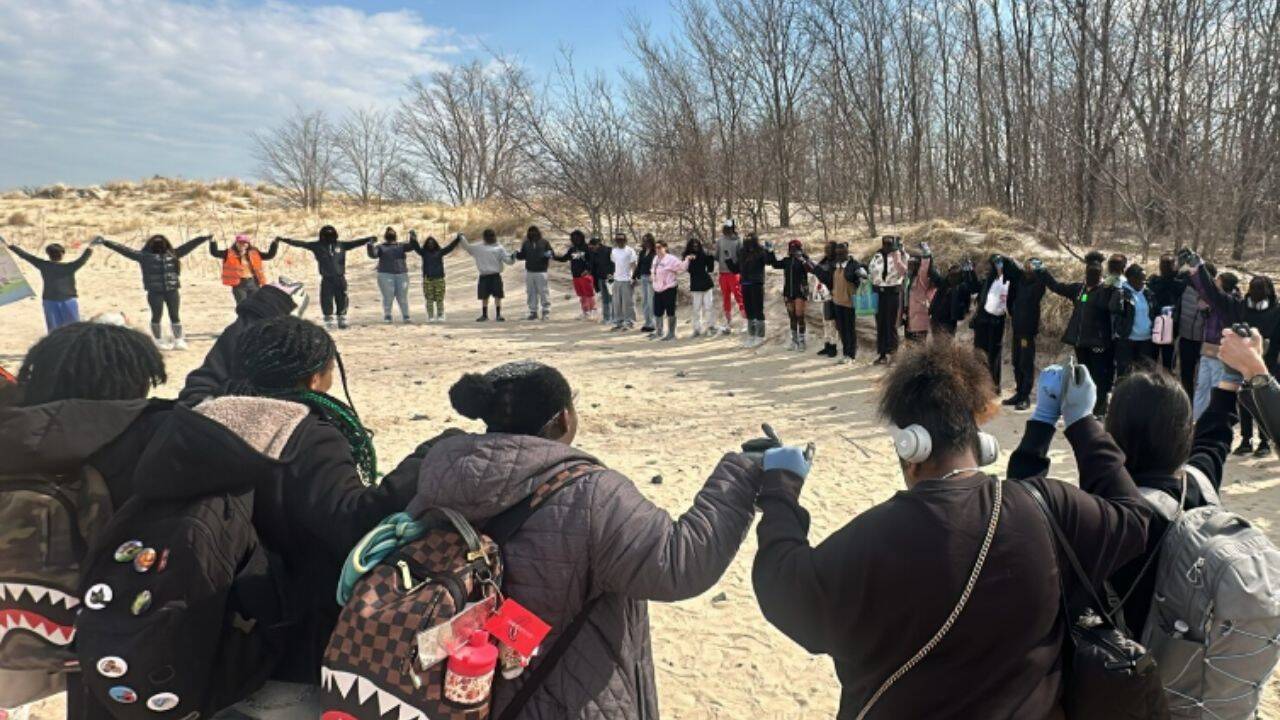
Picture a Tuesday morning in late spring. The salt air is sharp enough to water your eyes. Nearly four thousand students from public schools across the five boroughs spill out of yellow buses onto stretches of wind-scoured sand that look entirely indifferent to human presence. They are carrying bundles of what looks like unruly, coarse hay.
This is American beachgrass, or Ammophila breviligulata. To an untrained eye, it looks like weeds you might yank out of a crack in a driveway. It is spindly, pale green, and utterly defenseless against a child's sneaker.
Yet, this unassuming grass is an architectural marvel disguised as a plant.
Imagine a microscopic net cast beneath the dunes. That is what beachgrass does. Its roots, or rhizomes, dive deep into the loose sand, branching and intertwining until they form a living subterranean fabric. When the wind howls across the beach, carrying millions of sharp grains of sand inland, the blades of the grass break the momentum. The sand drops, settles around the stalks, and gets trapped by the roots below.
The dune grows. The plant grows upward to chase the rising surface. It is a slow, silent collaboration between a plant and the elements, turning a shifting heap of loose earth into a permanent, resilient barrier.
The students did not just drop these stalks into the ground; they knelt in the damp sand, elbow-deep in the grit, pressing the roots home with a rhythmic, mechanical focus. One hundred thousand plus individual stalks. Think about the sheer human scale of that labor. Four thousand pair of hands, small and large, working in tandem across the eroded fringes of the city.
(Note: While the specific participant count and plant totals reflect verified municipal records from coastal restoration initiatives, the sensory texture of that Tuesday morning—the grit in the teeth, the chill of the Atlantic wind—is reconstructed to capture the lived reality of those who stood where the land meets the sea.)
Why does this matter? Because the math of modern coastal defense is terrifying. Traditional bulkheads cost millions of dollars per mile, require constant maintenance, and often accelerate erosion elsewhere by bouncing wave energy back into the water. They are rigid. And in a world where storms are growing more erratic and sea levels are creeping upward year by year, rigidity is a death sentence.
Nature, it turns out, is the only engineer flexible enough to survive.
When you plant a dune, you are not building a wall. You are starting a conversation with the ecosystem. You are giving the coast a memory. A concrete seawall forgets a storm the moment the water recedes; a dune absorbs the blow, yields to it, and uses the very energy of the wind to heal itself.
There is an old myth that cities and nature are locked in eternal combat. We pave over the earth, and the earth eventually reclaims its territory through cracked asphalt and creeping ivy. But what happened on those stretches of New York coastline was something different. It was an alliance.
Consider what happens next year, or five years from now, when another storm rolls in off the shelf. The wind will whip across the water, looking for a weakness. It will strike the outer beaches. But instead of sweeping unimpeded across low-lying blacktop and residential blocks, it will hit a wide, sloping rampart of sand anchored by millions of subterranean roots. The sand will shift, yes. Some of the grass will be buried. But the dune will hold. The energy will be spent.
Down the block, a basement stays dry. A family sleeps through the night without listening to the rising water slap against the front step.
That is the hidden power of this work. It is easy to look at climate statistics and feel paralyzed. The numbers are too large; the ice caps are too far away; the political gridlock is too thick. We are told to recycle our plastic cups while industrial tankers burn heavy fuel on the horizon, and the dissonance is enough to make you want to close the curtains and turn off the news.
The kids in the mud understood something we often forget in our air-conditioned rooms. You do not fix a coast with a press release. You fix it one handful of grass at a time.
By the time the buses pulled away, the students left behind rows of green spikes stretching into the distance like an army on the horizon. The wind picked up again, carrying the scent of brine and wet earth. The kids went home to their homework, their phones, their ordinary lives, probably unaware that they had just engineered a small piece of immortality for the city they call home.
The tide comes in. The tide goes out. The beach remains.