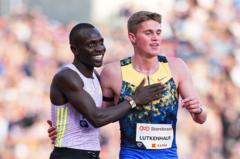
The air inside a track stadium during a premium 800-meter race does not feel like normal air. It is heavy, thick with the scent of wintergreen rub, damp synthetic rubber, and the collective anxiety of a few thousand people who know they are about to watch two minutes of pure, unadulterated suffering. The 800 is a cruel event. It is too long for a pure sprint, too fast for tactical breathing. It is two laps around a red oval where the human body intentionally floods itself with lactic acid until the lungs scream for mercy and the legs turn to wet cement.
Most people in that stadium look at the starting line and see numbers, jersey colors, or shoe sponsorships. But if you stand close enough to the track, you see the eyes.
On one side of the track stood Emmanuel Wanyonyi. He is not just a runner; he is an institution. He holds the Olympic gold medal around his neck from Paris. He is a man who has mastered the exact science of pacing, psychological warfare, and the brutal physics of the homestretch. When Wanyonyi steps onto a track, he carries the invisible weight of a nation’s legacy and the absolute expectation of victory. He looks like royalty because, in the world of middle-distance running, he is.
Then there was the kid.
Jonathan Lutkenhaus is seventeen years old. Let that number settle for a moment. At seventeen, most teenagers are navigating the minor crises of high school algebra, learning how to parallel park, or figuring out who they are supposed to be. They are inherently deferential to the world of adults, especially adults who happen to be the fastest human beings on the planet.
But running possesses a strange, democratic beauty. The track does not care about your resume. The clock does not read press releases.
When the gun fired, the race unfolded with the typical, terrifying speed of an elite 800. The pack shifted, a colorful snake of sinew and spiked shoes fighting for the inside rail. Wanyonyi moved with his characteristic grace, the smooth, metronomic stride that has broken the spirits of the best runners in the world. He took the lead because that is what champions do. They dictate the terms of the engagement. They make the track their kingdom.
Lutkenhaus stayed tucked away. To the untrained eye, he looked like a passenger, someone just trying to survive the furious pace set by the masters. But if you watched his shoulders, they were loose. His face lacked the tight, panicked grimace of a boy out of his depth. He was simply running.
The Chemistry of Disbelief
To understand what happened next, you have to understand what happens to a runner's brain at the 600-meter mark. This is where the race truly begins. Your body is out of oxygen. The brain, operating on pure survival instinct, begins sending urgent, frantic signals to the legs: Stop. Slow down. You are dying. It is at this exact moment that veteran runners rely on their pedigree. They remember the thousands of miles in their legs. Wanyonyi accelerated, a definitive move designed to snap the invisible rubber band connecting him to the rest of the field. It is a move that usually works. It is the moment where the champion asserts his dominance and the pretenders fade into the background.
But the teenager didn't fade.
Instead of breaking, Lutkenhaus seemed to find a bizarre, defying gear. He didn't just match Wanyonyi's surge; he countered it.
Imagine a high school theater student walking onto a Broadway stage mid-performance, taking the microphone from the lead actor, and singing the final aria better than the star. It defies the social contract of sport. We expect youth to wait its turn. We expect the hierarchy to be respected.
The stadium grew remarkably quiet for a fraction of a second as the realization set in. Lutkenhaus was moving up on the outside. His arms were pumping with a wild, unpolished ferocity that contrasted sharply with Wanyonyi’s textbook elegance. It wasn't pretty, but it was devastatingly effective.
With fifty meters to go, they were locked side by side.
The Myth of the Transition
We like to think that greatness is a slow, predictable ladder. We tell ourselves stories about local meets, state championships, national qualifiers, and the slow, agonizing climb to the international stage. We do this because it makes the world feel safe. It implies that if we work hard enough and follow the steps, our turn will come.
Lutkenhaus threw that entire playbook into the dirt.
In those final ten meters, the race became something primal. Wanyonyi digged deep, flashing the ferocious competitive drive that made him an Olympic champion. He leaned. He strained. He used every ounce of knowledge accumulated through years of world-class racing.
But youth has an unfair advantage over experience: it does not know what is impossible.
Lutkenhaus crossed the line first.
The clock flashed the times, but the numbers were secondary to the visual reality of the finish line. A seventeen-year-old high schooler had just beaten the best in the world.
The immediate aftermath of a race like that is a study in human emotion. Wanyonyi looked at the scoreboard with a mixture of confusion and professional respect. He didn't throw a tantrum; he is too big a man for that. But his eyes betrayed the shock of a king who had just realized his castle walls weren't quite as high as he thought.
Lutkenhaus, meanwhile, looked almost amused. He wasn't pounding his chest. He wasn't putting on a show for the cameras. He looked like a kid who had just won a pickup basketball game at the local park and was wondering if there was any Gatorade left in the cooler.
That lack of reverence is precisely what makes him dangerous. When you don't fully comprehend the magnitude of the giant in front of you, you cannot be intimidated by him. Fear requires context. It requires an understanding of odds, history, and reputations. If you strip all of that away, it’s just two laps around a track against another guy in shorts.
The Loneliness of the Track
People will spend the coming weeks analyzing the training split times, the wind assistance, the specific phase of the season, and whether Wanyonyi was at peak fitness. The pundits will try to rationalize the result because sports culture loathes an anomaly. We want everything to fit into a neat, tidy spreadsheet.
They will miss the point entirely.
The beauty of what happened isn't found in the analytics. It is found in the sheer, terrifying audacity of a teenager who refused to accept his place in the world's pecking order. Track and field is an incredibly lonely sport. There are no teammates to pass to when you are tired. There is no coach on the field to call a timeout when the pressure gets too intense. You are entirely alone with your doubts, exposed to thousands of people under bright lights.
To step into that loneliness against an Olympic champion takes a specific kind of courage. To win takes something else entirely—a complete lock on one's own capability that borders on delusion.
The running world has a new name to reckon with, and the hierarchy has been permanently disrupted. The next time Jonathan Lutkenhaus stands on a starting line, the air will be just as thick, and the stakes will be just as high. But things will be different. He won't be the anonymous kid anymore. The world will be watching, waiting to see if the magic can happen twice.
As the stadium lights began to dim and the crowds trickled out toward the parking lots, the track sat empty again. The red rubber showed the faint scuff marks of spikes, the physical remnants of a moment that defied logic. A champion had been tested, a boy had become a giant, and for one brief evening, the normal rules of the universe simply ceased to apply.