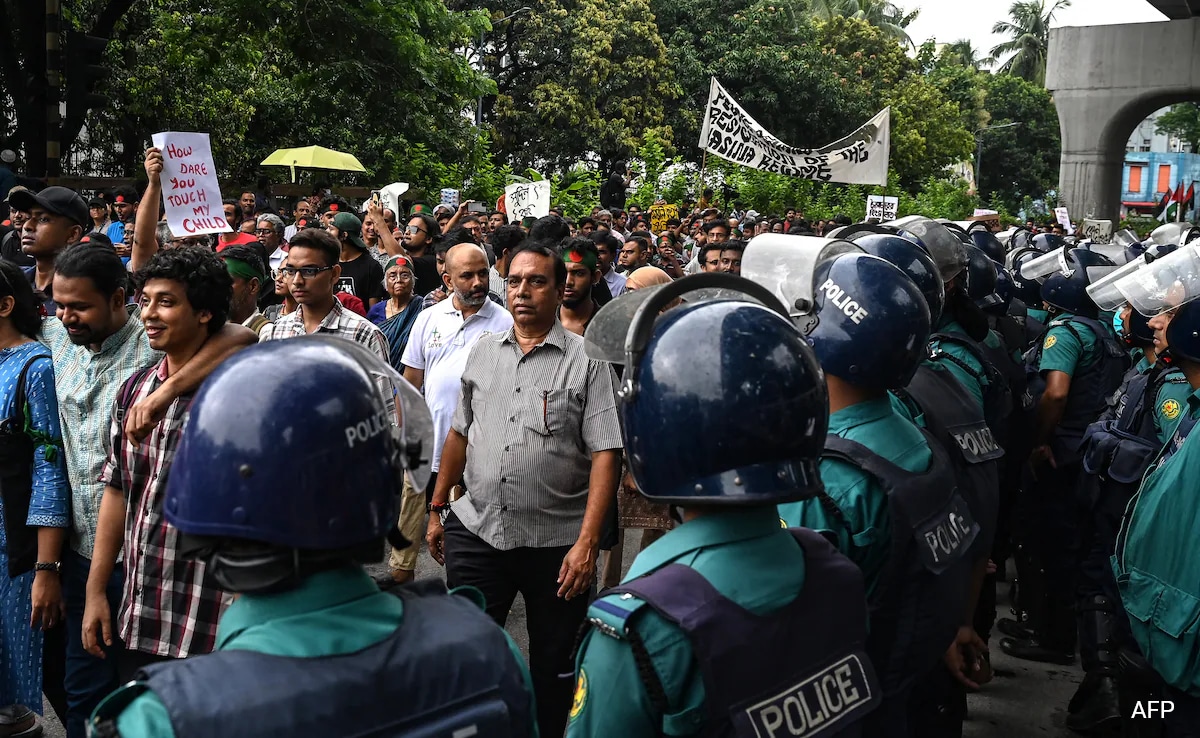
The death sentences handed down to two police officers for the killing of Abu Sayed represent a rare fracture in the wall of impunity that has historically shielded the Bangladesh security forces. In July 2024, Sayed, a student at Begum Rokeya University, stood alone with his arms outstretched before a phalanx of armed riot police. He was unarmed. He was not charging. He was simply standing. The subsequent shots, captured on mobile phone footage that bypassed state-controlled media, did more than just kill a young man. They ignited a national uprising that eventually toppled a decade-long administration. This verdict is the first major legal reckoning for the violence that defined that summer, but it also raises uncomfortable questions about how deep the accountability will actually go.
The court in Rangpur found that the officers acted with clear intent, bypassing standard protocols for crowd control. In a country where the "crossfire" narrative—a euphemism for extrajudicial killings—has been a standard police defense for years, this judgment serves as a jarring departure from the status quo. However, focusing solely on the two men in uniform ignores the structural machinery that put them on that street with live ammunition.
The Anatomy of a Trigger Pull
To understand why Abu Sayed died, one must look past the individuals and at the culture of the Bangladesh Police. For years, the force has been utilized as a political instrument rather than a public service body. Training manuals emphasize the "preservation of order," a vague term often interpreted by local commanders as the total suppression of dissent.
When the 2024 protests began, the police response was not a series of isolated errors. It was a systemic application of force. The officers sentenced to death were part of a unit that believed, perhaps with good reason based on history, that they were untouchable. They operated under a legal framework—specifically the Digital Security Act and its successors—that criminalized criticism and empowered the state to use force against "instigators."
The evidence against the officers was irrefutable because of the democratization of the lens. Every bystander with a smartphone became a forensic witness. The court could not ignore the high-definition reality of a student being gunned down in cold blood. This wasn't a murky midnight encounter in a rural village. It was a broad-daylight execution.
Beyond the Scapegoats
Critics of the current judicial process argue that the state is offering up sacrificial lambs to satiate public anger. While the guilt of the two officers is supported by the evidence, the chain of command remains largely unscathed. Who gave the order to carry live rounds to a student protest? Why were non-lethal methods, such as water cannons or tear gas, abandoned so early in the engagement?
In most professional police forces, a discharge of a firearm results in an immediate internal affairs investigation and the suspension of the commanding officer. In Rangpur, the initial reaction was one of denial and obfuscation. It took a total collapse of the previous government for these charges to even be brought to a courtroom. This suggests that justice in Bangladesh is currently tied to political shifts rather than an independent legal process.
If accountability stops at the patrolmen, the culture remains. The systemic rot in the security apparatus requires more than a few death sentences. It requires a complete overhaul of how police are recruited, trained, and overseen by civilian bodies.
The Role of Technology in Toppling the Narrative
During the 2024 unrest, the government attempted to enforce a total internet blackout. They understood that information was the most dangerous weapon the students possessed. Yet, the footage of Abu Sayed’s death had already leaked. It became the defining image of the movement, a visual shorthand for state overreach.
This digital trail made it impossible for the police to rely on their traditional "clash between groups" defense. The video showed no other groups. It showed a man and a gun. This level of transparency is new to the Bangladesh legal system. It has forced judges to weigh physical, digital evidence against the word of state officials—a contest the state officials are finally losing.
The Long Road to Police Reform
The sentencing is a start, but it is a shallow victory if the underlying laws do not change. Bangladesh still relies on colonial-era policing structures designed to control a subject population. These laws prioritize the protection of the state over the rights of the citizen.
Meaningful reform would involve:
- Establishing an independent police oversight commission with the power to prosecute.
- Mandating body cameras for all officers involved in public order duties.
- Strictly defining the "proportionality of force" in the police code to ban live ammunition against unarmed protesters.
- Removing political appointees from senior police leadership roles.
Without these steps, the threat of the gallows for a few officers will only encourage others to be more careful about being filmed, rather than more careful about human life.
The Fragility of the Moment
There is a danger that these verdicts will be used to signal that the "problem is solved." The international community, often quick to praise such rulings as signs of democratic progress, must look closer. The judiciary in Bangladesh is currently under immense pressure to deliver results that align with the post-revolutionary sentiment. True judicial independence is measured by how a court handles a case when the public isn't watching, or when the evidence is less than a viral video.
The families of the hundreds of other students killed during the protests are still waiting for their day in court. Their cases are more complex, the evidence less clear, and the perpetrators more senior. The Rangpur verdict is an easy win for the current transitional authorities. The real test of the legal system will be the prosecution of the generals and ministers who designed the strategy of lethal suppression.
Justice is not a one-time event; it is a persistent state of being. While the death penalty remains a controversial tool of the state, its application here serves as a grim reminder of the stakes. The state killed a student for standing his ground; now the state kills its own for following the unspoken rules of a defunct regime. It is a cycle of violence that only transparent, non-political reform can break.
The legacy of Abu Sayed is not the death of two policemen. His legacy is the realization that a single person, standing still, can expose the cowardice of an entire system. The task now is to build a system that doesn't require a martyr to function.


