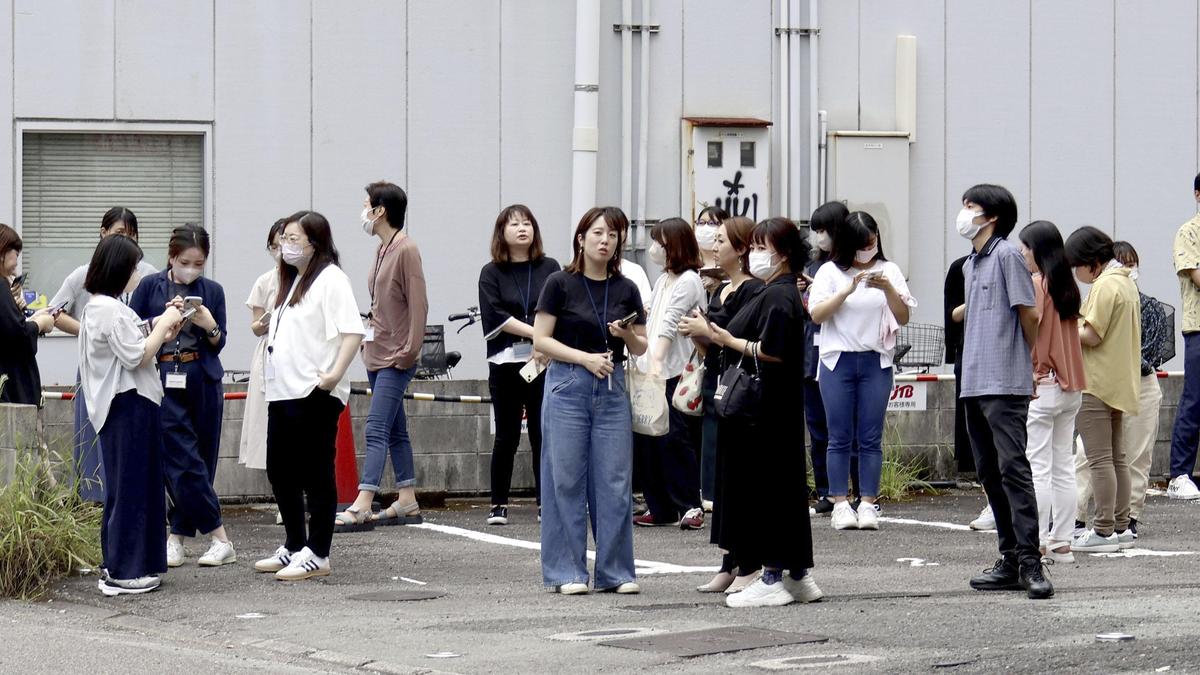
A magnitude 6.1 earthquake recently rattled northern Japan, centered off the coast of Aomori Prefecture. While the shaking was felt as far away as Hokkaido and Tokyo, the immediate damage reports remained low, and no tsunami warning followed the initial jolt. For most global news outlets, this was a routine update—a brief blip in the 24-hour news cycle. They are missing the point.
The real story isn't that Japan survived another mid-sized quake. The story is the widening gap between Japan’s hardened infrastructure and a world that assumes "6.1" is a manageable number. In any other corner of the globe, a 6.1 magnitude event at a shallow depth would be a humanitarian catastrophe. In Japan, it is a Tuesday. This disparity reveals a uncomfortable truth about global urban planning: we are building cities on a foundation of wishful thinking while Japan builds on a foundation of cold, hard physics.
The Engineering of Survival
Japan’s resilience is not a stroke of luck. It is the result of decades of brutal lessons learned from disasters like the 1995 Kobe earthquake and the 2011 Tohoku tragedy. When the 6.1 hit northern Japan, the country’s Early Earthquake Warning (EEW) system went into overdrive. Within seconds, P-waves—the fast-moving, non-destructive initial tremors—were detected by a dense network of seismometers.
This data traveled faster than the destructive S-waves. It triggered automatic braking systems on Shinkansen bullet trains, paused elevators at the nearest floor, and sent a piercing chime to every smartphone in the impact zone. This system buys people time. Five seconds to dive under a desk. Ten seconds to step away from a glass window. In the world of seismic survival, five seconds is the difference between a broken arm and a crushed skull.
Most nations lack this integrated logic. They rely on "soft" alerts or localized sensors that don't talk to the power grid or the transit network. Japan has turned its entire geography into a giant, living circuit board designed to shut itself down the moment the earth moves.
The High Cost of the Seismic Gap
We often talk about "earthquake-proof" buildings. This is a myth. No building is truly proofed against the raw power of the tectonic plates. Instead, Japanese engineers focus on seismic isolation and energy dissipation.
In Aomori and surrounding northern regions, buildings often sit on lead-rubber bearings. When the 6.1 magnitude tremors hit, these structures didn't fight the earth; they slid with it. This technique uncouples the building from the ground's movement, absorbing the kinetic energy that would otherwise snap concrete pillars like dry twigs.
Why the 6.1 Benchmark Matters
A 6.1 magnitude earthquake releases energy roughly equivalent to 30 kilotons of TNT. To put that in perspective:
- Hiroshima Atomic Bomb: ~15 kilotons
- Aomori 6.1 Quake: ~30 kilotons
The northern Japan quake was essentially two atomic bombs worth of energy detonating beneath the seafloor. The reason we don't see rubble in the streets of Hachinohe is that Japan mandates Base Isolation for critical infrastructure. In the United States, Southern Europe, and Central Asia, building codes are often decades behind. We are still building rigid structures that rely on "strength" to survive. Strength fails. Flexibility survives.
The Silent Threat of Nuclear Proximity
Northern Japan is home to some of the world's most sensitive energy infrastructure. The Higashidori nuclear power plant and the Rokkasho reprocessing facility are situated right in the crosshairs of these northern tremors. Following the 6.1 event, the Nuclear Regulation Authority (NRA) reported no abnormalities.
However, this "all clear" masks a deeper tension. The 2011 disaster taught us that it isn't the quake itself that kills a reactor; it’s the loss of off-site power and the subsequent failure of cooling systems. Every time a 6.0+ hits near these facilities, the integrity of the backup power grid is tested.
The industry is currently debating the active fault designations near these plants. Geologists are digging trenches and analyzing soil strata that are hundreds of thousands of years old to determine if a specific crack in the earth is "active." If a fault is deemed active, the plant might never restart. This creates a collision between energy security and seismic reality. The 6.1 quake serves as a reminder that the earth does not care about regulatory definitions or energy quotas.
The Psychological Toll of Constant Alert
There is a concept in disaster sociology known as "warning fatigue." When you live in a region where 6.1 is considered a moderate event, the population develops a psychological callosity. You see it in the videos posted to social media during the northern Japan quake: people continue eating their ramen while the lights overhead sway violently.
This stoicism is a double-edged sword. It prevents mass panic, which kills more people in urban environments than the actual falling debris. But it also creates a dangerous sense of security. The 6.1 magnitude event was a "crustal" quake, meaning it happened within the plate. These are different from the "megathrust" events that happen at the subduction zone and trigger massive tsunamis.
The public's ability to distinguish between a "scary shake" and a "deadly wave" is dependent on the clarity of government communication. In this instance, the JMA (Japan Meteorological Agency) was flawless. They predicted no tsunami within minutes. But as our climate changes and sea levels rise, the margin for error for even a "small" tsunami triggered by a 6.1 event becomes razor-thin.
The Failure of Global Mapping
While Japan has mapped every square inch of its seismic risk, the rest of the world is flying blind. We are currently seeing a trend where major earthquakes are occurring on "blind faults"—cracks in the earth that don't reach the surface and aren't visible to traditional satellite mapping.
The Aomori quake happened in a well-monitored zone, but it highlights the sheer density of the Japan Trench. Global investors and logistics firms often overlook the fact that northern Japan is a critical chokepoint for subsea fiber optic cables. A 6.1 might not knock down a house, but it can trigger underwater landslides that sever the digital arteries of the global economy.
We saw this in the 2006 Hengchun earthquake off Taiwan, where a 7.1 event cut eight cables and effectively took Southeast Asia offline for weeks. We are one misplaced 6.0 event away from a global internet blackout, and yet the conversation remains stuck on "how many buildings fell?"
Moving Beyond the Richter Scale
The obsession with the Richter scale (or the more modern Moment Magnitude scale) is a distraction. What matters is the Shindo scale—Japan’s unique measure of seismic intensity at a specific location.
The 6.1 quake registered a "4" on the Shindo scale in many areas. This means people were startled, and hanging objects swung, but most people could continue their day. In a "5 Upper" or "6 Lower," you cannot stand. By focusing on the magnitude of the earthquake rather than the intensity of the shaking, international observers fail to understand why Japan invests so heavily in localized sensor data.
The Hidden Data in the Shaking
Seismic waves change based on the soil they travel through. If you are on reclaimed land or soft silt, a 6.1 feels like an 8.0 because the ground liquifies. This phenomenon, known as liquefaction, is the silent killer of modern cities.
Japan’s northern coast is a patchwork of rocky cliffs and soft alluvial plains. The recent quake provided a massive amount of "small-scale" data that engineers use to map exactly which neighborhoods will sink when the Big One finally arrives. This is the true value of these mid-sized events: they are full-scale stress tests for a society that refuses to be caught off guard.
The Reality of the Supply Chain
Northern Japan isn't just a quiet agricultural region. It is a hub for high-precision manufacturing and semiconductor components. When a 6.1 hits, the immediate concern for the global market is the "stop-start" cost.
Even if a factory doesn't collapse, the precision machinery used to etch microchips must be recalibrated if the ground moves more than a few microns. This leads to weeks of delays in the global supply chain. We saw this with the Renesas electronics plant fires and quakes in the past. The world is physically connected to the tectonic stability of northern Japan. Every time the ground shakes in Aomori, the price of a car in Ohio or a smartphone in London is at risk.
The Infrastructure Debt
The most significant takeaway from the northern Japan earthquake isn't about Japan at all. It is about the massive infrastructure debt owed by the rest of the world.
Japan spends roughly 1% of its GDP on disaster risk reduction. Most Western nations spend a fraction of that, usually in the form of "recovery funds" after the damage is already done. We are reactive; Japan is proactive.
If we continue to treat a 6.1 magnitude earthquake as a local news story in a far-off land, we ignore the blueprint for our own survival. The technology exists to stop trains, to isolate buildings, and to alert every citizen before the shaking starts. The reason we don't have it isn't a lack of engineering—it's a lack of political will.
Japan has proven that you can live on the edge of a tectonic abyss and thrive, but only if you are willing to pay the price of admission. That price is constant, unblinking vigilance and a refusal to settle for "good enough" engineering.
The next time you see a headline about a magnitude 6 earthquake in Japan, don't look at the lack of casualties as a sign that the earthquake wasn't serious. Look at it as a testament to what is possible when a society decides that its citizens' lives are worth more than the cost of a seismic damper.
Stop waiting for the disaster to happen before you decide to build a city that can survive it.